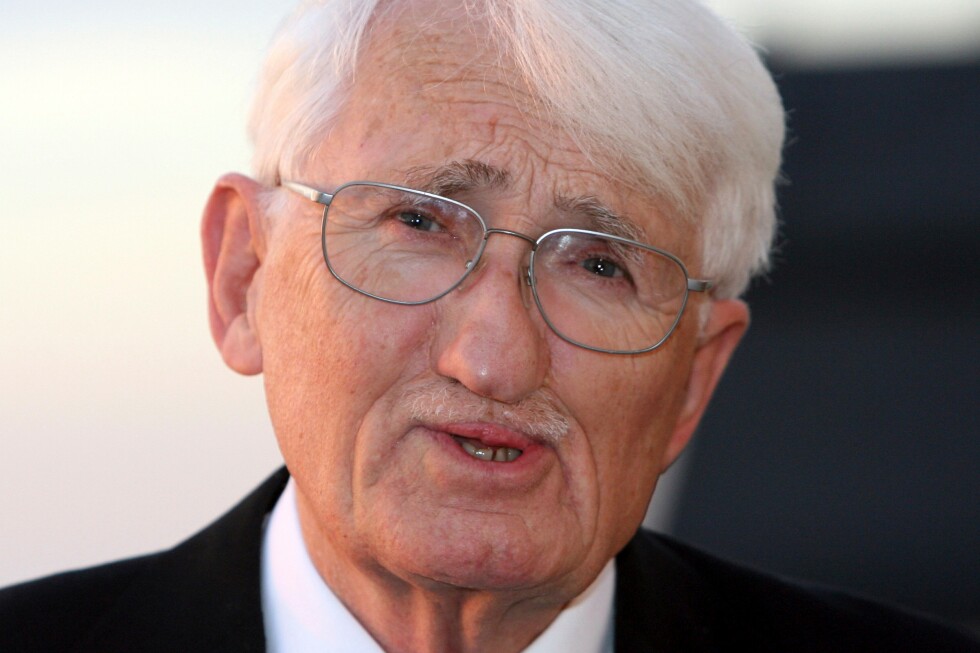
Jürgen Habermas, a preeminent philosopher whose insights into communication, rationality, and sociology profoundly influenced modern thought and intellectual discourse, has passed away at the age of 96. His contributions reshaped our understanding of society and interaction, leaving a lasting legacy.
Habermas’ publisher, Suhrkamp, confirmed his death on Saturday in Starnberg, near Munich.
Over several decades, Habermas actively engaged in political discourse, utilizing his expansive writings that traversed various academic and philosophical realms. His most renowned works include the two-volume Theory of Communicative Action.
Having been 15 at the end of World War II, Habermas reflected on the emergence of a new epoch in 1945 and grappled with the chilling realities of Nazi atrocities, an experience he acknowledged as pivotal in motivating his journey into philosophy and social theory. He remarked, “you suddenly saw that it was a politically criminal system in which you had lived.”
His relationship with Germany’s left-wing student movement of the late 1960s was complex; he engaged with the movement but also cautioned against the rise of what he termed “left-wing fascism.” This response stemmed from a provocative speech by a student leader, which Habermas later deemed “slightly out of place.” Nevertheless, he ultimately recognized the movement’s role in catalyzing a “fundamental liberalization” within German society.
In the 1980s, Habermas emerged as a key figure in the Historians’ Dispute, where he contested the perspectives of historians like Ernst Nolte, who sought a re-evaluation of the Third Reich and German identity. Habermas argued that such comparisons diminished the severity of Nazi horrors by equating them with atrocities under other regimes, such as Stalin’s Soviet Union.
Chancellor Friedrich Merz remarked that “Germany and Europe have lost one of the most significant thinkers of our time.” He acknowledged the impact of Habermas’ sociological and philosophical contributions on countless researchers and intellectuals, stating, “his voice will be missed.”
Habermas supported the ascent of center-left Chancellor Gerhard Schröder in 1998 but criticized the “technocratic” orientation of Schröder’s conservative successor, Angela Merkel. In 2016, he expressed concerns over what he described as the suffocating effect of “the foam blanket of Merkel’s policy of sending people to sleep” on public opinion.
Particularly critical of the “limited interest” exhibited by German leaders and media in fostering a cohesive European political landscape, he lauded French President Emmanuel Macron in 2017 for articulating a vision for European reform, stating, “the way he speaks about Europe makes a difference.”
Born on June 18, 1929, in Düsseldorf, Habermas spent his childhood in Gummersbach, where his father was the head of the local chamber of commerce. At the age of 10, he became a member of the Deutsches Jungvolk, a youth organization under the Hitler Youth.
Habermas faced numerous surgeries as a child due to a cleft palate, an experience that would influence his views on language. He emphasized the necessity of spoken language as a “layer of commonality without which we as individuals cannot exist,” and openly shared his struggles with communication. He also highlighted the “superiority of the written word,” suggesting that “the written form conceals the flaws of the oral.”
His wife, Ute Habermas-Wesselhoeft, passed away last year. The couple is survived by three children: Tilmann; Rebekka, who died in 2023; and Judith.
Key Takeaways
- Jürgen Habermas was a prominent philosopher known for his work on communication and sociology.
- He played a significant role in political discourse in Germany and was an advocate for liberalization in society.
- Habermas contributed critically to discussions around the history and identity of Germany, particularly regarding the Nazi regime.
- His thoughts on language and communication stemmed from personal experiences in his childhood.
- Habermas’s legacy continues to influence generations of researchers and thinkers across disciplines.
FAQ
Who was Jürgen Habermas?
Jürgen Habermas was a renowned German philosopher whose work significantly impacted communication theory, sociology, and political discourse.
What were his key contributions?
Habermas is best known for his extensive writings on communicative action and his critical engagement with political and historical issues in Germany.
How did Habermas view the Nazi era?
He reflected on the Nazi regime’s crimes and emphasized the importance of confronting these realities through philosophy and social theory.
What were his views on political leadership?
Habermas critiqued both left- and right-wing political leaders, advocating for a more engaged and visionary approach to European politics.