The ongoing conflict in the Middle East has taken a new turn following Iran’s Supreme Leader Ayatollah Mojtaba Khamenei’s recent statements. His determined stance indicates sustained aggression against Gulf Arab nations, while global concerns over energy supplies and international tensions continue to rise.
Iran’s New Leadership and Growing Tensions
Iran’s secretive new leader issued his first public statements Thursday, resolving to keep fighting, promising more pain for Gulf Arab states and threatening to open “other fronts” in a war that has already disrupted world energy supplies, the global economy, and international travel.
The hard-line stance revealed by Supreme Leader Ayatollah Mojtaba Khamenei came as Israeli Prime Minister Benjamin Netanyahu said his country’s attacks were creating conditions for the Iranian population to topple the government.
“It is in your hands,” Netanyahu said at a news conference, addressing the Iranian people. “We are creating the optimal conditions for the fall of the regime.”
Since the start of the war, U.S. and Israeli strikes have targeted security checkpoints in Iran to undermine the government’s ability to suppress dissent, according to Armed Conflict Location and Event Data, the U.S.-based independent monitoring group known as ACLED.
Intense airstrikes hit early Friday around Iran’s capital, Tehran, as well as outlying areas. It was not immediately clear what had been targeted.
Netanyahu Denounces Iranian Leader
Netanyahu denounced Khamenei as a “puppet of the Revolutionary Guards.”
Khamenei is close to Iran’s paramilitary Revolutionary Guard and is widely seen as even less compromising than his father, Ayatollah Ali Khamenei.
Khamenei said in a statement read by a state TV news anchor that he was keeping a “file of revenge.” He did not appear on camera and has not been seen since his father and wife were killed in the war’s opening salvo, which also wounded him, according to an Iranian ambassador.
AP AUDIO: Iran’s secretive top leader vows to keep up attacks in his first statement since being appointed
AP correspondent John Leicester in Paris reports that the Iran war has blocked the Strait of Hormuz, a vital oil chokepoint, and reopening it is a big challenge.
Oil Prices Spiral Again as Stocks Sink
The war continued to escalate on its 13th day as oil prices spiraled up again to $100 per barrel, and stocks sank worldwide over fears that the conflict could drag on longer than hoped.
To relieve the surge in prices, the U.S. Treasury Department announced it was further easing sanctions on Russian oil by granting a license that authorizes the delivery and sale of some Russian crude oil and petroleum products for the next month.
Trump signaled earlier this week that he would take more action to address the squeeze on oil flows. The move follows the administration’s decision to grant temporary permission for India to buy Russian oil.
The new exemption applies only to Russian oil already at sea. Last week, analysts estimated there were about 125 million barrels loaded on tankers. To put that in perspective, about 20 million barrels of oil per day usually pass through the Strait of Hormuz, according to the International Energy Agency.
Iran has made clear it plans to keep up attacks on energy infrastructure across the region and use the effective closure of the strait as leverage against the United States and Israel. A fifth of the world’s traded oil flows through the waterway leading from the Persian Gulf toward the Indian Ocean.
At a news conference Thursday, Iran’s ambassador to Tunisia, Mir Masoud Hosseinian, said Iranian naval forces “have established full control” over the strait and “carried out precise strikes in response to attacks on our oil infrastructure.”
“Global energy security is contingent on respect for Iran’s sovereignty,” he said.
The pinch was being felt worldwide. South Korea reinstated government-set caps on oil prices for the first time in three decades as it sought to calm soaring fuel costs. The two-week caps, which took effect Friday, set maximum prices for petroleum products supplied by refiners to gas stations and other businesses.
Iranian Leader Calls for Shutdown of U.S. Bases
Hosseinian told The Associated Press the new supreme leader was wounded in the attack on his family’s home, but “it is not serious.” The hope is he will attend the massive, state-organized Eid prayer next week that his father traditionally led. However, Khamenei remains a target for the Israelis, who have vowed to kill him.
Hosseinian said Iran’s strikes on Gulf nations have been strategic. “Even when we targeted hotels, we had precise information that they were hosting American and Israeli soldiers,” he said.
Khamenei called on Gulf Arabs to “shut down” U.S. bases in the region, saying protection promised by Washington was “nothing more than a lie.”
He also said Iran has studied “opening other fronts in which the enemy has little experience and would be highly vulnerable” if the war continues. He did not elaborate, but Iran has been linked to previous attacks on U.S., Israeli, and Jewish targets around the world.
Attacks on Gulf states continued Friday with Saudi Arabia’s defense ministry saying its air defenses downed more than three dozen drones headed toward the kingdom’s Eastern Province over the span of a few hours, marking an unusually large barrage.
Iran’s Nuclear Program Takes More Hits
U.S. President Donald Trump said in a social media post Thursday that ensuring Iran does not develop a nuclear weapon was a higher priority than soaring oil prices.
Hours later, Netanyahu announced Israeli attacks had killed a top Iranian nuclear scientist and targeted others, but provided few details.
Israel stated earlier it struck a nuclear facility in Iran in recent days that it had previously destroyed with an airstrike in October 2024. Earlier this year, satellite photos raised concerns that Iran was working to restore the facility.
France Says Soldier Killed in Attack in Iraq
The U.S. military said American forces have now struck more than 6,000 targets since the operation against Iran began, including more than 30 minelaying vessels.
On Friday, French President Emmanuel Macron announced that a French soldier was killed in an attack targeting Irbil in Iraq’s northern Kurdish region. France earlier stated six soldiers had been hurt in a drone strike in Irbil, where French troops are deployed as part of a multinational counterterrorism mission supporting Iraqi forces in their fight against Islamic State militants.
In the same region, British officials reported that several U.S. personnel suffered minor injuries Wednesday when drone strikes hit a base in Irbil that houses both British and American troops.
And on Thursday in western Iraq, rescue efforts were underway after an American military refueling plane went down. U.S. Central Command, which oversees the Middle East, said in a statement that two aircraft were involved, including one that landed safely, and that the cause was not related to friendly or hostile fire.
Israel Targets Heart of Beirut in Fight with Hezbollah Militants
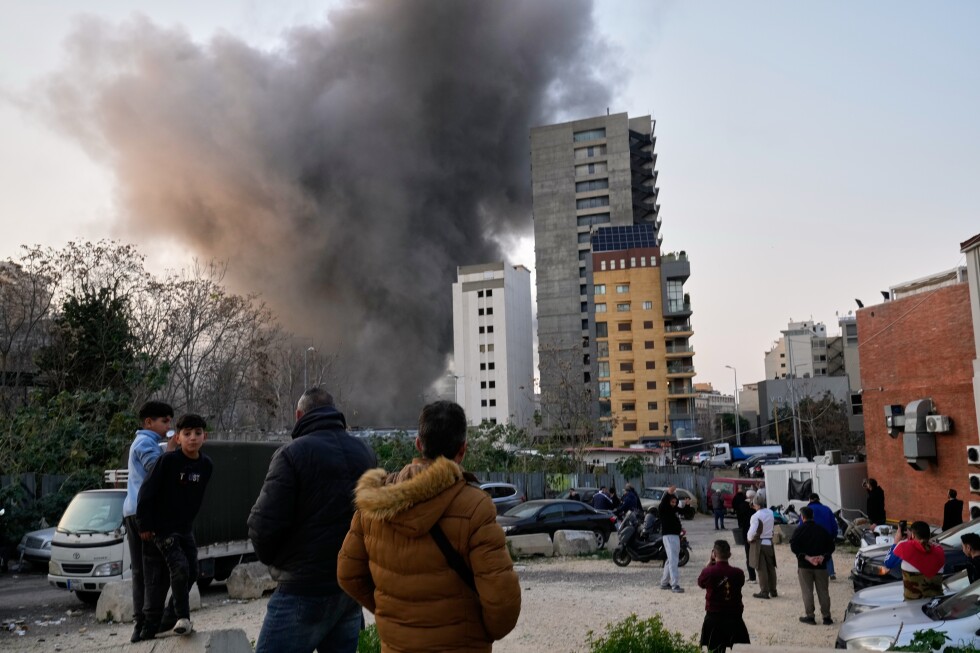
Israeli warplanes pummeled Lebanon, targeting even the busy heart of Beirut, in response to missiles from Iran-backed Hezbollah fighters launched into Israel. One strike hit in a neighborhood that is close to Lebanon’s parliament, United Nations offices, and international embassies.
Israeli military spokesperson Avichay Adraee stated forces were targeting a “facility affiliated with Hezbollah.”
An Israeli strike hit in the vicinity of Lebanon’s only public university, killing a professor and the director of the science faculty at the campus in Hadath, on the outskirts of Beirut’s southern suburbs. There was no immediate comment from Israel.
Israeli strikes also resulted in the deaths of 15 other individuals, including five children, in southern Lebanon, according to the Lebanese Health Ministry. An AP photographer witnessed several buildings flattened in one village where rescue workers searched through the rubble.
Key Takeaways
- Iran’s new leader emphasizes continued aggression against Gulf states.
- The ongoing conflict severely affects global energy supplies.
- U.S. and Israeli strikes target Iranian security infrastructure amid rising tensions.
- Iranian naval forces claim control over the Strait of Hormuz.
- Escalating oil prices lead countries like South Korea to impose price caps.
FAQ
What is the significance of the Strait of Hormuz in the current conflict?
The Strait of Hormuz is a vital waterway through which approximately a fifth of the world’s traded oil passes.
What actions has the U.S. taken regarding sanctions on Russian oil?
The U.S. Treasury Department has eased sanctions to allow the delivery and sale of certain Russian crude oil products for a limited time.
What was targeted in the recent Israeli airstrikes?
Israeli airstrikes aimed at military facilities linked to Iranian-backed groups, particularly in Lebanon.
The current state of affairs in the region remains tense, with ongoing military actions and rising geopolitical stakes. As the situation evolves, the implications for international energy markets and regional stability are notable and merit close attention.