In recent days, tensions have escalated in the Middle East, marked by Iran’s aggressive actions against Gulf Arab nations. This ongoing conflict has significant implications for oil prices and global economies, as evidenced by recent attacks that have disrupted supplies and prompted international responses.
Ongoing Attacks and Geopolitical Implications
DUBAI, United Arab Emirates (AP) — Iran launched new attacks on Tuesday at Gulf Arab countries as it kept up pressure on the Middle East in a war that has sent oil prices surging and stunned global economies. Five pro-Iranian militiamen were killed in an airstrike in northern Iraq.
Incoming missile sirens sounded early in the morning in Dubai in the United Arab Emirates, and in Bahrain, while Saudi Arabia said it had destroyed two drones over its oil-rich eastern region, and Kuwait’s National Guard reported shooting down six drones.
In addition to firing missiles and drones at Israel and American bases in the region, Iran has also targeted energy infrastructure, coupled with its control over the Strait of Hormuz, causing a significant rise in oil prices.
Brent crude, the international standard, spiked to nearly $120 on Monday before falling back, yet it remained around $90 a barrel on Tuesday, nearly 24% higher than prior to the conflict beginning on February 28.
U.S. President Donald Trump, who has previously indicated that the war could extend for a month or more, on Tuesday sought to mitigate rising concerns over a prolonged regional conflict, asserting it was “going to be a short-term excursion.”
Contradictory Messages from Leaders
The war has severed major supplies of oil and gas to world markets and triggered fuel price increases across the U.S. The fighting has prompted foreigners to flee key business hubs and led millions to seek refuge as bombs targeted military bases, government buildings, oil and water installations, hotels, and at least one school.
Iran has effectively halted tankers from traversing the Strait of Hormuz, the vital shipping route between the Persian Gulf and the Gulf of Oman—which facilitates 20% of the world’s oil transport. Attacks on merchant vessels near the strait have resulted in the deaths of at least seven sailors, as reported by the International Maritime Organization.
In a post on social media on Tuesday, Trump appeared not to acknowledge this reality, declaring that “If Iran does anything that stops the flow of Oil within the Strait of Hormuz, they will be hit by the United States of America TWENTY TIMES HARDER than they have been hit thus far.”
In what seemed to be a reaction to Trump’s remarks, a spokesperson for the paramilitary Revolutionary Guard, Ali Mohammad Naini, remarked that “Iran will determine when the war ends.”
Kamal Kharazi, foreign policy adviser to the office of the supreme leader, stated on CNN that Iran is prepared for a long conflict. He expressed skepticism regarding the potential for diplomacy unless economic pressures motivate other nations to intervene and halt the “aggression of Americans and Israelis against Iran.”
Asylum for Iranian Women’s Soccer Team
Five members of the Iranian women’s soccer team, who were in Australia for a tournament when the Iran war commenced, were granted asylum, as confirmed by Home Affairs Minister Tony Burke in Brisbane.
The team gained significant media attention in Australia when they chose not to sing the Iranian anthem before their first match.
Burke shared photos on social media featuring the women joyously clapping as he signed the necessary documents, stating they “were very excited about embarking on a life in Australia.”
The team of 26 players had traveled to participate in the Women’s Asian Cup last month, just before the onset of the conflict. After their recent elimination from the tournament, concerns arose about their potential return to a war-torn homeland.
Burke indicated that all players on the squad have been offered asylum, but it remains uncertain when, or if, the other 21 players will return to Iran.
Airstrike on Iran-Linked Militia in Iraq
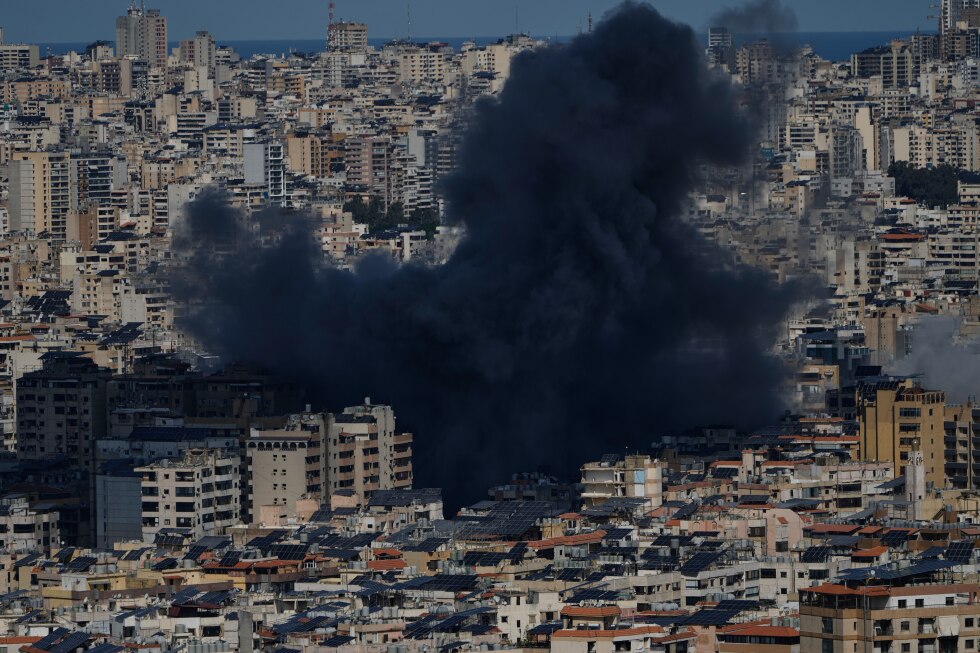
As the conflict expands across the region, Israel has executed multiple strikes against Hezbollah in Lebanon, to which the Iranian-backed group has retaliated by launching missiles into Israel.
Pro-Iran militias in Iraq have similarly targeted U.S. bases since the conflict began.
Early Tuesday, one such group, the 40th Brigade of the Popular Mobilization Forces in Kirkuk, experienced an airstrike that resulted in at least five militiamen killed and four others injured, according to officials who requested to remain anonymous due to their lack of authorization to speak to reporters.
It is currently unclear who is responsible for these strikes.
Meanwhile, the Israeli military reported that it completed a series of attacks on Hezbollah’s financial arm, al-Qard Al-Hasan. Israel asserts that Hezbollah relies on al-Qard al-Hasan to fund its military operations, and several of the group’s branches in southern and eastern Lebanon were targeted last week.
Israel’s military has repeated its call for all residents of southern Lebanon to evacuate, announcing its plans to “operate forcefully” in that area against Hezbollah.
Since the onset of the war, more than 1,230 individuals have lost their lives in Iran, at least 397 in Lebanon, and 11 in Israel, according to officials.
Seven U.S. service members have also died.
Financial markets, which have experienced volatility in recent days, opened the day Tuesday in Asia with early gains, reflecting some optimism in the U.S. markets.
In light of the conflict’s pressures, Saudi Arabia’s oil giant Aramco reported 2025 profits of $104 billion, down from $110 billion in 2024.
Aramco, formally known as the Saudi Arabian Oil Co., stated that its 2025 revenues reached $445 billion, a decrease from $480 billion in 2024.
___
Magdy reported from Cairo, and Rising reported from Bangkok. Associated Press writers Qassim Abdul-Zahra in Baghdad, John Pye in Gold Coast, Australia, and Melanie Lidman in Tel Aviv, Israel, contributed to this story.
Key Takeaways
- Iran’s military actions have escalated tensions in the Middle East, especially against Gulf Arab nations.
- The ongoing conflict has caused significant spikes in oil prices, impacting global markets.
- The Strait of Hormuz, a crucial shipping lane, is under Iranian control, affecting oil transportation.
- U.S. President Trump aims to minimize fears of a prolonged conflict, while Iranian leaders hint at a long-term struggle.
- The Iranian women’s soccer team has successfully sought asylum in Australia amid the conflict.
- Recent airstrikes have targeted Iran-linked militias in Iraq, further complicating the regional situation.
FAQ
What caused the recent rise in oil prices?
The rise in oil prices is primarily due to Iran’s military actions and the disruption of supply routes, particularly through the Strait of Hormuz.
What is the significance of the Strait of Hormuz?
The Strait of Hormuz is a vital shipping lane that facilitates the transport of 20% of the world’s oil, making its security crucial for global oil markets.
Are other countries getting involved in the conflict?
While there have been calls for intervention, the responses from foreign countries have varied, with some leaders suggesting diplomacy is unlikely under current conditions.
What has happened to the Iranian women’s soccer team?
Five members of the Iranian women’s soccer team were granted asylum in Australia due to concerns for their safety after the outbreak of war in Iran.
How many people have been killed in the conflict?
According to officials, over 1,230 people have died in Iran, at least 397 in Lebanon, and 11 in Israel since the conflict began.