
Multivitamins have sparked an intense scientific discussion regarding their actual benefits for health versus their role in a billion-dollar industry. A recent long-term randomized controlled trial conducted in the United States has provided some compelling evidence suggesting that these nutritional supplements may have the ability to slow the aging process.
“Many people take a multivitamin without being fully aware of its potential benefits, so gaining more insights into its health advantages is essential,” states Howard Sesso, the senior author and an epidemiologist at Mass General Brigham.
When examining vitamins, research findings on health and longevity have been quite inconsistent. In the United States, over 100,000 vitamin and dietary supplements are available, and while some earlier studies suggest that supplements often do not contribute to longer life, multivitamins may still offer health benefits in older individuals.
This new research, led by scientists at Brigham and Women’s Hospital and Harvard Medical School, rigorously evaluated two supplements for their potential effects on biological aging.
The tested supplements included a comprehensive multivitamin–multimineral (MVM) and 500 milligrams of cocoa flavanols.
The study analyzed data from nearly 1,000 participants in the COcoa Supplement and Multivitamin Outcomes Study (COSMOS), who had an average age of about 70. Results indicated that those who consumed a daily multivitamin for two years exhibited signs of slower aging according to two biological aging clocks when compared to placebo recipients.
On the other hand, the cocoa extract had no influence on any of the five aging markers assessed, despite prior studies linking it to various health benefits.
Sesso and his colleagues have described their findings regarding multivitamins as “promising,” while also noting the necessity for larger trials and extended participant observations to ascertain whether these supplements provide significant clinical advantages.
It is important to mention that participants who consumed multivitamins showed improvements in both inflammation and cognitive function.
“Within COSMOS, we are excited to utilize a rich set of biomarker data to explore how these two interventions might enhance biological aging and lessen age-related health conditions,” Sesso explained.
Currently, only a few small-scale randomized controlled trials have explored vitamin impacts on epigenetic aging, with many of these focusing on individual vitamins rather than a holistic approach.
Though imperfect, epigenetic aging clocks—relying on associations and predictions—have recently proven to be effective tools to measure an individual’s biological aging speed relative to their chronological age.
These clocks function by examining DNA patterns in blood samples to predict the aging trajectory. Influencing some of these markers may slow aging, and multivitamins could serve as a method to achieve this.
“Today, there’s a significant interest in not only prolonging lifespan but also ensuring improved quality of life,” remarks Sesso. “The benefits of multivitamins in relation to biological aging markers are exciting. This study opens opportunities for learning about safe, accessible interventions that could promote healthier aging experiences.”
In this trial, the two epigenetic clocks linked to multivitamin consumption were PCPhenoAge and PCGrimAge. These advanced models have shown promise in past research and correlate with various longevity measures.
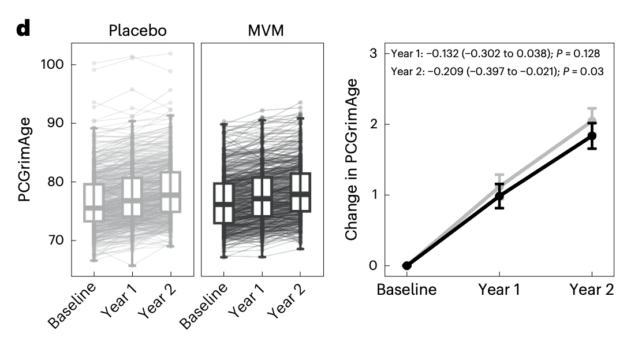
Ultimately, the consumption of a daily multivitamin for two years was associated with a yearly decrease of 0.113 years on the PCGrimAge clock and 0.214 years on the PCPhenoAge clock. Based on previous research, these observed changes could signify a reduced cancer risk over a decade, representing an approximate decrease of 3 to 7 percent.
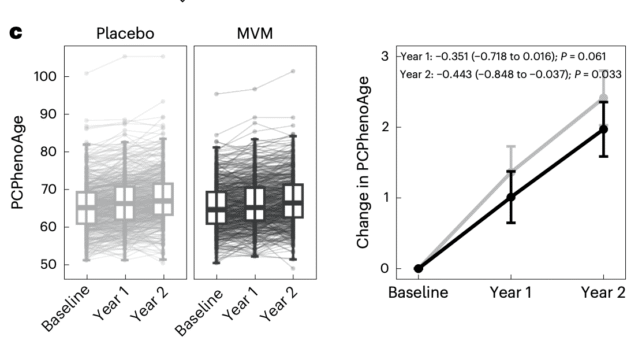
Participants who displayed accelerated aging on these clocks prior to the trial experienced more significant benefits from multivitamin use. For instance, on the PCGrimAge clock, these individuals’ aging rates slowed nearly twice as much compared to those with typical aging patterns at the start. This suggests that multivitamins may help enhance health outcomes by addressing nutritional deficiencies.
Related: 5 Things You Ought to Know Before Buying Supplements
The research team concluded, “Considering that extending a healthy lifespan by just one year could save the U.S. population approximately $38 trillion, our findings suggest that a daily MVM may be a highly cost-effective and accessible intervention to boost public health.”

While some authors of the study received funding from private companies with interests in nutrition supplements, the research was conducted independently, underwent peer review, and was mainly funded by the U.S. National Institutes of Health.
In a corresponding article in Nature, independent epigenetic researchers Calen Ryan and Daniel Belsky described the findings as “a significant advancement in the field of supplements.” They noted, however, that it remains uncertain if such interventions can extend healthspan.
This study was published in Nature Medicine.


