Salary Based on Experience Level
Your experience greatly influences your earnings as a data scientist. However, the key to significant salary increases lies not just in the number of years worked but in your growth and development. In the early stages of your career, you’ll focus on executing tasks and supporting larger projects. As you accumulate experience, your role will expand to include project ownership, strategic influence, and leadership. This shift from executing tasks to directing them is where real salary growth occurs.
Entry-Level/Junior Data Scientists
Experience: 1-4 years
Salary Range: $66,000 – $120,000
If you’re beginning your career, expect your salary to fall within this range. The specifics of your offer will depend on your experience with internships, bootcamps, or relevant graduate programs. Graduates of a data science program that includes hands-on projects typically secure offers at the higher end of this scale.
At this stage, you’ll be honing essential skills such as data cleaning and basic analysis while supporting the work of senior team members. You’ll also begin to understand the business context behind the models you are working with.
Mid-Level Data Scientists
Experience: 3-5 years
Salary Range: $86,000 – $156,000
With three years of experience, you have moved beyond being a novice. You’ll manage projects from start to finish, including problem definition, model selection, and presenting your findings to stakeholders. Your work will significantly influence business strategies.
Professionals with a Master of Applied Data Science often find themselves advancing more quickly during this phase. The focused training and hands-on experience typically lead to quicker promotions and better salary offers.
This stage is also where you’ll begin to specialize, whether it be in areas like natural language processing, computer vision, or MLOps deployment.
Senior and Lead Data Scientists
Experience: 5+ years
Salary Range: $99,000 – $200,000+
Senior data scientists are responsible for setting the technical direction of their teams. You’ll be evaluating which problems are worth solving, mentoring junior staff, and collaborating directly with executives. At this level, many professionals transition into management or principal individual contributor (IC) roles.
With bonuses and equity, total compensation often exceeds $220,000. If you ascend to a Director of Data Science position, anticipate a salary of $250,000+.
Salary Variations by Location
The location of your job can significantly affect your salary as a data scientist. Cities with a robust presence of tech companies or higher demand for data skills generally offer more lucrative compensation. In contrast, salaries may be lower in areas with a lower cost of living or reduced competition for talent. As a result, two data scientists with comparable experience may see vastly different salaries depending on their location.
According to recent data, cities like San Francisco, Princeton-Trenton, Madison, and New York City rank among the highest-paying locations for data scientists, offering salaries that far exceed typical industry benchmarks.
The Charlotte Case Study: High Salaries, Lower Costs
Charlotte is emerging as a significant data science hub, largely due to the presence of major financial institutions like Bank of America and Wells Fargo. This has created a rich talent pool and a strong demand for data professionals. Salaries for data scientists in Charlotte range from $96,000 to $133,000, competitive with more expensive cities.
Another advantage is that the median rent in Charlotte is approximately $1,600/month, compared to around $3,600 in San Francisco. This discrepancy amounts to a potential savings of $24,000 annually, which you can use for investments, savings, or paying off student loans more quickly.
Remote Work and Pay Adjustments
The rise of remote work has altered how companies approach salary ranges. Some businesses now offer the same pay regardless of location, while others adjust salaries based on an employee’s geographical area. In numerous cases, remote workers based in lower-cost regions may earn slightly less than those in major tech hubs, yet their overall purchasing power can still be higher due to decreased living expenses.
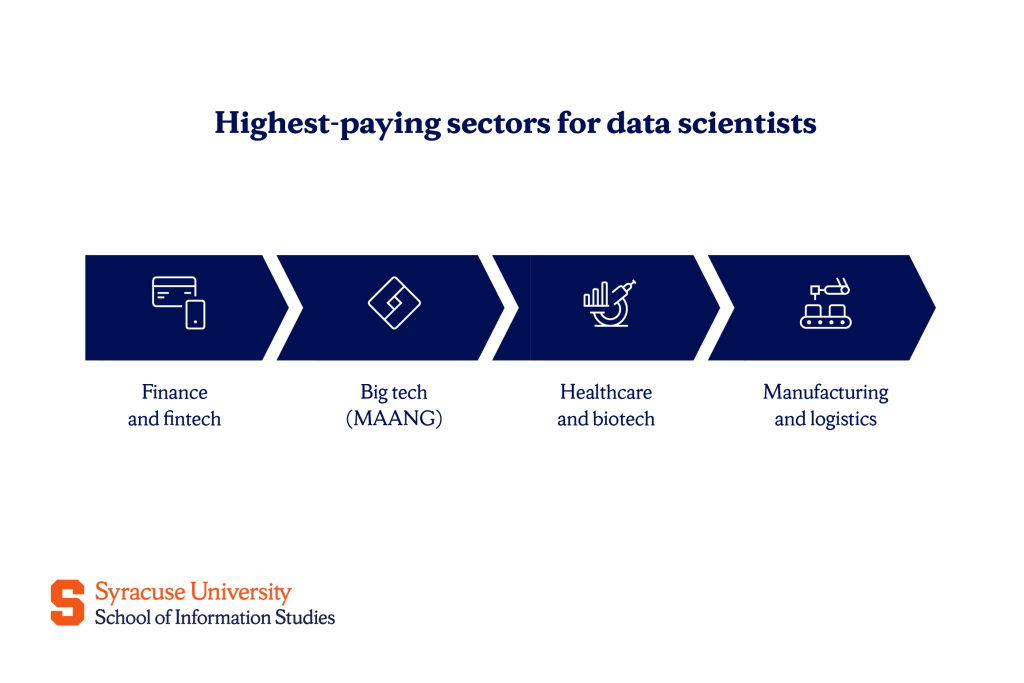
Top-Paying Industries for Data Science
The industry you work in significantly impacts your pay. Certain sectors are willing to offer higher salaries for data science talent, driven by the high stakes and profit margins involved.
Highest-Paying Sectors
Average Salary: $98,000-$136,000 per year
Why: The need for regulatory compliance, fraud detection, and algorithmic trading drives the demand for sophisticated data models. A single error can result in massive financial losses.
Average Salary: $150,000 – $200,000+
Why: Data underpins product development, user experience, and advertising revenue. Prominent companies like Amazon and Google view data science as a core function rather than a support role.
Average Salary: $122,000
Why: Predictive analytics for patient outcomes and drug discovery involve advanced statistical methods. The work is both complex and heavily regulated.
- Manufacturing and Logistics
Average Salary: $133,000 – $170,000
Why: Supply chain optimization and predictive maintenance rely on scalable big data technologies.
Lower-Paying Sectors
Nonprofits, Education, and Government generally offer lower salaries than the private sector. A mid-level data scientist in public service might earn between $90,000 and $110,000. However, these positions often come with better work-life balance, student loan forgiveness programs, and the opportunity to contribute to meaningful causes.
Factors Impacting Earning Potential
While you can’t control external market conditions, you can control the skills you acquire. Here are the key factors that can boost your market value.
Education: How Significant is it?
Educational qualifications have a notable impact on both starting salaries and long-term career advancements in data science.
- Bachelor’s Degree Graduates: Typically earn between $95,000 and $110,000 early in their careers.
- Master’s Degree Holders: Generally start at higher salaries than bachelor’s degree holders, with quicker advancement into mid-level positions.
- PhD Holders in Specialized Research Roles: Can earn $140,000+ right from the start, especially in sectors like biotech or AI research.
A Certificate of Advanced Study (CAS) in Data Science is a great option for those wanting to enhance their skills without pursuing a full degree. Such programs emphasize practical training and can substantially increase your salary potential.
The graduate programs at Syracuse iSchool focus on hands-on experience through capstone projects, industry partnerships, and mentorship, directly leading to higher starting salaries.
Skills & Tools: What Should You Learn?
Baseline Requirements: These are essential skills expected by employers. Lacking them may hinder your hiring chances, while possessing them alone may not suffice for competitive positions.
High-Value Skills:
- Large Language Models (LLMs): As generative AI transforms workflows, there is a high demand for professionals who understand how to fine-tune and deploy LLMs.
- MLOps and Deployment: Understanding how to productionize models using tools like Docker, Kubernetes, and CI/CD pipelines is essential. Deployment skills are often compensated more than modeling skills due to their direct business value.
- Cloud Platforms: Proficiency in AWS, Azure, or GCP is increasingly crucial. Organizations seek data scientists who can scale solutions efficiently within the cloud.
A solid understanding of the differences between machine learning vs. AI and Data Science vs. ML specializations can help you target the most lucrative roles.
Specialization: Generalist vs. Specialist
Generalists in data science are valuable; however, specialists tend to command higher salaries. If you choose to focus on:
These areas require a deeper level of expertise and are often more challenging to recruit for, driving up salaries.
Future-Proofing Your Data Science Career
Achieving a salary of $200,000+ requires three key strategies:
- Develop Expertise in High-Value Skills: Focus on areas such as modeling, deployment, LLMs, and cloud infrastructure.
- Strategically Choose Your Location: High salary and low cost of living mean greater wealth accumulation.
- Commit to Continuous Learning: The tools and technologies are always evolving, making lifelong learning essential.
If you’re focused on maximizing your earning potential, a structured educational path can expedite the process. Programs like Syracuse iSchool’s Master of Applied Data Science integrate technical skills with real-world application, providing you with a robust portfolio that employers value.
Are you ready to embark on a high-earning data science career? Discover Syracuse iSchool’s data science programs and learn how hands-on learning, industry mentorship, and a global alumni network can give you a competitive edge.
Frequently Asked Questions (FAQs)
What is the quickest way to reach $200k as a data scientist?
Transition into a senior or principal IC role at a top-tier tech company or enter management within five to seven years. Specializing in high-demand fields like MLOps or NLP can accelerate this process.
Do specialized skills like NLP or Computer Vision command higher salaries than generalist roles?
Yes, specialists typically earn more than generalists due to a smaller talent pool and greater technical complexity.
Is a remote data science salary significantly lower than on-site salaries at tech hubs?
It varies by company. Some offer location-agnostic salaries, while others adjust pay by 10-15%. Nonetheless, living in a lower-cost area often enhances net purchasing power.
Will starting as a data analyst adversely affect my long-term earning potential in data science?
Not at all. Many successful data scientists begin as analysts. To ensure a smooth transition within two to three years, focus on upskilling in programming, statistics, and machine learning.