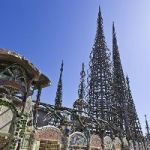
 Simon Rodia, an Italian immigrant, was a man of unwavering determination. From 1921 to 1955, he spent nearly every day chicken-wiring steel pipes and rods together, often taking breaks only to sip on malt liquor.
He devoted himself to building a series of towering sculptures in his backyard located in the Watts district of Los Angeles. The motivation behind this endeavor remains a mystery; perhaps he simply found joy in creating.
After 34 years of relentless work, Rodia suddenly ceased his efforts. On a whim, he transferred ownership of the property to a neighbor and boarded a bus to the East Bay. After that, he was never seen again in Watts. Nevertheless, his creations, known as the Watts Towers, have gained recognition as a National Historic Landmark.
Throughout our nearly two decades of riding the LA Metro Blue Line (now the A Line) from Long Beach to Los Angeles, we often gazed out the window while passing through Watts, pondering what extraordinary mind was responsible for these towers.
Rodia has achieved a form of immortality; he is one of the many figures featured on the cover of The Beatles’ Sgt. Pepper’s Lonely Hearts Club Band. Look closely, and you’ll spot the expression of the eccentric artist just to the left of Bob Dylan.
The Watts Towers symbolize dedication and remarkable endurance in a neighborhood marred by hardship and strife. Within these structures, and the nearby “Ship of Marco Polo” adorned with shells and glass fragments, lies a value that can only be truly understood within the context of their environment.
In 1965, a decade after Rodia left, and just a month following his passing, Watts erupted in flames.
Today, our curiosity lies not just with Rodia or the fervor behind his unusual creations, but rather with the lessons imparted by these enduring symbols of resilience through times of turmoil.
Let It Burn
On August 11, 1965, the first sparks of the Watts riots ignited. Over the next five days, South Central Los Angeles saw widespread destruction, with more than 30 lives lost.
Perhaps clearer communication could have averted the chaos. However, some upheavals—like a financial market crash—seem more a matter of when than if.
In the scorching summer of 1965, racial tensions were already high in the region. The riots could have been incited by any incident, compounded by a desire to loot small businesses for both fun and profit.
The immediate catalyst was the arrest of a drunk driver by a white policeman. The driver, an African American man, had his stepbrother ask to take the car home—a straightforward request that was denied, prompting an escalation of emotions.
Tempers flared as the arrested man’s mother—who was cooking a rabbit just down the street—learned of the situation and rushed to assist her son. By then, a hostile crowd had gathered, escalating the confrontation.
When the arrested man’s mother attempted to intervene, she, along with her stepbrother, found themselves handcuffed and placed in the back of a police car. Rumors emerged of police misconduct, including reports of a pregnant woman being assaulted, further igniting the fury of the crowd.
The following night, the tension exploded into violence. Despite her calls for peace, the mother was met with hostility as bricks flew, windows shattered, and stores were looted. Over 1,000 buildings were charred, many reduced to rubble.
The response from law enforcement was determined: they established a blockade around the riot zone, restricting access in and out. The policing strategy was simple: let it burn.
Within this chaotic “looting playground,” rioters chanted, “Burn, Baby, Burn!”
But what is the underlying message here?
Hyperinflation or Mega Asset Price Deflation
In a parallel scenario today, with inflation reaching a 40-year peak and investor anxiety on the rise, the Federal Reserve might find itself in a situation where it must adopt a hands-off approach—essentially letting the market burn.
As the clock struck midnight to usher in 2022, major U.S. stock indexes were nearing historic highs. Meanwhile, valuation metrics like the CAPE ratio and the Buffett Indicator reached alarming all-time peaks.
Simultaneously, inflation was gaining momentum. Soon, the Fed shifted gears towards interest rate increases and quantitative tightening. The question was no longer if there would be a market panic, but rather when it would occur.
This year, stocks have been faltering, with the clear trigger being rampant consumer price inflation. For the first time in four decades, the Fed faces the daunting choice between hyperinflation and significant asset price declines.
Thus far, it appears the Fed has opted for the latter approach—allowing the market to flounder.
Realistically, this might be the only rational decision for the Fed. The economic indicators today stand in stark contrast to those present when Alan Greenspan executed the “Greenspan put” following the 1987 Black Monday crash.
In 1987, interest rates, after peaking in 1981, were still significant, with a 10-Year Treasury yield of about 9 percent. This allowed ample room for interest rates to decrease. Additionally, inflation, which plagued the 1970s, had begun to diminish.
Now, however, the circumstances are drastically different…
Burn, Baby, Burn!
Today, with interest rates trailing far behind surging consumer prices, the idea of invoking the “Fed put”—cutting rates and ramping up liquidity to cushion the stock market—cannot be executed without fanning the flames of inflation further.
Instead, the Fed must prioritize controlling inflation before it can establish a safety net for the stock market or inject liquidity to stimulate the economy. These actions cannot happen simultaneously.
Any attempt to boost stock market values or stimulate the economy prior to curbing inflation would only result in heightened inflationary pressures.
This week, following the June Federal Open Market Committee (FOMC) meeting, the Fed increased the federal funds rate by 75 basis points, bringing it to a range of 1.50 to 1.75 percent. Officially, consumer price inflation stands at 8.6 percent—though the reality may exceed 16 percent.
A federal funds rate of 1.75 percent is insufficient to quell rising consumer prices. In a bear market following extensive capital inflation fueled by unrestrained monetary policy, the absence of the “Fed put” implies one conclusion…
“Burn, Baby, Burn!”
Currently, financial markets are ablaze, leaving authorities with little choice but to step back and allow the flames to spread. What insights can we draw from this?
Disorder, much like brutal bear markets and inner-city riots, is an undeniable aspect of life. Throughout our lives, we may find ourselves grappling with various forms of turmoil. The true challenge lies in emerging from such experiences with minimal scars.
When much of the area devastated during the Watts riots in 1965 was laid to waste, Rodia’s towers remained untouched. Even those in despair recognized their inherent value—something worth safeguarding.
At present, assets such as gold, silver, and long-term food storage are increasingly appealing. In contrast, stocks and bonds, much like the buildings in Watts, face impending chaos.
[Editor’s note: Don’t allow the stock market decline to obliterate your hard-earned investments. As inflation threatens to erode your life savings, it’s crucial to consider financial alternatives. Over the last six months, I have dedicated time to researching practical strategies that everyday Americans can adopt to safeguard their wealth and financial privacy. I have compiled these insights in the Financial First Aid Kit. If you’re interested in learning more about this essential publication, visit the link today!]
Sincerely,
MN Gordon
for Economic Prism

