
Explore the latest in technology with our newsletter. Enjoy updates, tool reviews, and valuable insights from an enthusiastic founder who has transitioned into investment while always staying curious about technology.
Hello everyone,
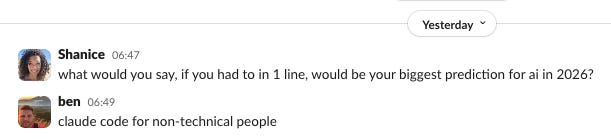
This year, one of my major forecasts has been “Claude Code for everyone.”
Anthropic has recently launched a fascinating research preview called Cowork. This new tool offers an advanced version of Claude Code, now featuring a web browser, MCP connectors, and capabilities for document handling—essentially targeting non-coding tasks. While you could perform similar functions using Claude Desktop previously, the added abstractions make it significantly more user-friendly. For instance, rather than requiring a filesystem MCP, users can simply select a folder.
This tool is tailored for non-technical users, yet I believe it has the potential to make them more technically savvy. Cowork displays the tools, commands, and code it generates, which will inevitably spark questions about how agents function. Users may start to ponder the significance of specific commands or the rationale behind certain actions. The context sidepanel is also pivotal in guiding users towards understanding context engineering.
Currently, Cowork is in its early development stages and has several quirks that need attention. My attempts at using it yielded mixed results (for instance, creating an artifact with AI embedded within it is not possible yet, as you might find on Claude Web). Nevertheless, Claire had some success with it. Similar to CLI agents, there’s an increasing demand for custom versions of applications like this. I’ve already come across two examples. This aligns with my vision of ‘personal operating systems.’ Ultimately, we may either be engrossed in ChatGPT or Claude throughout our working hours or seek to customize our own applications.
An exciting development has been the introduction of a plugin called Ralph-wiggum, which allows coding agents to execute tasks over extended periods. The concept is simple: you start with a detailed specification document and continue looping through tasks until completion. Anthropic released a plugin for it recently, but Ralph’s creator, Geoffrey Huntley, indicated that it wasn’t quite right. He streamed a session discussing the system for 30 minutes, followed by Ralph running for 5 hours while adding analytics to his site. Another user adapted it to create a web-based UI for SQLite databases.
I developed a Ralph skill that you can try using with droid, Claude Code, or any agent. Simply direct your agent to the repository and command it to install, followed by ‘use ralph-skill.’ Additionally, Ian created a fantastic CLI version.
Gmail is enhancing its Gemini integration in several ways: Suggested Replies, AI Overviews, and an AI Inbox feature. Suggested Replies now offer responses in your voice beneath the email thread and are significantly improved. AI Overviews deliver concise textual summaries before the list of emails appears when performing a search in Gmail. The groundbreaking new “AI Inbox” creates a daily report highlighting important items and tasks from your entire inbox. This rollout will be gradual, beginning in the U.S., so you might need to wait a few months to see these updates. Just another day at Google.
Apple and Google recently announced that new Apple Foundation Models will be built using Gemini.
Creating Voice AI can be straightforward in demos but complex in real-world applications. The Speechmatics Startup Program is designed to assist founders in scaling with speech APIs that work effectively with various audio conditions—accents, cross-talk, background noise, and over 55 languages. Accepted startups can receive up to $50k in credits and engineering support.
-
How I write using AI with Wispr Flow, Claude, and Pangram. (Not me, by the way.)
-
Common patterns in agent design observed over the past year.
-
Collaborative Intelligence – viewing agents as social participants in multiplayer systems.
-
The Ramp team integrated Claude Code into Rollercoaster Tycoon, also developing an internal coding agent they call Inspect. Here’s their reasoning.
-
Exploring how compact conversations work in Claude Code.
-
Seamlessly search with Dropbox Dash, a context-aware AI that integrates with all your work applications. This tool enables you to access work files, messages, and projects in one simple, secure workspace—streamlining searches across your tools without juggling multiple tabs.*

-
Radiant is an innovative Mac app that transforms meetings into actionable work items, including follow-up emails and summaries, all generated promptly without any bots.*
-
Actforge – Let Claude Code handle all your non-coding tasks effortlessly.
-
Stagehand Agent – Streamline complex workflows using AI-powered browser agents.
-
Do Anything – Tackle your to-do lists with agents that have distinct identities and can work at any time.
-
Better Shot – An open-source, native macOS screenshot tool that is both local and free.
-
Livedocs – A versatile data agent capable of working smoothly with your spreadsheets, databases, and more.

-
CallMe, a simple plugin that enables Claude Code to call you on your phone.
-
bash-tool – A specialized tool for agents to utilize filesystems and bash commands effectively.
-
ralph-tui – Connect your coding agent to your task manager to observe agents at work in a terminal UI.
-
nanocode – A lightweight alternative to Claude Code, implemented in Python.
-
CodexMonitor – An application for MacOS that allows for the operation of multiple Codex agents with device access.
-
Agentboard – A web-based UI tailored for tmux, optimized for agent TUI management, possibly allowing operations from mobile devices.
-
UI Skills – Defined constraints for crafting better interfaces with agents.
-
A skill for Claude Code to fine-tune a model using the Tinker tool from Thinking Machines.
-
OpenAI has acquired Torch, a small company focused on enhancing ChatGPT’s capabilities.
That’s all for today! I welcome your comments and thoughts. 👋
Thanks to our sponsors who made this newsletter possible. 🙂
Interested in partnering with us for Q1?