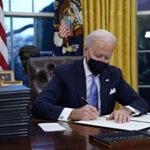
 Recently, the White House released a fact sheet announcing that President Biden has made good on his promise to forgive $10,000 of student debt for low- to middle-income borrowers. But who truly benefits from this initiative?
The student debt crisis is undeniably alarming. Approximately 45 million borrowers collectively owe around $1.6 trillion, with much of this debt tied to federal student loans.
The federal government, having provided this credit, is largely accountable for the current situation. The influx of federal loans contributed to an inflated bubble in higher education and fostered an environment of entitled, often misguided intellectualism.
This business model thrives on enrolling naive 18-year-olds into substantial government-backed loans. These young individuals have been indoctrinated, from a very early age, to believe that a college degree is the key to success. However, as tuition rates soared alongside an increase in student loans, the original value of that promise began to fade.
It’s worth noting that canceling student debt predominantly serves a flawed educational industry rather than alleviating the burden of indebted students. It enables colleges and universities to sustain inflated programs.
Instead of debt cancellation, Biden should terminate government-sponsored student loans altogether, dismantling the financial lifeline that undeservedly enriches these institutions.
What impact would this have on the well-paid professors and lavish college campuses reliant on such debt? Tuition fees would likely decrease, professor salaries would be reduced, and campuses would adapt to more sustainable financial practices.
Would the quality of education suffer? Not in critical fields that genuinely matter.
In fact, a more modest budget might eliminate unnecessary courses that offer little educational value, many of which exist solely due to abundant federal loans.
Roadside Distractions
A simple act of canceling student debt does not erase the burden of debt itself. Remember, debt represents borrowed funds from the future, which ultimately must either be repaid or defaulted upon.
In this case, canceling student loans transfers the financial responsibility from borrowers to the wider American populace—you will bear the cost through increased taxes and inflation for years to come.
Yet this seems to be what many people desire. A society accustomed to growing government oversight becomes desensitized to it over time. As generations progress, the collective character may shift, making people more accepting of centralized aims.
Individuals begin to lean on the welfare state, supporting politicians who offer ever-increasing benefits. They expect the government to magically solve societal problems.
This erosion of political liberty and individual independence creates a centralized power. The collective will starts overshadowing personal freedoms, as collectivism demands conformity to the capacities of the least able, labeling those who seek freedom as domestic terrorists.
In this environment, layers of regulations and governmental agencies often serve as distractions. They draw focus and resources away from the productive exchange of goods and services, replacing it with the mundane compliance tasks.
For many workers, compliance measures become the nucleus of their jobs.
Legal Compliance
Meanwhile, jobs in government agencies are often misconstrued as meaningful employment. These departments provide a safety net for graduates with degrees that may lack practical value—workers clock in, perform tedious tasks, and collect a paycheck.
This experience includes stable job security, good benefits, and attractive pensions. Unfortunately, the reality is that much of this work is merely administrative minutiae offering no substantial benefit to society. Yet, if it aids bureaucrats in managing and controlling their surroundings, it must hold some value.
In truth, these agency jobs are wealth-depleting. Their primary aim is to regulate and control, diverting resources away from genuine production into a sinkhole of inefficiency.
At a local level, government overreach can reach absurdity. For example, in San Francisco, potential restaurant owners may be required to pay 17 different fees totaling nearly $22,648 before they can serve their first meal. These costs are in addition to the standard expenses of launching a restaurant.
So why take the risk?
What incentive is there to open a restaurant if a stable government job is more appealing? The clock out time is 5 p.m., weekends and holidays are off, and the benefits are superb.
Overall, the disadvantages of entrepreneurship heavily outweigh the benefits when faced with so many rules and regulations. Even simple business ideas are bogged down by excessive requirements.
For instance, starting a home-based tutoring service should be straightforward, perhaps as simple as placing an ad in the local newspaper. Yet in Phoenix, a whopping 21 different regulatory steps are needed to legally operate.
This is sheer madness, and its consequences are deeply damaging…
The Politics of Control and Economic Oblivion
Recall that the Bureau of Labor Statistics reported a shocking decline in labor productivity for the second quarter of 2022—down 4.1 percent. As output decreased by 1.4 percent while hours worked increased by 2.7 percent, this marked the steepest drop in productivity in 74 years.
This situation indicates that people are working more but producing less, effectively moving backwards. The implications include diminished availability of goods, contributing to significant consumer price inflation.
Why has there been such a collapse in productivity?
Productive activity relies on workers’ mental and physical abilities, striving to generate new services and goods with minimal energy and material costs. In theory, producing more at a lower cost fuels economic advancement.
However, despite technological advancements since the industrial revolution, productivity has plummeted. Why?
Possible explanations often trace back to a few core factors: excessive regulation, high taxation, aggressive money printing, market manipulation, and the overarching interference from various government levels that have spiraled out of control.
Although canceling student debt could sway some voters in the upcoming mid-term elections—something Biden is undoubtedly counting on—it also represents yet another step towards the centralized planners’ vision of a future defined by political control and economic oblivion.
Sincerely,
MN Gordon
for Economic Prism
Return from The Politics of Control and Economic Oblivion to Economic Prism

