Hong Kong
Reuters
—
A recent court ruling in Hong Kong has drawn significant attention, as it highlights the far-reaching implications of the national security law enacted in 2020. The case involves a father’s attempt to access his daughter’s insurance policy amid a politically charged environment, revealing the intersection of personal and political hardships faced by families in the region.
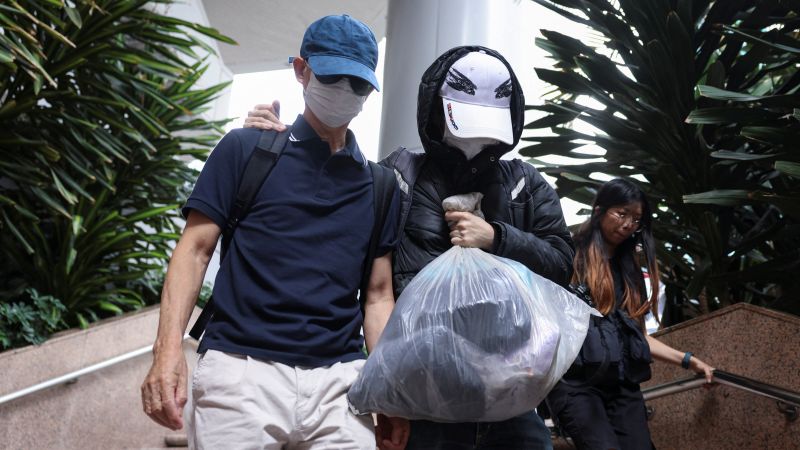
Kwok Yin-sang, 69, was sentenced to eight months in prison on Thursday for attempting to terminate his daughter’s insurance policy and withdraw the associated funds. This action was deemed a violation of Hong Kong’s national security law, specifically related to dealing with the financial resources of someone considered an “absconder.”
He is the first individual convicted of this specific offense under the national security law. Despite pleading not guilty and refraining from testifying during the trial, he remained composed in court before being taken back into custody.
His daughter, Anna Kwok, is a prominent figure in the Washington-based organization Hong Kong Democracy Council and is among 34 activists currently wanted by Hong Kong’s security police.
Anna is accused of colluding with foreign forces, and authorities have placed a bounty of HK$1 million (approximately $128,000) for her capture.
In an interview before her father’s sentencing, Anna expressed her disdain for the government’s actions against him, describing it as “utterly despicable.”
“This is the first case, but it is not going to be the last,” she remarked.
Kwok Yin-sang was accused of trying to withdraw a total of HK$88,609 ($11,342) from an insurance plan he established for Anna when she was just two years old.
Magistrate Andy Cheng emphasized the seriousness of Kwok’s offense under the national security law, clarifying that family relationships do not mitigate the gravity of the crime.
“There is no such thing as collective punishment, and it has absolutely nothing to do with whether the defendant and the fugitive are family,” Cheng stated.
Reflecting on her father’s situation, Anna Kwok expressed a heartfelt wish to hug him and apologize for the difficulties he faced due to her activism.
“Asian dads are not very known for showing affection with hugs and I realized this year, I actually … don’t think I’ve ever hugged my dad since I became an adult,” she shared.
In 2020, China implemented a comprehensive national security law in Hong Kong, with a second wave of national security legislation—Article 23—passed in 2024 to address what the authorities termed as “loopholes” in the existing framework.
Key Takeaways
- Kwok Yin-sang was sentenced to eight months in prison for violating Hong Kong’s national security law.
- This case marks the first conviction under these specific circumstances in Hong Kong.
- His daughter, Anna Kwok, is leading a democracy advocacy effort and faces similar charges.
- The Hong Kong government has placed a bounty on Anna’s head, indicating the seriousness of the situation.
- Magistrate emphasized the separation between family relationships and legal accountability.
FAQ
What charges does Anna Kwok face?
Anna Kwok is accused of colluding with foreign forces and is one of 34 activists wanted by Hong Kong authorities.
What is the context of the national security law in Hong Kong?
The national security law, enacted in 2020, aims to curb dissent and has resulted in numerous arrests and convictions.
What was the amount involved in Kwok Yin-sang’s case?
Kwok Yin-sang attempted to withdraw HK$88,609 (approximately $11,342) from an insurance policy.
What did the magistrate say about family ties in this case?
The magistrate stated that family relationships do not influence legal responsibilities under the national security law.
What was Anna Kwok’s reaction to her father’s sentencing?
Anna described the government’s actions against her father as “utterly despicable” and expressed a desire to reconnect with him.