Introduction
In the world of agriculture, understanding pollinator activity is crucial for enhancing crop yields and promoting biodiversity. Researchers at The Ohio State University and Dartmouth College have developed an innovative open-source tool known as “buzzdetect.” This system utilizes machine learning and passive acoustic monitoring to continuously track pollinator presence. Below, we delve into the functionality and implications of this groundbreaking technology.
By Fabiana Fragoso, Ph.D.
Imagine standing in the middle of a vast soybean farm, surrounded by the sounds of nature. You may hear a distant tractor or the gentle rustle of leaves, but what if you could tune into the hidden symphony of pollinators around you? This concept is becoming a reality thanks to the innovative work of researchers at The Ohio State University’s Department of Entomology and Dartmouth College’s Department of Computer Science.
In a recent study published in the Journal of Insect Science, the team introduced “buzzdetect,” a powerful new open-source tool designed to monitor pollinator activity through machine learning and passive acoustic monitoring.
The Limits of Traditional Sampling
Fieldwork in pollination research can be incredibly taxing. Imagine trying to track pollinator activity throughout an entire day or season. “If you want to analyze daily pollination trends with a resolution of 30 minutes, you must be in the field from dawn to dusk, constantly sampling,” explains Luke Hearon, a Ph.D. student at OSU and lead author of the study. “Yet, by the end of a long day, you may only have a single data point.”
When attempting this across various sites and days, the limitations of traditional methods become apparent. Passive acoustic monitoring solves these challenges by allowing researchers to set up microphones in multiple locations that continuously record over extended periods. “This method provides virtually unlimited temporal resolution,” Hearon states. Buzzdetect’s capability to operate around the clock enables researchers to gather high-frequency data on pollinator activity, surpassing the confines of conventional methods.
Turning Buzzes Into Data
To develop buzzdetect, Hearon and his team applied deep learning models to analyze field audio. This type of machine learning imitates the brain’s structure to learn patterns from large datasets.
Initially, simple audio recorders were placed in agricultural fields to capture insect sounds. Hearon’s team then marked the audio when buzzing was detected. Instead of building a model from scratch, they utilized transfer learning, refining the pre-trained Google audio model YAMNet, which was already familiar with various everyday sounds, to hone in on insect flight sounds. The resulting model effectively identified insect buzzes amidst environmental noises, achieving a sensitivity of 28% and a precision of 95%.
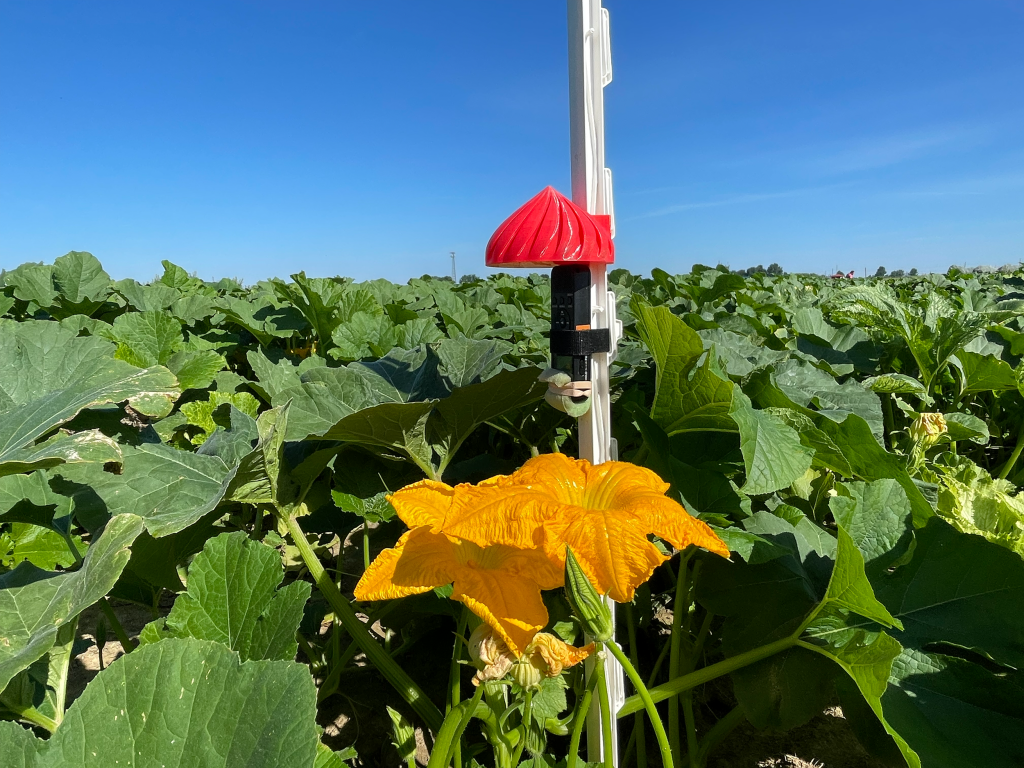
To evaluate its effectiveness, the researchers deployed microphones across agricultural fields and analyzed 24-hour recordings from five different crops: pumpkin, watermelon, mustard, soybean, and chicory. The results confirmed established patterns of pollinator behavior: chicory exhibited significant morning activity peaks, while soybean showcased heightened action later in the day. Interestingly, variations were noted even within single crops; in watermelon fields, some recorders noted over 4,000 buzzes in a day, compared to others that captured only around 1,200, indicating authentic differences in local pollinator activity.
While buzzdetect shows remarkable accuracy, it’s worth noting that, like any automated system, it can make errors. However, Hearon observes that most false positives are understandable. “Many misidentifications can be explained when you review the audio or its spectrogram,” he explains. However, some of the misclassifications are quite memorable. “From strange rattles and clicks to intense squabbles between squirrels, and a myriad of buzzing variations, the challenges of categorizing these sounds are evident,” he recalls. Such experiences raise vital questions in the field of bioacoustics about how to accurately label and classify a wealth of sounds.
An Open, Accessible Tool for Many Users
Hearon takes pride in the fact that buzzdetect is not only free and open-source but also designed to operate on relatively affordable hardware. “Our primary analysis GPU, the GTX 1650, was one of the most cost-effective cards from four hardware generations ago. Additionally, our audio recorders are basic MP3 devices, avoiding the need for expensive scientific equipment,” he notes.
Such accessibility means buzzdetect has potential applications far beyond academic research. Crop farmers may monitor pollinator activity prior to pesticide application, while public gardens could assess the efficacy of various pollinator habitats. Furthermore, citizen scientists could track local bee activity in their own backyards. “The more people engage with this technology, the better our understanding will grow,” adds Hearon.
Moreover, the barriers to utilizing tools like buzzdetect are decreasing rapidly. Hearon notes, “Besides navigating some confusing error messages, the process is surprisingly straightforward. Machine learning is becoming increasingly approachable, with improved software and an abundance of online resources.” He encourages interested individuals to immerse themselves in this world: “Even if you have no background in Python, I urge you to dive in; the journey may lead you somewhere unexpected.”
A spectrogram of buzzes recorded by buzzdetect showcases its capability to monitor pollinators in real-time. (Video courtesy of Luke Hearon, Ph.D.)
A Complementary Tool
While buzzdetect offers an innovative solution for automated, large-scale monitoring, Hearon emphasizes that it should be regarded as a complement to, rather than a replacement for, traditional methodologies. “So far, the trends from buzzdetect largely align with findings from previous studies, providing consistency,” he explains. “However, every sampling approach has its biases, including bioacoustics. Although future results may diverge from earlier studies, determining which one is misleading can be challenging. This is why we advocate for buzzdetect as a supplementary tool: the most robust conclusions arise from synthesizing diverse data sources.”
Listening Beyond the Data
Beyond its practical implications, Hearon shares that working with buzzdetect has reshaped his perception of sound in natural environments. “Throughout this project, I have come to appreciate the wealth of information embedded in auditory cues,” he explains. “Our senses filter what we notice, especially amidst background sounds, but listening intently unveils an entire soundscape. The rustle of leaves, bird calls, and even the different sounds of night and day become more apparent when consciously engaged.”
Ultimately, Hearon reflects that while the tool they developed is significant, the greater understanding gained throughout the journey is invaluable. “I cherish innovative methods and powerful models, but at the end of the day, they are just models. The true essence lies in the world around us, waiting to be explored.”
Fabiana Fragoso, Ph.D., is an entomologist and biologist who hails from Brazil but is currently based in Italy. She has recently completed a postdoctoral research position with the USDA Agricultural Research Service in Madison, Wisconsin. Email: fabianapfragoso@gmail.com.
Related
Discover more from Entomology Today
Subscribe to receive the latest updates delivered to your email.