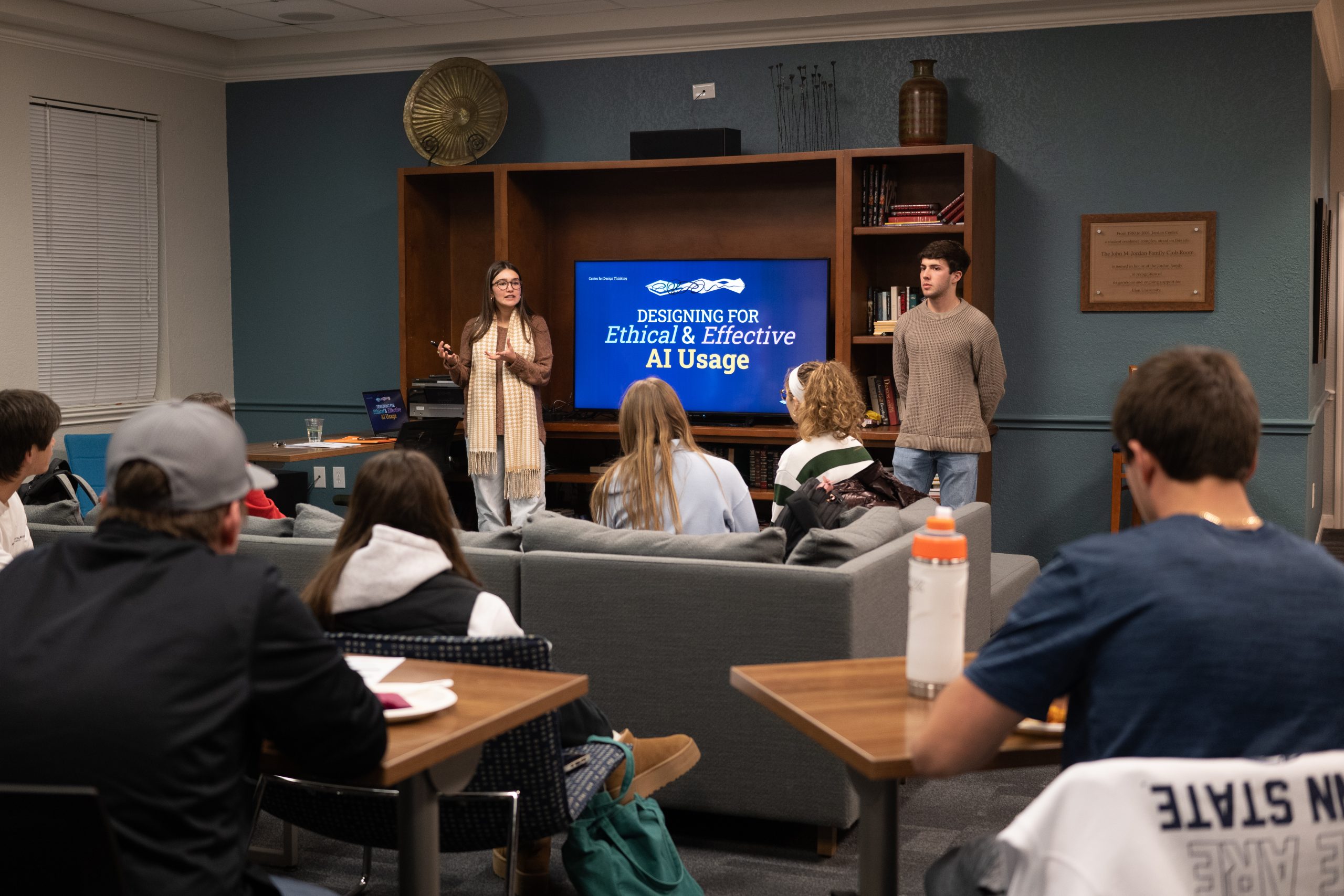
Recently, Danielle Lake, Director of the Center for Design Thinking, along with Design Thinking Catalyst Anya Bratić, led an engaging AI workshop tailored for a faculty development program in India.
Share:
As artificial intelligence continues to influence higher education globally, many institutions are reconsidering how to integrate AI into their practices in a manner that is both effective and ethical, supporting all stakeholders—students, faculty, and staff alike.
The Center for Design Thinking has initiated a discourse on the use of AI in academia through its workshop titled “Designing for Ethical and Effective AI Usage.” This workshop is designed to bridge the divide between the intended use of AI by educators and how students can interact with these technologies in a responsible manner.
 The Center has successfully supported over 110 faculty members through a developmental initiative aimed at fostering innovative AI solutions for the next generation. This program is dedicated to equipping educators, researchers, and industry professionals with a comprehensive understanding of design thinking principles and their vital role in developing user-centric AI innovations.
In line with this global dialogue, Danielle Lake and Anya Bratić conducted the “Designing for Ethical and Effective AI Usage” workshop, presenting the latest research findings that emphasize the importance of AI in nurturing student growth.
Lake discussed the key stages of the design thinking process, particularly highlighting the importance of problem framing and exploration. She stressed the necessity of clearly identifying issues, taking responsibility for solutions, and recognizing the impact of unconscious bias on decision-making.
Encouraging participants to dive deeper into exploration and research, Lake facilitated discussions that allowed faculty members to share their experiences and insights.
Bratić concentrated on the ethical dimensions of AI in educational settings, addressing the reliance students are placing on tools like ChatGPT. She pointed out how improper use of AI can result in plagiarism and impede learning and highlighted the growing necessity for AI literacy in the job market.
Bratić emphasized the crucial role faculty members play in guiding ethical AI use, offering three tools to help educators instruct students on effective AI utilization. These tools consist of rules for ethical use, a structured approach to prompt building, and the concept of “mind before machine.”
Furthermore, Bratić demonstrated various AI applications that can enhance student learning, such as language development tools and productivity software. She underscored the importance of originality and accountability, encouraging students to engage in independent thought before utilizing AI resources.
The workshop concluded with interactive sessions where faculty members brainstormed and integrated AI tools into their teaching methods, reinforcing ethical considerations, creativity, and critical thinking skills.
Through collaboration, dialogue, and practical application, the workshop confirmed that successful AI integration begins with well-informed and empowered educators. By prioritizing ethics, creativity, and critical thinking, the Center for Design Thinking ensures that AI serves as a vehicle for growth rather than a substitute for genuine learning.