
Your Ultimate Tool for Boosting Productivity
Multitasking is often perceived as a skill we all possess, but the reality can be quite different.
When I refer to multitasking, I’m not mentioning the simple tasks like cooking dinner while making a phone call. I’m talking about activities that demand your full concentration and mental involvement. Personally, I’ve discovered that multitasking usually leads to a flurry of unfinished tasks—many beginnings, but no completions.
Another significant barrier to productivity is distractions, which are abundant in our environments.
IDENTIFY AND REMOVE DISTRACTIONS
Distractions are rampant, and unfortunately, they severely impact our productivity. Whether in an office or working from your home, there’s a plethora of distractions—your smartphone, social media notifications, chatty colleagues, even your pets. Finding a quiet moment to focus can be daunting; however, recognizing and addressing these distractions is crucial (with the exception of your dog, of course).
I personally struggle with a short attention span, which has hindered my productivity for years. I often begin working on one project only to get sidetracked by another idea, resulting in minimal progress across the board.
Are you still following along? I noticed that, despite feeling busy while multitasking, I wasn’t achieving anything meaningful. To combat this, I started meticulously scheduling everything in my calendar—even mundane tasks like “feed the dog.” This helps me stay organized and focused. During the day, I often switch my phone to airplane mode for an hour or two to fend off distractions. Merely silencing notifications didn’t suffice; the habit of checking my phone was too ingrained. By disabling it entirely, I can focus completely on my work. Next time you’re engaged in an important task, take a moment to consider any subtle distractions that might be pulling your attention away from your objectives. You might be surprised at what you discover.
ESTABLISH A SCHEDULE
Now, let’s introduce your primary productivity tool: time blocking. Although it goes by several names, the essence remains the same: dedicate specific time slots purely for your tasks, free from distractions. Think of it as scheduling time around your key priorities.
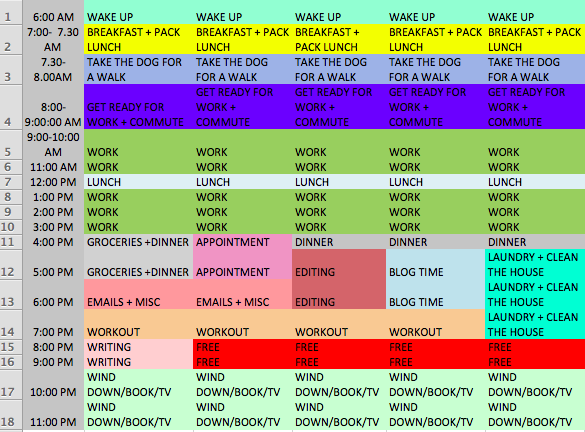
NOT my actual schedule, just a sample I created for you.
You can break your schedule into 15-minute, 30-minute, 45-minute, or even 1-hour increments, depending on your needs. Your schedule might look entirely different from mine, and that’s perfectly acceptable. While adhering strictly to a schedule is not always feasible, having one in place gives you the tools to get back on track whenever unexpected events arise.
I like to relax on weekends, so I don’t follow my schedule as strictly on Saturdays and Sundays. Although I’m somewhat of a control enthusiast, I also value a touch of spontaneity in my life. For instance, I have dinner plans with a friend tomorrow, and I wouldn’t dream of checking the clock and saying: “Oh no, it’s 4:30 PM already? According to my schedule, I have laundry at 5 PM!“
No, that sounds unnecessarily constrictive.
PINPOINT YOUR PRIORITIES AND SCHEDULE THEM
Identify the most critical task you need to tackle and allocate a time block to focus on it. It could be for 15, 30, or even 45 minutes—choose a duration that suits you best and utilize a timer. During this focused period, give your task your full attention. I find that tools like this one make it easier to stay committed to your schedule, ensuring that you spend just the right amount of time on each task.
SCHEDULE MANDATORY BREAKS
Productivity isn’t merely about relentless work; it’s about smart working. Designate regular short breaks of 5-10 minutes and stick to them—even when you feel completely absorbed in your work. Stepping away for a brief moment can offer you a fresh perspective, almost as if you’re viewing your work through new eyes. Use this time for stretching, hydrating, or even a quick scroll through your social media feeds. But once your break is over, return to your tasks with renewed energy.
My writing is heavily dependent on taking regular breaks. I seldom finish tasks in one sitting, unless they’re extremely straightforward—this applies to both my “work” job and my blogging efforts.
Managing a full-time job alongside a blog keeps me constantly busy, but I embrace this because I love staying productive. I can confidently say that my ability to juggle these responsibilities effectively comes down to time blocking and having a well-defined schedule. I allocate time for writing, photo editing, responding to emails, social media engagement, workouts, and meal preparation. I tried multitasking for years, and it simply didn’t yield results.
Time blocking and maintaining a structured schedule requires commitment. It’s not enough to just create a plan; you have to stick to it. Consistency is vital for cultivating a routine that works for you. We often claim we lack time for various activities, but the truth is that managing your schedule takes discipline and focus.
While scheduling your tasks into time blocks may seem overly meticulous, it truly makes a substantial difference and fosters greater discipline—especially when balancing a full-time job with blogging.
If you’re interested in starting your own lifestyle blog for just $3, check out my comprehensive step-by-step guide here.