 The Commerce Department disclosed on Tuesday that the economy expanded at an annual rate of 2 percent in the third quarter, a revision downward from last month’s initial estimate of 2.5 percent. More concerning, after-tax income, adjusted for inflation, saw a decline of 2.1 percent—the most significant drop in personal incomes since the third quarter of 2009.
This decrease in income could negatively impact growth rates in the upcoming fourth quarter. It’s essential to remember that consumer spending accounts for 70 percent of the economy. A fall in incomes is likely to lead to a drop in consumer spending, ultimately resulting in slower economic growth.
At the heart of economic recovery lies the job market. However, not just any jobs will suffice; we need profitable positions. Jobs that generate more revenue than they consume, drive business growth, and facilitate further investment and hiring are essential.
Unfortunately, the economy is currently lacking in such job creation. On Wednesday, the Labor Department reported an uptick in unemployment insurance applications, rising to 393,000, an increase of 2,000 from the previous week’s 391,000.
Sadly, the unemployment rate has lingered around 9 percent for over two years now. Continue reading
 Popular movements often find themselves led by charismatic figures. These individuals champion the trending ideologies of the moment, often neglecting substance and rational thought in favor of the fervor of the crowd.
Take Che Guevara as an example. The Argentine Marxist was often misguided, spreading a convoluted ideology across South and Central America. “In this period of the building of socialism we can see the new man and woman being born,” he claimed. “The image is not yet completely finished – it never will be, since the process moves forward hand in hand with the development of new economic forms.”
Guevara was deeply troubled by the glaring disparities around him. Confronted with the stark contrast of poverty and wealth, he perceived a grave injustice that fueled his determination to forge a better world.
Unfortunately, his methods were fundamentally flawed. Instead of seeking private solutions, Guevara turned to political means. He believed that with the correct government and policies, the world could be reshaped according to his vision. Continue reading
 Shortly after the market opened on Wednesday, oil prices surged above $100 per barrel—marking a 26 percent increase in less than two months. What’s behind this spike?
The Associated Press suggests that the Labor Department’s recent report, indicating a decline in consumer prices from 3.9 percent to 3.5 percent in October, contributed to pushing oil prices back above $100 for the first time since July. However, we find this connection puzzling.
Perhaps the AP implies that lower consumer prices will stimulate consumer spending, which in turn will increase demand for oil and subsequently drive up prices. This, however, is merely speculative, as the report did not clarify this correlation.
Alternatively, it could be that oil trading at $100 per barrel suggests a growing demand constrained by limited supply. Yet this interpretation only scratches the surface of a more complex situation. Continue reading
 Last Friday, while many enjoyed their time off for Veteran’s Day, we dedicated our day at the office to analyzing issues that matter to our clients—and by extension, to ourselves. Yet we took a moment to reflect on the Armistice and the current state of our world.
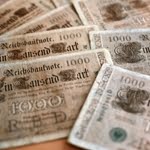
It appears that ‘the war to end all wars’ resulted in a new kind of disorder in Europe. By its conclusion, economies were devastated, governments had fallen, and public confidence was shattered. Furthermore, the Treaty of Versailles and its fallout led to Germany’s catastrophic hyperinflation.
One key provision of the treaty mandated that Germany make reparations that its economy could not possibly support. To alleviate this burden, the German government, known as the Weimar Republic, resorted to printing vast amounts of paper currency. The outcome was disastrous.
Between January 1922 and November 1923, the wholesale price index skyrocketed from 36.7 percent to an astronomical 726,000,000,000.0 percent. By late 1923, it required 200 billion marks to purchase a single loaf of bread. Ultimately, Germany’s currency collapsed along with its middle class. Continue reading