The tragic case of Russian opposition leader Alexei Navalny has once again drawn international scrutiny, as new revelations point to his death being orchestrated by the Russian state. This situation raises significant concerns about political dissent and the lengths to which authorities may go to silence opposition voices.
Navalny’s death was attributed to poison derived from the South American dart frog toxin known as epibatidine.
The opposition leader passed away at the age of 47 while imprisoned in a remote Arctic penal colony two years ago, having been sentenced to a lengthy term on dubious embezzlement charges.
His death was officially disclosed by the Russian state on February 16, 2024, prompting accusations from his allies that the Kremlin had assassinated him due to the threat he posed to the government.
Epibatidine is reported to be 200 times more potent than morphine and is utilized by some indigenous groups in South America for hunting. Its effects include nerve damage, resulting in paralysis and numbness.
The specifics of how Navalny was purportedly poisoned remain unclear.
The UK, along with allies Sweden, France, Germany, and the Netherlands, condemned the ‘barbaric’ act, stating that only President Vladimir Putin’s government could be responsible for such a lethal poison classified as a chemical weapon.
In a statement from the Foreign Office, the spokesperson remarked: ‘The UK, Sweden, France, Germany, and the Netherlands are confident that Alexei Navalny was poisoned with a lethal toxin.

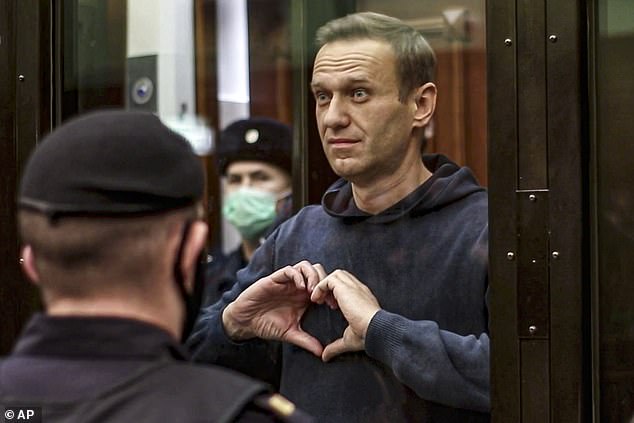
Russian opposition leader Alexei Navalny makes a heart with his hands as he appears in court in Moscow on February 2, 2021

Yulia Navalnaya, widow of Navalny, is seen in St Mary’s Church in Berlin after lighting a candle on what would have been her husband’s birthday in June 2024

Navalny is pictured with his wife after a rally in Moscow, Russia, in September 2013

The UK and its allies Sweden, France, Germany and the Netherlands said the ‘barbaric’ act – using a neurotoxin that is classed as a chemical weapon – could only have been carried out by Vladimir Putin’s government

Navalny’s death was the result of poison from a South American dart frog toxin called epibatidine (Pictured: Ecuadorian poison dart frog)
‘This is the conclusion of our Governments based on analyses of samples from Alexei Navalny. These analyses have conclusively confirmed the presence of epibatidine.
‘Epibatidine is a toxin found in poison dart frogs in South America. It is not found naturally in Russia.
‘Russia claimed that Navalny died of natural causes. However, considering the toxicity of epibatidine and the symptoms reported, poisoning is a highly likely cause of his death. Navalny passed away while imprisoned, indicating that Russia had the means, motive, and opportunity to administer this poison to him.’
The statement further asserted that ‘only the Russian state had the combined means, motive, and disregard for international law to carry out the attacks’.
The Foreign Office emphasized that Russia had not fully destroyed its chemical weapons, despite its assertions in 2017. Additionally, they spotlighted the Salisbury poisoning incident that occurred on UK soil in 2018.
At the time of his death, Navalny was serving a 19-year sentence, having campaigned against corruption and organized significant protests against the Kremlin.
In the aftermath, his widow, Yulia Navalnaya, expressed her conviction that her husband had been poisoned, commending European allies for providing ‘proof’.
She remarked: ‘Scientists from five European countries have established that my husband, Alexei Navalny, was poisoned with epibatidine – a neurotoxin, one of the deadliest poisons on earth.’
‘This poison, which is found on the skin of the Ecuadorian dart frog, causes paralysis, respiratory failure, and a painful death. I was certain from the outset that my husband had been poisoned, but now there is proof: Putin killed Alexei with a chemical weapon.’
‘I am grateful to the European nations for their meticulous work over the past two years in uncovering the truth. Vladimir Putin is a murderer and must be held accountable for his crimes.’

It is not clear how the frog poison was allegedly administered to Mr Navalny (Pictured during his imprisonment)

Yulia Navalnaya attends the 2024 Munich Security Conference on the day Russia announced her husband’s death

Ms Navalnaya meets with the British Foreign Secretary Yvette Cooper at the Munich Security Conference on Saturday

The Foreign Secretary embraces Ms Navalnaya at the Munich Security Conference today
British Foreign Secretary Yvette Cooper met with Ms Navalnaya at the Munich Security Conference over the weekend.
Ms Navalnaya made the heartbreaking announcement of her husband’s passing at this event in 2024.
Ms Cooper stated: ‘Since Yulia Navalnaya announced the loss of her husband here in Munich two years ago, the UK has pursued the truth regarding Alexei Navalny’s death with steadfast commitment.’
‘Only the Russian government possessed the means, motive, and opportunity to deploy this lethal toxin against Alexei Navalny during his time in prison in Russia.’
‘Together with his widow, the UK aims to expose the Kremlin’s barbaric plot to silence his voice.’
‘Russia viewed Navalny as a threat. The use of such poison illustrates the dreadful tools available to the Russian state and the acute fear they have of political opposition.’
Previously, Ms Navalnaya stated that the Kremlin’s assertion of natural causes behind her husband’s death was false.
Two independent laboratories had verified that he was poisoned, although Ms Navalnaya did not disclose specifics regarding the poison or the analyses undertaken but encouraged the labs to publish their findings.
In a video shared on social media, she reiterated: ‘I will not remain silent. I assert that Vladimir Putin is responsible for the murder of my husband, Alexei Navalny.’

Navalny’s death while in Russian detention was announced on February 16, 2024

Navalny takes part in a march at Strastnoy Boulevard in memory of Russian politician and opposition leader Boris Nemtsov in 2019

The Foreign Office released a statement alongside the UK’s European allies Sweden, France Germany and the Netherlands
She added: ‘The perpetrators took careful measures to erase evidence, but we managed to retain some. We secured samples of Alexei’s biological material and transported them abroad. Labs in at least two countries independently examined these samples and reached the same conclusion: Alexei was murdered, and more specifically, he was poisoned.’
In denial of any responsibility, the Kremlin attributed his death to sudden cardiac issues and chronic conditions.
Previously, Ms. Navalnaya accused unknown western nations of attempting to cover up the true nature of her husband’s death due to political motivations.
‘They wouldn’t want inconvenient truths to surface at an inopportune time,’ she asserted.
‘I demand that the laboratories that conducted the analyses publish their findings. Cease accommodating Putin for so-called higher considerations. You won’t appease him. As long as you remain silent, he will continue. I demand full public disclosure of the results revealing precisely what poison was used against my husband.’
President Joe Biden, who was in office at the time of Navalny’s death, expressed that there was no doubt regarding Putin’s involvement shortly after the announcement of his passing.
Ms. Navalnaya, residing outside Russia for years, released images of the cell where her husband died, which displayed vomit and personal items, including an English-Russian dictionary and his mittens. ‘This is where his murder occurred,’ she remarked.
In the video, she detailed her husband’s final days based on claims by prison staff.
On the day he died, she stated that her husband felt ill after being taken out for exercise. When returned to his cell, ‘he lay down on the floor, curled up, and began moaning in agony… then he started to vomit.’
‘Alexei experienced convulsions while the prison guards observed his suffering through the bars.’
Medical assistance was delayed by 40 minutes after he first exhibited symptoms. He succumbed shortly thereafter. Prison officials told his mother, Lyudmila, that her son had experienced ‘sudden death syndrome.’
Putin, who avoided mentioning Navalny during his lifetime, acknowledged his passing a month later, stating that a person’s departure is ‘always a poignant event.’

Last year Navalny’s widow, Yulia Navalnaya said the Kremlin’s claim that he died of natural causes was a lie

Reacting to the statement from the UK and allies today, Ms Navalnaya said she was ‘grateful’ to have ‘proof’ her husband had been poisoned

Russian opposition leader Alexei Navalny’s parents Anatoly and Lyudmila, accompanied by Alla Abrosimova, who is the mother of Navalny’s widow Yulia Navalnaya, come to Navalny’s grave to mark the first anniversary of his death at a cemetery in Moscow in February 2025

After Navalny’s death, people gathered across Europe to mourn (Pictured: Mourners at the Russian embassy in Warsaw, Poland)
Leaked official Russian documents from 2024 indicated that Navalny exhibited symptoms consistent with poisoning prior to his death. These documents also hinted at attempts by officials to conceal the cause of death.
Navalny, a prominent anti-corruption activist, led essential protests against President Putin’s 26-year rule. He was one of the few figures able to unite Russia’s fragmented opposition. In his last court appearances, he spoke out against the war in Ukraine and called on compatriots to resist.
Navalny had previously survived an assassination attempt in 2020 when agents from the FSB poisoned him in Siberia with a Soviet-era nerve agent.
Following international pressure, he was airlifted for treatment to a clinic in Berlin. Upon returning to Moscow in January 2021, he was arrested immediately, marking the last day of his freedom before his death.
To avoid potential dissent, the Kremlin initially favored a secret burial for Navalny. His elderly mother, Lyudmila, endured sub-zero temperatures moving between Arctic morgues in search of her son’s body. ‘Time is not on your side; corpses decompose,’ she was reportedly informed.
After public outcry, the Kremlin ultimately released Navalny’s body for burial at Moscow’s Borisovskoye cemetery. His funeral service evolved into a rally, drawing significant attendance amid Russia’s full-scale invasion of Ukraine.
However, since Navalny’s passing, his exiled allies in the Anti-Corruption Foundation (FBK) have faced challenges maintaining their relevance in Russia while losing key financial backers. Recently, Ivan Zhdanov, the FBK’s director, stepped down, stating: ‘It’s not the same at all without Alexei.’
Russian authorities have persistently rebuffed allegations of any role in Navalny’s death.
Key Takeaways
- Alexei Navalny was allegedly poisoned while imprisoned in Russia.
- The toxin involved, epibatidine, is far more potent than morphine.
- Multiple European governments have concluded that the Russian state was responsible for Navalny’s death.
- Navalny’s wife, Yulia Navalnaya, has publicly accused Putin of murder.
- The Foreign Office reiterated concerns about Russia’s chemical weapons capabilities.
- Navalny’s death has sparked significant protests and calls for accountability from the Russian government.
FAQ
What caused Alexei Navalny’s death?
Navalny’s death was attributed to poisoning with epibatidine, a highly toxic substance derived from certain South American dart frogs.
Which countries are involved in investigating his death?
The UK, Sweden, France, Germany, and the Netherlands have stated their confidence in the findings regarding Navalny’s poisoning.
What are the symptoms of epibatidine poisoning?
Symptoms include paralysis, respiratory failure, and potential death due to its neurotoxic effects.
Did the Kremlin acknowledge involvement in Navalny’s death?
The Kremlin has denied any involvement, attributing his death to natural causes.
The revelations surrounding Alexei Navalny’s untimely death emphasize the ongoing international concerns regarding political repression in Russia. As investigations continue, the demand for transparency and accountability remains a priority for those seeking justice.