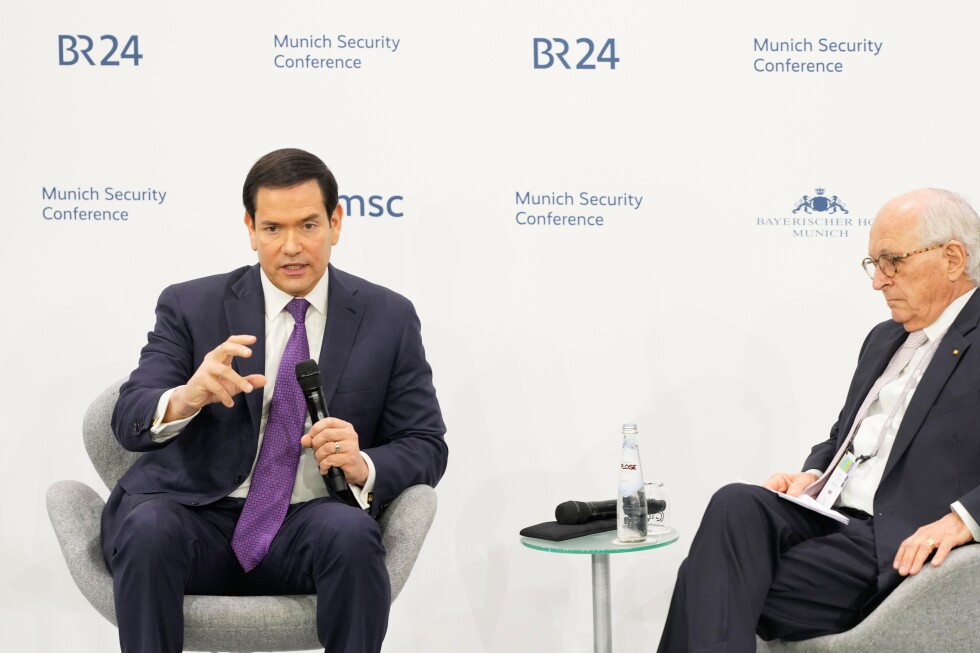
At the annual Munich Security Conference, U.S. Secretary of State Marco Rubio delivered a message aimed at reassuring America’s European allies. By striking a moderate yet resolute tone, he emphasized the administration’s commitment to reshaping the trans-Atlantic alliance, particularly after a turbulent year marked by President Donald Trump’s confrontational rhetoric against traditional partners.
Rubio reminded the audience of America’s deep historical ties to Europe, affirming that the U.S. will continue to stand united with its allies as it advocates for adjustments in international relationships and institutions that have underpinned the post-World War II order.
His address came a year after Vice President JD Vance shocked listeners with a critical assessment of European values. This was in the context of various statements and actions from the Trump administration, which included a brief threat to impose new tariffs on European nations regarding U.S. control over Greenland, a territory of NATO ally Denmark.
On Friday, German Chancellor Friedrich Merz initiated the conference by calling for the U.S. and Europe to “repair and revive trans-Atlantic trust together.” He argued that even the U.S. cannot navigate the complexities of today’s world alone, given that the previous global order has dissolved. However, he and other European leaders affirmed their commitment to founding principles such as free speech, climate policy, and free trade.
‘A child of Europe’
Rubio adopted a more calming tone than often associated with recent U.S. discourse, yet he firmly upheld the administration’s policies. He criticized “a climate cult” and an “unprecedented wave of mass migration” as threats to societal cohesion.
He suggested that the “euphoria” following the Western victory in the Cold War led to the misguided belief in a universal shift towards liberal democracy, where trade ties would trump national borders.
“We made these mistakes together and now together we owe it to our people to face those facts and to move forward to rebuild,” Rubio articulated.
He acknowledged that while America’s geographic home is in the Western hemisphere, it will forever remain a “child of Europe.” Rubio also highlighted the shared sacrifices made by U.S. and European forces in various conflicts, contrasting them with disparaging comments made previously by Trump regarding NATO contributions. He sought to reassure allies that America is committed to forging a prosperous future together.
U.S. officials accompanying Rubio noted that while his message aligned with Vance’s from the previous year, it was presented in a softer tone intended to resonate better with the audience, which had reacted negatively to past Trump statements.
Europeans reassured but not complacent
The president of the European Commission, Ursula von der Leyen, described Rubio’s speech as “very reassuring,” although she pointed out that some in the administration maintain a sharper tone on various matters.
In her address, she emphasized that Europe must strive for greater independence, particularly in defense, and asserted the need for digital sovereignty when addressing hate speech on social media platforms.
British Prime Minister Keir Starmer cautioned against complacency, emphasizing the necessity for the U.K. to strengthen ties with Europe. He advocated for investments aimed at transitioning from overdependence to interdependence in defense matters.
Estonian Defense Minister Hanno Pevkur remarked on Rubio’s statement regarding America as a “child of Europe,” calling it bold. He suggested that while the speech was necessary, it should not lead to complacency.
The conference also shed light on tensions beyond the trans-Atlantic alliance. Following Rubio’s speech, Chinese Foreign Minister Wang Yi conveyed Beijing’s contentment with Trump’s respect for President Xi Jinping but raised concerns about certain voices within the U.S. that remain wary of China’s rise.
“Some forces are still trying their best to suppress and contain China, attacking and slandering it by any means,” Wang asserted, cautioning against a return to a “Cold War mentality.”
___
Moulson reported from Berlin. Jamey Keaten in Geneva contributed to this report.
Key Takeaways
- Marco Rubio reassured European allies of America’s continued commitment during the Munich Security Conference.
- The speech contrasted with previous harsh critiques from the Trump administration.
- European leaders stressed the importance of independence and shared values.
- Members from both sides highlighted the importance of trans-Atlantic unity.
- Concerns about global tensions, including U.S.-China relations, emerged during discussions.
FAQ
What was the main message of Rubio’s speech?
Rubio aimed to reassure European allies of America’s commitment to the trans-Atlantic alliance while advocating for necessary changes in international relations.
How did European leaders react to Rubio’s address?
European leaders expressed reassurance but emphasized the need for independence in various areas, including defense and digital sovereignty.
What were some criticisms mentioned in the speech?
Rubio criticized a “climate cult” and mass migration as threats to societal cohesion, pointing out the complexities of today’s global landscape.