 “Imagine someone wanting to construct a tower. Won’t they first sit down and calculate the costs to ensure they have enough resources to complete the project? For if they lay the foundation but cannot finish it, everyone who sees it will mock them, saying, ‘This person started to build and could not complete it.’”
– Luke 14:28-30
Seize the Towers
The highlight of last month’s 2024 Grammys was the enchanting duet by Tracy Chapman and Luke Combs, as they performed Chapman’s iconic 1988 song “Fast Car.” Their collaboration resulted in a memorable musical moment.
This otherwise lackluster event was hosted at the luxurious Crypto.com Arena (formerly the Staples Center) in downtown Los Angeles, a rare hotspot that draws the city’s elite away from their upscale enclaves in Malibu Colony and Beverly Hills.
The view from the Star Plaza entrance of the arena offers a quintessential Los Angeles atmosphere, one that both delights and challenges the eye.
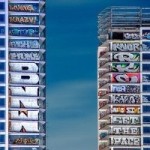
In the backdrop of statues honoring renowned LA athletes looms the Oceanwide Plaza, a trio of luxury towers that have remained unfinished since they were abandoned in 2019 due to financial struggles faced by the developer, Oceanwide Holdings.
Recently, talented graffiti artists have started tagging the vacant Oceanwide Plaza towers. Scaling the unfinished exteriors, they creatively spray-paint vibrant phrases in eye-catching designs. Some even base jumped off and paraglided down Flower Street.
A collective known as the People’s City Council of Los Angeles, an abolitionist, anti-capitalist, and anti-imperialist group advocating for the people’s voice, described the scene as:
“It perfectly illustrates Los Angeles – political corruption, real estate, ‘crime’ + LAPD, and the people expressing themselves through beautiful art. The graffiti is stunning. Seize the towers.”
Beauty, of course, is subjective. Opinions may vary on the artistic merit of the colorful graffiti now gracing the Oceanwide Plaza towers, yet the collective raises valid concerns.
Undoubtedly, the graffiti reflects the ongoing issues of political corruption and crime in LA.
Racketeering
Oceanwide Holdings, a real estate development firm based in China, has left city officials grappling with the aftermath. Now, public funds are being utilized to address the situation.
Recently, the LA City Council allocated an initial $1.1 million to regain control of the site. Efforts thus far have included the removal of abandoned construction scaffolding and the installation of new fencing to deter graffiti artists and intruders from accessing the property.
This situation arises in the district represented by City Councilman Kevin de León. According to de León, the $1.1 million allocation is intended to safeguard the city:
“Someone will eventually attempt to scale the buildings, and they could fall to their death. If that happens, the city will be held responsible.”
To his credit, Mr. de León is trying to clean up a mess created during the tenure of his predecessor, José Huizar, who represented the 14th District for 15 years but became embroiled in corruption.
In late January, Huizar received a sentence of 13 years in prison for corruption connected to at least $1.5 million in pay-for-play bribery linked to expedited real estate approvals. Recorded evidence even captured $200,000 in bribery cash hidden in a Johnny Walker Blue Label whiskey box along with another $200,000 in a Don Julio box.
This degree of corruption is unfortunately all too familiar in major cities around the world. And although it may seem disheartening, it’s just a glimpse into the pervasive corruption we endure.
While we cannot confirm if Huizar’s actions directly influenced Oceanwide Plaza, he was undoubtedly preoccupied with illicit dealings when the approval for this failed project was granted.
Hell On Earth
Adjacent to Oceanwide Plaza, within the 14th District, lies a half-square-mile area plagued by urban decay. Here, depravity, chaos, addiction, insanity, and even medieval diseases flourish like a malignant growth. Centered around the Union Rescue Mission at 545 South San Pedro Street, Skid Row houses approximately 10,000 individuals living in dire circumstances.
These residents endure massive encampments surrounded by trash, human waste, rats, and neglect. They navigate a treacherous landscape littered with concrete, glass, stones, and gravel, all while facing the threat of ancient diseases like typhus and flesh-eating bacteria.
Take the example of Reverend Andy Bales, former CEO of the Union Rescue Mission. He is a man driven by compassion and a strong commitment to helping those in need, stemming from his family’s history of homelessness.
After two decades leading the Union Rescue Mission, Rev. Bales retired in October 2023 and returned to Iowa. While this was a positive step for him, it came at a cost.
In the mid-2010s, while distributing water bottles to those he helped, Rev. Bales contracted three lethal bacteria: E. coli, strep, and staph. This lethal combination ravaged his body, forcing him to make an agonizing choice: his leg or his life.
He now moves around using a wheelchair, sometimes wearing a prosthetic leg. Despite these challenges, until his retirement, he dedicated himself to his mission with warmth and wisdom. According to Rev. Bales:
“Skid Row represents the most devastating man-made disaster in the United States. By far.”
If you want to witness true despair, take a walk down San Pedro Street through Skid Row on a weekday evening, when the Union Rescue Mission serves dinner. The sight of countless individuals pouring into the streets from their encampments is nothing short of haunting. ‘There but for the grace of God go I.’
Ghosts of the Alexandria Hotel
The 14th District is a truly bizarre and tumultuous area. Having worked in downtown LA for over two decades, we know it well.
Last year, this district experienced three significant commercial real estate defaults, with Brookfield Properties’ DTLA fund defaulting on approximately $1.1 billion in debt across three towers between February and May of 2023. The properties affected include the Gas Company Tower, the 777 Tower, and EY Plaza.
The causes of these defaults are typically straightforward. The twin pressures of increased vacancy rates following the pandemic and rising interest rates have transformed these once-profitable buildings into massive financial burdens.
Regrettably, such significant commercial real estate defaults are not isolated to LA’s 14th District. A recent report by real estate data firm ATTOM indicated a sharp increase in U.S. commercial foreclosures in January 2024.
ATTOM’s methodology is simple: each month, it counts the number of commercial properties facing at least one foreclosure filing. In January, this number reached 635, representing a 97 percent increase from the previous year and a 17 percent increase from December 2023. According to ATTOM:
“The 97 percent year-over-year jump indicates a reviving market that is managing the long-term economic shifts following a global event, adjusting with resilience to new commercial realities.”
Perhaps ATTOM is correct. Perhaps this surge in foreclosure filings signifies a market revival. But what will the timeline look like?
In the vicinity of the now-receivership-bound Gas Company Tower in LA’s 14th District sits the Alexandria Hotel. When it opened its doors in 1906, it was the pinnacle of elegance in Los Angeles, with distinguished visitors including President Teddy Roosevelt, King Edward VIII, and innumerable Hollywood stars from the early film era.
However, the Alexandria Hotel declared bankruptcy and closed in 1932, and it has struggled to regain its footing since.
After numerous ownership changes and closures, the once-opulent property devolved into single-room occupancy housing during the 1990s, frequented by those engaged in extreme risk-taking behavior.
Despite ongoing revitalization efforts, including recent conversions into apartments, the Alexandria Hotel remains a blend of market-rate and subsidized housing.
It is possible that Oceanwide Plaza and other failing commercial properties across the country may eventually recover. Perhaps this will occur without triggering a major banking crisis.
Yet, if the ghosts of the Alexandria Hotel have any influence, these failed properties might burden local municipalities for decades, if not longer.
[Editor’s note: The best advice during a recession? Put your fears aside and do the OPPOSITE of what your friends and neighbors are doing. >> Here’s why and how.]
Sincerely,
MN Gordon
for Economic Prism
Return from Ghosts of the Alexandria Hotel to Economic Prism