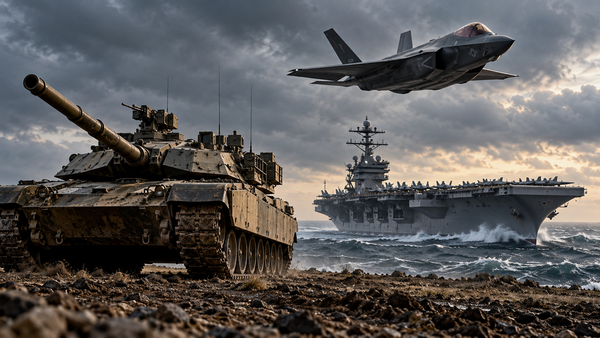
The recent increase in US military assets near Iran can be interpreted in various ways. One possibility is that it serves as a show of force, demonstrating heightened tensions in the region. However, there are signs that both the US and Israel may be miscalculating Iran’s resilience, similar to King Croesus’ fateful misinterpretation of the Oracle of Delphi. They seem to believe that Iran is more vulnerable than it actually is, operating under the assumption that another significant assault could destabilize the Iranian government. This line of thinking echoes the Collectively Western underestimation of Russia’s endurance, as there also appears to be a gross misjudgment regarding Iran’s capacity to inflict substantial damage on both the US and Israel, as well as its influence on the global economy.
The determination of the US and Israel to subdue Iran suggests they believe they possess a decisive advantage. Historically, however, their past attempts to implement strategies designed to cripple Iran have fallen short. During the 12 Day War, for example, Israel aimed to disable Iran’s air defenses and eliminate key leaders, but the impact was far less significant than anticipated, lasting only 8 hours rather than the expected 2-3 days. Iran quickly restored its operational capabilities, and no Iranian faction supported the destabilization efforts. Similarly, during recent protests that escalated following US and Israeli provocation, Iran regained control swiftly, notably by disrupting communication channels like Starlink, effectively quelling the unrest.
Benjamin Netanyahu is scheduled to fly to the US tomorrow for a meeting on Wednesday. Some speculate that this visit is intended to solidify demands that are unmanageable for Iran, which include:
🚨JUST IN: Netanyahu allegedly demands the following from Trump on Iran:
– Full cancellation of nuclear program
– Zero enrichment capabilities
– Removal of all enriched uranium
– A limit of 300km range for missiles
– Dismantling of their entire proxy network.
– Full long… https://t.co/KoFvvtiktU pic.twitter.com/okiCTokcqG— Mario Nawfal (@MarioNawfal) February 7, 2026
Alternatively, it is possible this is a strategic bluff, with the potential for a US attack coinciding with Netanyahu’s visit. Iran has explicitly stated that it will respond decisively if attacked again, regardless of how the US tries to frame the strike as merely symbolic.
Eventually Tehran’s response plan in case of
American-Israeli attack:1. Massive missile and drone strikes on American bases in the Middle East within hours of the attack.
2. Concurrent cyber attacks on all accessible targets.
3. The Iranian fleet, utilizing a… pic.twitter.com/R0Bm4vHQYO— Sprinter Press (@SprinterPress) February 7, 2026
During an interview with Danny Haipong, Justin Podhur emphasized that Iran should not be viewed as having “proxies.” Instead, allies like Ansar Allah, Hezbollah, and Shia militias in Iraq have asserted that they would retaliate should the US attack Iran. In the past, even when neighboring countries have launched missiles toward Iran, it has primarily targeted Israel in response. Iran has made it clear that any nation involved in an attack against it will face repercussions; it could inflict catastrophic damage on Saudi Arabia by targeting its oil fields.
Moreover, Alastair Crooke has indicated that a US attack might prompt the Supreme Leader of Iran to issue a fatwa, potentially igniting uprisings among the Shia populations across the region, including a significant 13% within Saudi Arabia itself. Crooke suggests that subsequent unrest could far exceed the Arab Spring in intensity.
Previously, we elaborated in detail how the then-present US forces in the area were insufficient to effectively execute regime change or achieve Israel’s goal of destabilizing Iran, even before considering Iran’s potential response, such as closing the Strait of Hormuz while conducting bombings against Israel and US bases. Independent analysts have expressed skepticism about the US’s ability to make any significant impact, even with recent military reinforcement. Both Larry Johnson and former Royal Navy Commodore Steve Jermy have argued that the most the US could manage would be a brief, high-intensity campaign lasting around 5 days, or up to two weeks at a lower intensity. Recent assessments suggest that the operational capacity from US airbases remains similarly limited. A significant constraint is the inability to deploy B-52 bombers without facing significant risks; recall that after allowing B-52s to target nuclear sites at the end of the 12 Day War, Iran has since declared it will not permit such actions again.
In what can be seen as a sign of weakness, the US has once more requested that Iran engage in superficial retaliatory strikes, which Iran suitably rejected.
Israeli Channel 15 cited sources stating that:
The Americans have asked the Iranians to create a plan outlining the concessions they would be willing to make as part of the negotiations. pic.twitter.com/0wimccVR8w
— Sprinter Press (@SprinterPress) February 8, 2026
Yet, oddly, the Israelis appear unusually self-assured. Based on insights shared from a business contact in Israel:
On how Israelis feel about the impending war:
A sample of about 12 Israelis reveals that the prevailing sentiment is not only that the conflict is inevitable but that Israel will secure a decade of stability through their planned actions. Most are not supporters of Netanyahu’s government and do not come from settler communities; they are local Israelis with families in the country. Notably, only one has moved children abroad—prior to the 12 Days. With the possibility of strikes starting soon, many are extending their plans should strikes begin before this past weekend.
It seems to me that we are less than two weeks away from the conflict resuming, possibly kicking off around February 20, but it could happen even as soon as Friday the 13th.
Is it conceivable that the Israelis believe that if the US launches a forceful attack, it could bring Iran to its knees by destroying critical infrastructure such as water systems and the power grid? Recent reports highlighted that Israel’s defense minister instructed the military to prepare a strike package in late January.
Notably, key Iranian figures also doubt that the US is merely posturing:
Iranian TV host:
“In my opinion, the deployment of American forces is an attempt to pressure for an agreement and to intimidate.”
Arab expert on air:
“No, Mr. Host. The United States will definitely launch an attack.”
I know and have information that such a large-scale deployment… pic.twitter.com/w2wBL1zSwj— Sprinter Press (@SprinterPress) February 8, 2026
The US continues to reinforce its military presence in the region:
🇺🇸🇮🇷 The US has finalized the deployment of Patriot and THAAD missile defense systems across 20 bases in the Middle East — Channel 14
Key locations in the region:
🇯🇴 Jordan,
🇰🇼 Kuwait,
🇧🇭 Bahrain,
🇸🇦 Saudi Arabia,
🇶🇦 Qatar,
🇦🇪 United Arab Emirates,
🇮🇶 Iraq,
🇮🇱 Israel pic.twitter.com/pDARk2P8wA— Lord Bebo (@MyLordBebo) February 8, 2026
Meanwhile, Daniel Davis, who typically maintains a balanced perspective, expressed significant concern about the trajectory of events:
All of this indicates that the two sides are vastly different in their objectives, leading to the question of whether ongoing negotiations serve any purpose beyond buying time for military preparations.
Recent developments reinforce this notion. For instance, in just the past 48 hours, there has been a sustained buildup, with a total of 112 US Air Force C-17s either arriving or en route to the Middle East, along with additional Royal Air Force logistics flights from RAF Marham to Cyprus. Such movements highlight a significant increase in military capacity in the region.
Additionally, the US has finalized deploying Patriot and THAAD missile defense systems across 20 bases, emphasizing a serious consideration of air defense capabilities. This implies a belief that an offensive may come, as moving such massive defense systems would generally only happen if expecting significant missile threats. Past experiences demonstrate that while some strikes may be intercepted, Iran’s offensive capabilities have consistently proven effective.
Similarly, at the conclusion of his Sunday commentary, Alexander Mercouris conveyed urgent concerns regarding US intentions:
I have recently received a growing number of concerning reports from reliable sources regarding the escalating tension between the US and Iran. These individuals, among them well-informed commentators who have appeared on various programs, express grave worries about the current circumstances.
As per recent discussions, the Iranians maintain their right to conduct enrichment, particularly on their own soil, and are unwilling to bargain on ballistic missiles. The US’s apparent expectation of more significant concessions from Iran, however, remains unmet and leads to increasing frustration within Washington, which now appears to be leaning toward military action.
Additionally, any dialogue between US officials and Iranian representatives has yielded little more than an unyielding stance from Tehran. The Iranian leadership has signaled its ongoing preparations for possible military confrontation, which now seems imminent.
An aside worth noting: Scott Bessent has made some brash statements regarding the US’s role in crashing the Iranian rial. Such comments reveal a reckless disregard for the humanitarian implications of US actions, demonstrating how the US would inflict hardship on ordinary citizens to advance political objectives. This perspective inadvertently supports the Iranian narrative that its economic challenges largely stem from external, rather than internal, factors.
Independent analysts have pointed out that efforts to destabilize Iran could also endanger regional powers like Russia and China. Although there is a strategic distance between Russia and Iran, their interests are intertwined, especially as Iran is geographically located in a sensitive area. Russia had previously warned the US about the ramifications of a potential war against Iran, though it seems those alarms went unacknowledged.
Despite increasing support from Russia and China for Iranian defenses, the effectiveness of these efforts remains uncertain. After the 12 Day War, Iran sought to boost its defense independence but accepted Russia’s offer to establish integrated air defenses—a project projected to take more than two years. Notably, while reports suggest recent deliveries of equipment like S-400 systems, the training of Iranian personnel also plays a crucial role in their effectiveness.
Moreover, reports indicate growing military cooperation between Russia and Iran, including arms deliveries. Yet, questions linger regarding the speed and efficiency of implementing these new capabilities.
🇷🇺🇮🇷 Iranian Media:
Russia Supplies Iran with “Iskander” Missiles Capable of Carrying Nuclear Warheads pic.twitter.com/XG4ykXAhFK
— Global Insight Journal (@GlobalIJournal) January 6, 2026
🇮🇷 🇷🇺 OSINT image from #Iran has confirmed the delivery of the first Mi-28NE ‘Night Hunter’ attack helicopter to the country, marking the first time #Russia has delivered one of the most capable combat aircraft of any type to its southern neighbor. https://t.co/rj0pSNbIBb pic.twitter.com/Urs9Tankyt
— Francesco Salesio Schiavi (@frencio_schiavi) January 29, 2026
From various sources, it appears Iran might be receiving advanced military assets, although the extent and effectiveness of these additions remain to be seen.
🚨BREAKING: 🇨🇳 Beijing says it has supplied strategic radar systems to🇮🇷Iran for the first time, the YLC-8B Anti-Stealth Radar, designed to detect🇺🇸B-2 Bombers. pic.twitter.com/OrQE8jXSHz
— PLA Military Updates (@PLA_MilitaryUpd) February 4, 2026
Furthermore, reports suggest that Iran has shifted from relying on US GPS systems to utilizing China’s BeiDou system, enhancing its military operations while simultaneously jamming US signals.
🌀 Middle East: Iran abandoned US GPS in favor of Chinese BeiDou system. Iran no longer depends on US-controlled GPS:
Tehran has completely flipped over to BeiDou, the Chinese satellite navigation system.
This change significantly strengthens its military capabilities: the GPS… pic.twitter.com/opMfLbBhno
— Sahel Revolutionary Soldier (@cecild84) February 3, 2026
In summary, the current rigidity of US and Israeli goals, combined with potentially flawed intelligence, may soon encounter a stark reality check. The emotional responses being reported suggest a lack of rationality, reminiscent of past geopolitical miscalculations. Whereas there seemed to be an eagerness for conflict during previous engagements, it appears that a rapid escalation might be on the horizon this time.
_____
1 Jordan is so closely aligned with the US that it would almost certainly support a US operation.
2 Asian Boss has provided useful context on Iran’s recent economic struggles, though some argue it downplays the significant impact of US sanctions on Iran’s economy.
3 Although some reports suggest previous deliveries of S-400 systems to Iran, operational effectiveness is contingent on adequate training of Iranian personnel.