As tensions with Iran escalate, U.S. forces stationed at Al-Udeid, the largest American base in the Middle East, have taken precautionary measures. Recent satellite imagery indicates that missiles have been loaded onto truck launchers, allowing for swifter deployment if necessary.
Storing Patriot missiles in mobile trucks, rather than static launch sites, demonstrates a strategic response to increasing risks amid growing tensions. This mobility enables U.S. forces to react more rapidly, whether to launch a strike or reposition defensively in response to potential Iranian threats.
President Donald Trump has warned of military action against Iran due to its nuclear ambitions and support for groups in the region, while ongoing discussions aim to prevent a conflict.
Additionally, the United States maintains several bases in Iraq, Jordan, Kuwait, Saudi Arabia, Qatar, Bahrain, the United Arab Emirates, Oman, Turkey, and on Diego Garcia in the Indian Ocean.
Iran’s Revolutionary Guards have issued warnings that any strikes on Iranian soil would prompt retaliation against U.S. bases in the region.
An analysis of satellite photographs from early February, compared to those taken in January, reveals a notable increase in aircraft and military equipment throughout the region, according to forensic imagery analyst William Goodhind from Contested Ground.

At Al-Udeid, the visibility of Patriot missiles mounted in M983 Heavy Expanded Mobility Tactical Trucks (HEMTT) was noted at the beginning of February, according to Goodhind.
“This decision significantly enhances mobility, allowing for quicker repositioning or relocation to alternative sites,” he explained.
It remains unclear as of Tuesday if the missiles are still housed within the HEMTTs.
A spokesperson for the Pentagon was not available for immediate comment.
Iran has stated that it has replenished its missile stockpile following a conflict last summer when Israel targeted its nuclear facilities, a campaign which the United States later joined.
Iran possesses several underground missile complexes located near Tehran, Kermanshah, Semnan, and along the Gulf coast.
The Iranian naval drone carrier IRIS Shahid Bagheri was captured in satellite images on January 27, positioned approximately 5 kilometers from Bandar Abbas, with further sightings near that location on February 10.

Changes Observed at U.S. Middle East Bases via Satellite Imagery
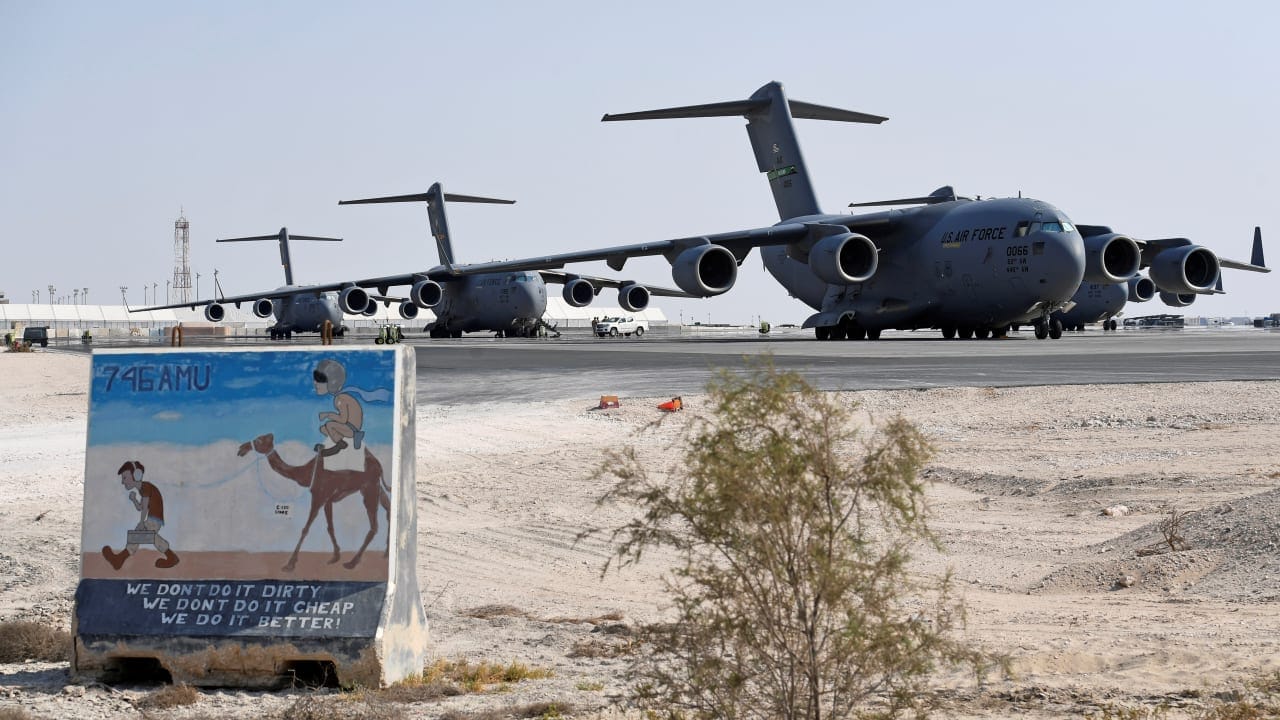
Satellite images from February 1 revealed the presence of an RC-135 reconnaissance aircraft, three C-130 Hercules aircraft, 18 KC-135 Stratotankers, and seven C-17s at Al-Udeid Air Base in Qatar. In comparison, on January 17, only 14 Stratotankers and two C-17s were noted.
Approximately ten MIM-104 Patriot air defense systems were seen parked in HEMTTs.
February 2 images of a site in Muwaffaq, Jordan, depicted 17 F15-E strike aircraft, eight A-10 Thunderbolt aircraft, four C-130s, and four unidentified helicopters. Earlier images from January 16 had lower resolution and did not allow for precise identifications of the aircraft.
Additional images from February 2 at a different location in Muwaffaq showed a C-17 and a C-130, alongside four EA-18G Growler electronic warfare aircraft. Previous photographs from January 25 did not show any aircraft at this location.
At Prince Sultan Base in Saudi Arabia, images captured on February 2 revealed a C-5 Galaxy and a C-17 aircraft, whereas images from December 6 indicated the presence of five aircraft believed to be C-130s.
Satellite images from February 6 indicated an increase of seven aircraft compared to what was observed on January 31 at Diego Garcia in the Indian Ocean.
Images captured on January 25 and February 10 illustrated a notable rise in aircraft at Dukhan Base in Oman.
Key Takeaways
- U.S. military forces have increased readiness at bases in the Middle East due to rising tensions with Iran.
- Patriot missiles are currently deployed on mobile truck launchers for quicker response capabilities.
- Ongoing discussions aim to de-escalate potential conflict while military assets are visibly increasing in the region.
- Iran has stated it would retaliate against U.S. bases if attacked.
- Recent satellite images indicate a significant uptick in the presence of military aircraft across U.S. bases in the area.
FAQ
Why are U.S. forces increasing their military presence in the Middle East?
Heightened tensions with Iran have prompted the U.S. to bolster its military capabilities in the region.
What type of missile systems are being deployed?
The U.S. is utilizing Patriot missile systems, which are mounted on mobile trucks for improved maneuverability.
What has Iran stated regarding potential military strikes on its territory?
Iran has warned that it would respond to any strikes on its territory with retaliation against U.S. bases.
How has the presence of military aircraft changed at U.S. bases?
Satellite imagery shows a notable increase in the number of military aircraft across various U.S. bases in the Middle East.
What efforts are being made to prevent conflict?
Ongoing discussions and diplomatic efforts are aimed at de-escalating tensions and avoiding a potential war.
The growing military readiness indicates a significant shift in U.S. strategy in the region. Continued monitoring of the situation is crucial as diplomacy attempts to mitigate the risks of conflict with Iran.