For many years, Mahnoor Omer refrained from discussing menstruation openly.
Each time the subject came up, her friends in Islamabad, the capital of Pakistan, would flush with embarrassment, Omer reflected.
“This happened so many times. A classmate of mine would get her period during class,” she recounted. “Her white kameez had a large red stain on the back. She panicked, completely unaware of what was happening.”
Now, at 25 years old, Omer and her colleague, 29-year-old Ahsan Jehangir Khan, are determined to dismantle this stigma. They are pursuing a significant legal case aimed at urging the government to eliminate the tax on menstrual products and classify them as essential goods rather than luxury items.
Many medical professionals and women’s rights advocates who support the case commented that the lingering social taboos surrounding sexual health in Pakistan have resulted in tax policies that hinder significant portions of the population from affording these crucial sanitary products, aggravating gender disparities in education, health, and social welfare.
“What we’ve initiated here is more than a legal case; it’s a movement to bring period poverty to light,” Omer stated.
As the petitioner in the case, Omer, along with Khan, hopes to replicate the successes seen in other regions, where governments have either reduced taxes on menstrual products or eliminated them entirely, as has been accomplished in India and Nepal.
This regional wave of legislative change has “empowered” them, Khan observed, noting: “In the Global South, there are conversations happening around this issue. We need to take the lead ourselves.”
CNN has reached out to Pakistan’s health ministry for comments regarding the case.
Bushra Mahnoor, a reproductive rights activist, belongs to a small group of women and girls in Pakistan—approximately 12%, as reported by the UNICEF—who access commercial sanitary products instead of homemade alternatives.
However, menstrual products were considered a “luxury” in her household. She often had to improvise by layering her pads with cotton or using cleaning rags to extend their use beyond the medically recommended limit.
“Periods were a source of trauma throughout my childhood,” the 22-year-old from Attock, a small town in northern Punjab province, shared with CNN. She began menstruating at 10, a period she described as “very isolating.”

Lawyers argue that by imposing taxes on menstrual products, the Pakistani government has systematically failed to uphold women’s and girls’ rights to health and education—hampering their full engagement in public life and violating Article 25 of the Constitution, which prohibits discrimination based on sex.
The Sales Tax Act of 1990 imposed an 18% sales tax on domestically produced sanitary pads and a 25% customs tax on imported menstrual products, as outlined in the legal petition submitted by Omer and Khan in October.
This additional charge, combined with other local taxes, results in women in Pakistan facing a 40% surcharge on menstruation products, which, according to UNICEF, has made them inaccessible for the most vulnerable.
As of mid-2025, nearly 45% of the population lived below the World Bank’s global lower middle-income poverty line of $4.20 (approximately 1,175 Pakistani rupees) per day, as reported last year.
The cost of essential goods severely strains limited household budgets, with consumers spending around 363 Pakistani rupees for a dozen eggs or 2,186 Pakistani rupees for a kilogram of wheat flour, according to data from CEIC Data based on figures from the Pakistan Bureau of Statistics for 2025.
In contrast, a pack of ten commercial sanitary pads ranges from 400 to 485 Pakistani rupees—equivalent to $1.43 to $1.73—and may not provide enough supply for one woman or girl for an entire month.

The failure to enforce laws meant to protect women and girls is compounded by the existing taboos surrounding menstruation, Omer explained, which restrict public discourse on the subject.
Following a hearing in Islamabad at the end of November, a court directed the government to provide a “timely response” to the lawyers’ arguments in order for the case to proceed, Omer reported.
In the meantime, Omer hopes that the government will take her case seriously. “With a tax like this, every day the burden of injustice is felt by half the population,” she informed CNN last week.
After beginning her menstruation, Mahnoor expressed feeling like a stranger in her own body, an experience many girls in Pakistan face, according to a health worker, who noted a lack of educational materials addressing the changes that accompany puberty.
“When girls get their periods, they think they are suffering from an illness,” explained Dr. Azra Ahsan, a gynecologist in Karachi. “They believe they are dying until they speak to someone about it.”
In a society where men primarily serve as breadwinners and oversee household finances, and where menstrual products remain unaffordable for many, women’s healthcare needs are often overlooked, Ahsan noted.

Efforts to provide sexual health education face significant backlash, Dr. Ahsan noted.
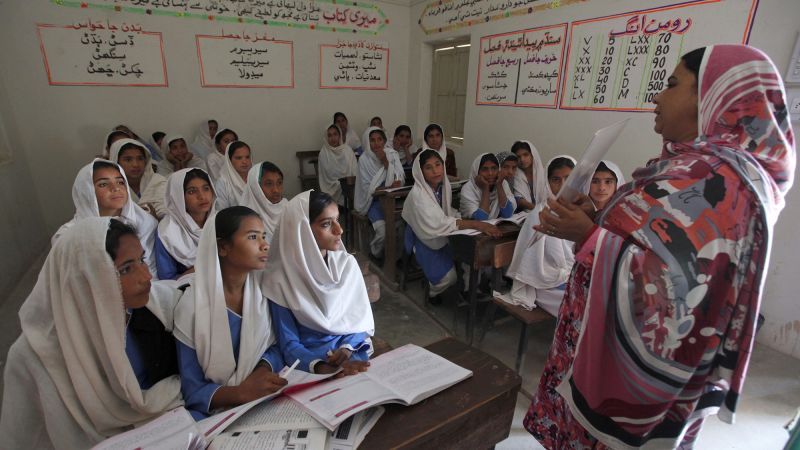
The lack of knowledge spans across various income and education levels, Ahsan indicated, allowing misinformation to thrive. Limited access to toilets, running water, or menstrual supplies in public settings forces many girls and women to withdraw from public life. UNICEF reported that one in five girls in Pakistan misses school during their menstrual period, leading to a significant loss of educational opportunities.
Some students avoid attending class if they experience a stain on their clothing due to lack of access to sanitary pads, Mahnoor explained. In her own experience, her teacher bypassed sections in the textbook discussing periods, implying that “you’re not allowed to know about your own body.”

On one occasion, Mahnoor recounted another female teacher sending a student home because her period had begun. The student was instructed to stand at the back of the class until her parents arrived to take her home. “She had to take notes and participate in class while standing just because she was bleeding,” Mahnoor remarked. “It was incredibly harsh.”
The school had no sanitary items available to offer to the girl, Mahnoor explained. “If she sat down, a stain could appear on her clothes, which would be even more shameful.”
The difficulties surrounding menstruation extend beyond the school environment. Employers often do not allow bathroom breaks, meaning some women, particularly those in garment factories, lack the time to change their sanitary pads, Mahnoor added.
Over the last few years, seasonal flash floods, intensified by climate change, have trapped women in Pakistan in a harsh cycle of period poverty, Omer noted.
For individuals navigating their period in flood relief camps, the situation can be “painful,” Mahnoor remarked, highlighting her role in co-founding the non-profit Mahwari Justice in 2022, which works to distribute sanitary products in flood-affected areas.
Women have limited options and sometimes have to wash their rags in floodwater, as Mahnoor reported, noting that without sunlight, they may struggle to dry them. Some even resort to using their headscarves as makeshift pads. Others opt for “free bleeding” or attempt to enhance absorbency using mud and sand, which raises the risk of skin infection and urinary tract issues.

If a girl or woman needs to find privacy for relief, she may also encounter risks from individuals with malicious intent, Mahnoor noted.
Beyond physical health concerns, doctors and lawyers assert that the social stigma surrounding menstruation severely affects women’s mental health and self-image. Some religious communities prohibit women from sharing common living spaces during their menstrual period, Ahsan pointed out.
Consequently, women, particularly girls, may feel they are being “punished for bleeding,” Mahnoor expressed, emphasizing the complicity of men who choose to remain silent on the matter.

As the case progresses, Omer mentioned they have been “pleasantly surprised” by the “encouraging” reactions from a wide range of the public, including national media.
The two lawyers aim to initiate conversations about reproductive rights, puberty, and sexual health within Pakistani society, especially targeting those in their teens and twenties. “It’s time to move beyond mere protests and actually confront what we can achieve through legal reform, advocacy, and effective lobbying,” Omer suggested.
“With younger generations entering the dialogue, people are beginning to speak out more on topics that were once considered taboo,” she added. “They are becoming increasingly vocal.”
Key Takeaways
- Mahnoor Omer and Ahsan Jehangir Khan are challenging the taxation of menstrual products in Pakistan through a legal case.
- The case aims to categorize menstruation products as essential goods and eliminate the associated taxes.
- Social taboos surrounding menstruation hinder access to sanitary products, exacerbating educational and health disparities for women and girls.
- A significant portion of girls in Pakistan miss school due to menstruation-related issues, impacting their education.
- Climate change-induced floods worsen the situation, pushing women into a cycle of period poverty.
- There is growing public discourse around reproductive rights, driven by initiatives like Omer and Khan’s legal challenge.
FAQ
What is the legal case about?
The case calls for the Pakistani government to eliminate taxes on menstrual products and classify them as essential goods rather than luxury items.
Why is menstrual health a significant issue in Pakistan?
Stigmas surrounding menstruation contribute to lack of education and accessibility to sanitary products, leading to broader social and health disparities.
How do climate change effects play a role in period poverty?
Seasonal floods have restricted access to essential sanitary products, trapping many women in a cycle of poverty and health risks.
What actions are being taken to address menstrual health issues?
Activists like Omer and Khan are raising awareness and advocating for legal reform to improve access to menstrual health products.
In summary, Mahnoor Omer and Ahsan Jehangir Khan’s advocacy highlights the multifaceted challenges surrounding menstruation in Pakistan. Through their legal action, they aim to dismantle long-standing stigmas and improve access to essential sanitary products. Their efforts signal a growing movement for reproductive rights that may lead to significant societal change.