Recent geopolitical shifts have placed Georgia under increased scrutiny as tensions rise between the U.S. and its traditional allies. The U.S. Helsinki Commission recently convened a hearing titled “From Partner to Problem: Georgia’s Anti-American Turn,” highlighting concerns regarding the country’s alignment.
The hearing featured Salome Zourabichvili, the controversial Georgian “President,” who is currently a 2025 Kissinger Fellow at the D.C.-based McCain Institute. Despite her ousting, she claims to represent the legitimate leadership, having attempted a color revolution following the elections in Georgia last year.
At present, Georgia is governed by the Georgian Dream party, which was once aligned with Western interests but has since sought closer ties with neighboring superpowers. This shift included the introduction of a foreign agents law last spring, mandating that non-governmental organizations (NGOs) and media that rely on over 20% international funding register with the government. The European Union recently issued a deadline of August 31 for Georgia to amend this law or risk losing visa-free travel benefits. In response, Georgian Dream froze the bank accounts of several prominent pro-EU NGOs. Although the government appears unfazed by external pressures, public discontent continues to brew:
“Protect visa free” – large crowds marched today in Tbilisi as Georgian Dream’s anti-democratic policies threaten losing visa-free travel that Georgians have enjoyed with EU since 2017. Day 290 of #GeorgiaProtests
🎥 Nini Gabritchidze/Civil.ge pic.twitter.com/beZXcQXso3— Civil.ge (@CivilGe) September 13, 2025
Despite its aspirations for balanced relationships with both East and West, the Georgian Dream party now finds itself on the unfavorable radar of Washington, which adheres to a binary of loyalty. The Helsinki Commission conveyed this sentiment emphatically in the hearing’s rationale, stating:
Georgia was once a core U.S. partner and a beacon of freedom in the Caucasus. Today, the ruling Georgian Dream party is dragging the country back into Russia’s orbit and deepening their relationship with China and other U.S. adversaries. Over the past few years, Georgian Dream has crippled Georgia’s institutions and further undermined Georgia’s sovereignty by courting Chinese investment while blocking U.S. businesses from Middle Corridor trade and access to Central Asian rare earth minerals…This hearing will examine the global consequences of Georgia’s slide into authoritarianism. Witnesses will also explore U.S. policy options.
The distinction between freedom and obedience to U.S. interests is crucial here; the reality is that Georgian Dream won elections that are not recognized by the West. While the party leans neoliberal and supports Zionism, it aims to reclaim autonomy by limiting foreign NGOs that, since the 1990s, have filled governance gaps left by the state’s capacity. Furthermore, the government expresses reluctance to provoke conflict with Russia, claiming NATO has pressured Georgia to open a “second front.”
Returning to the Helsinki hearings, the focus remained on potential U.S. policy responses. Witnesses presented a familiar suggestion: sanctions.
Specifically, they advocated for the Mobilizing and Enhancing Georgia’s Options for Building Accountability, Resilience, and Independence (MEGOBARI) Act, which mandates U.S. President Donald Trump to enhance sanctions targeting “certain foreign persons, including Georgian government officials, who undermine Georgia’s security or stability.”
In simpler terms:
This bill is a declaration of war against Georgia. https://t.co/7WeT6OkObd
— Sopo Japaridze (@sopjap) May 25, 2024
The MEGOBARI Act passed the House by a 349-42 vote in May but faces delays in the Senate due to the steadfast objections of Markwayne Mullin from Oklahoma, a former critic of Georgian government actions concerning Frontera Resources, a U.S. oil and gas company.
However, as Frontera’s relationship with Georgia improves, Mullin’s opposition has lessened, and he has sought to exclude the MEGOBARI Act from broader legislative discussions. Mullin explained to The Hill:
“It doesn’t make any difference what company it is…If we’re going to have investments there, they need to ensure that U.S. investments are protected and that there is confidence in the sustainability of their projects without fears of takeover.”
While Mullin’s motivations may stem from his alliance with Frontera, he raises pertinent questions about the efficacy of sanctions, which could unwittingly drive Georgia closer to Russia and China. As Western investments diminish, China is quickly filling the gap.
Advocates for sanctions argue they might exacerbate internal divisions and create opportunities for further destabilization. Georgia has already witnessed ↑violence between supporters of Georgian Dream and anti-government protestors, with ongoing demonstrations lasting nearly a year and claims of more serious confrontations brewing.
Exploring Alternative Avenues
Interestingly, the Helsinki hearings did not cover more “subtle” strategies that may be currently in motion, potentially involving covert operations linked to Washington’s ongoing initiatives in Ukraine. This support mechanism has aided entrenched destabilizing forces in Syria, Africa, and beyond, with signs indicating similar activities could emerge in Georgia.
Last year, Tbilisi cracked down on returning members of the Georgian Legion—anti-Russian mercenaries fighting in Ukraine—accusing them of plotting against the government in Tbilisi.
However, the government faces significant challenges. Recent investigations into explosives smuggled into Georgia led to the arrest of two Ukrainian citizens on charges of illegally acquiring, storing, and transporting explosives. The Georgian state security services discovered 2.4 kilograms of Hexogen hidden in their vehicle. Investigators surmise that the explosives were supplied by employees of the Security Service of Ukraine, with the intended destination being Tbilisi—an alarming thought considering the proximity to the October 4 local elections and the resurgence of daily protests.
The Geopolitical Significance of Georgia
Tina Khidasheli, Georgia’s former defense minister (2015–16), articulated key reasons for Georgia’s importance at the Helsinki hearings:
Georgia matters to the US, to Europe and to the international community for three main reasons:
-
its geographic position
-
its strategic connectivity
-
its example of democracy
While the latter reason may be debatable, the first two are indisputable. Khidasheli emphasized:
Georgia lies at the heart of the Middle Corridor – the modern Silk Road linking East and West, North and South, bypassing Russia and Iran. We are a small country, but our greatest advantage is that we are a gateway and a bridge, connecting the markets of Central Asia and Europe through pipelines, railways and ports. This is not just a trade route – it is a corridor of freedom, enabling the movement of goods, energy, data, and people free from the typical political pressures or blackmail from the north or Iranian influence from the south. The Middle Corridor is not an alternative – it is the only viable path. It is both practical and politically sound for the United States and its allies…Without Georgia, the Freedom Corridor cannot exist – the route will be closed, and the door will open to Russia, Iran, and China.”
Khidasheli’s view reflects a perspective that depends largely on the true intentions of the U.S. in the Caucasus. Do they genuinely aim to construct and manage logistical corridors, or do they hope to dislodge Russia, China, and Iran from their established power in the region?
This stance diverges significantly from those expressed by other opposition figures in Georgia, who argued that Georgia would become less relevant to Western interests following the announcement of the Trump Route for International Peace and Prosperity (TRIPP). They contend that Georgia’s significance is diminished as it now aligns with a corridor linking Azerbaijan and Turkey—possibly extending beyond through Armenia. However, this is not the full picture.
Although Washington could be amplifying its influence in the Southern Caucasus with TRIPP, the geographic and economic realities remain unchanged.
Russia continues to wield considerable economic and military clout in the region, while Iran closely follows. China’s escalating dominance in global supply chains renders it indispensable and indeed interested in fostering projects like the Black Sea port in Georgia, which has raised concerns in Western circles.
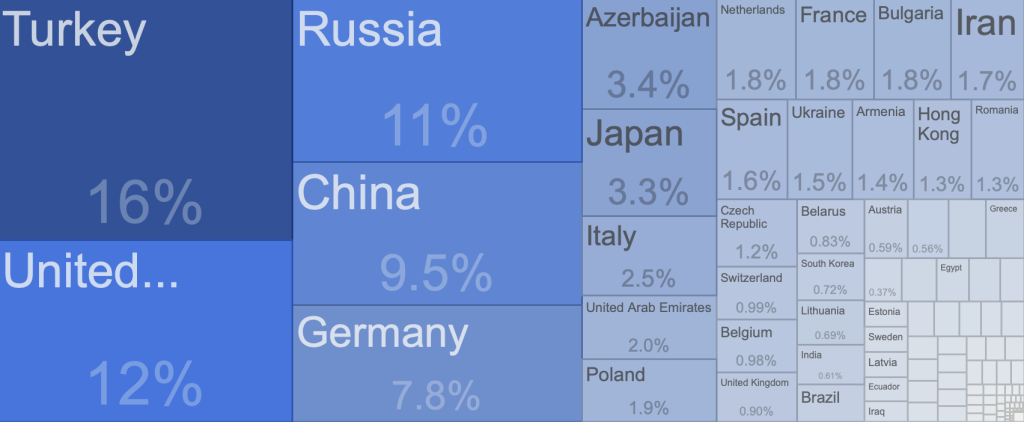
Georgia’s trade relationships with Russia, China, and nearby partners significantly overshadow ties with the EU and the U.S. The following details illustrate this disparity in imports:

Source: Trading Economics
And exports:

Source: Trading Economics
In parallel, the ongoing war in Ukraine has positioned Georgia as an increasingly attractive transit nation. China is boosting its investments in Georgia as it seeks to enhance trade route options should disturbances arise elsewhere.
It seems unlikely that Washington genuinely believes it can provide a more appealing alternative for Caucasus populations. The tide of sentiment has shifted, leaving destabilization as a more probable goal—igniting tensions in rival territories and hoping for collateral damage.
As observed in a recent piece, TRIPP serves to escalate tensions in the South Caucasus, yet its impact diminishes in the context of a sovereign and stable Georgia, which could bypass TRIPP entirely. Thus, the current scenario in Georgia indicates a broader strategy is at play in the northern segment of the region.


