Highlights
- Organizations that implemented AI-enabled governance platforms achieved a net present value of $8.8M and a 199% ROI within three years, significantly enhancing both strategic and operational performance.
- Companies utilizing integrated AI workflows report saving 20 hours per employee each month and have reduced fraudulent activities by as much as 95%.
- 80% of executives believe that collaborative governance and compliance across teams is essential for meeting strategic goals.
While your competitors deliberate on AI adoption, the enterprises interviewed in a recent study have already attained $8.8 million in net present value over three years through Thomson Reuters’ ONESOURCE+ governance and compliance solutions. The opportunity for gaining a competitive edge is shrinking. The Total Economic Impact™ study (TEI), commissioned by Thomson Reuters and conducted by Forrester Consulting, reveals that companies that utilize AI-driven collaborative platforms have undergone transformative operational changes. The composite organization derived from the interviewed customers has witnessed a fraud reduction of up to 95% and a 199% return on investment over three years.
Jump to ↓
The shift from traditional controls to strategic enablement
The collaboration-agility connection: Proven results
The executive framework for implementation
The evidence points in one direction
The shift from traditional controls to strategic enablement
Today’s executives are confronted with a pressing challenge: the need to maintain competitive agility while complying with stringent regulatory standards across diverse jurisdictions. Traditional governance practices often rely on isolated departments employing manual processes, leading to inefficiencies and delays that thwart agile responses during critical market moments.
Further research from Forrester Consulting, commissioned by Thomson Reuters in October 2025, indicates that 80% of respondents view inter-departmental collaboration among governance and compliance teams as vital or crucial for fulfilling strategic objectives².
AI-driven collaboration is redefining governance and compliance by shifting the focus from reactive issue management to proactive risk mitigation. These integrated platforms combine legal research, risk assessment, and tax compliance into seamless workflows that provide strategic insights, rather than merely ticking compliance boxes.
However, many organizations still face significant challenges due to insufficient context in completing tasks that are part of comprehensive governance and compliance workflows.
The collaboration-agility connection: Proven results
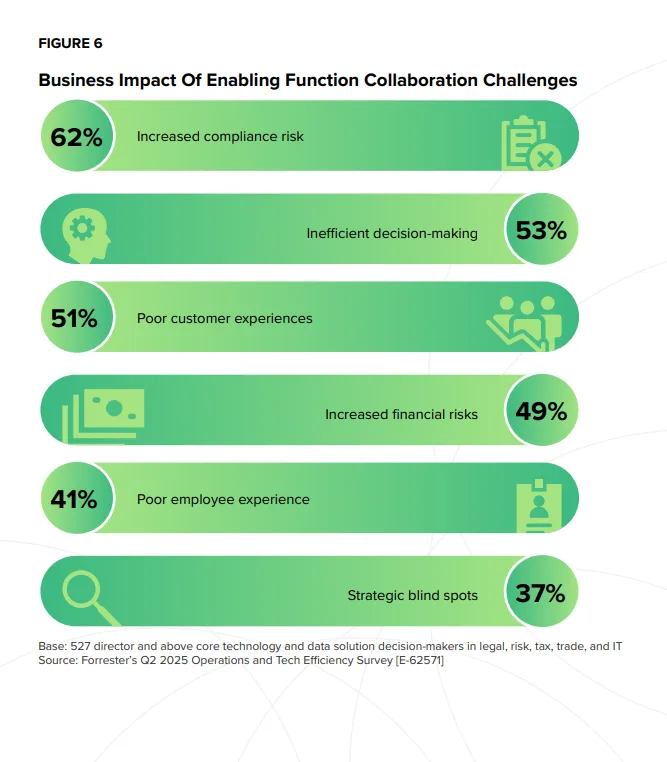
Research from Forrester indicates that fragmented data and isolated teams within governance and compliance roles are exacerbating compliance risks, hampering decision-making, and negatively impacting customer experiences. As illustrated in Figure 6 below from the Forrester Consulting Thought Leadership Paper, several challenges arise from such siloed environments²..
Operational efficiency at scale. According to the Forrester Total Economic Impact™ study on Thomson Reuters ONESOURCE+, organizations that implemented these AI-driven governance platforms have experienced notable operational enhancements. The research indicates that a composite organization consisting of 800 employees from legal, risk, tax, and trade sectors saved 20 hours per month per employee through automated workflows and intelligent collaboration tools.
Fraud prevention excellence. The study highlights that AI-enhanced platforms have allowed participating organizations toreduce fraud by up to 95% compared to outdated manual approaches.
We went from catching fraud after the fact to preventing it before it happened. Thomson Reuters helped us mitigate fraud by 95%.
enterprise risk, financial services
Quantified strategic impact
Financial returns: The Forrester TEI study displays significant financial advantages of AI tools, with organizations reporting:
- A 199% return on investment over three years.
- $8.8 million in net present value derived from enhanced efficiency in legal research, automation of risk processes, and streamlined trade compliance.
- A payback period of under six months¹, as outlined on page 6 of the Forrester TEI study.
Operational transformation: Participants in the study reported:
-
-
- Reduction of manual Foreign Trade Zone operations from seven specialists to three, enabling teams to concentrate on strategic priorities¹.
- Over a 50% decrease in legal research and document review tasks.
- Maintaining 2-3% yearly growth without adding staff, showcasing improved scalability¹.
-
System consolidation: The composite organization saved nearly $128,000 annually by replacing outdated and fragmented systems with Thomson Reuters’ integrated AI platforms¹.
Real-world strategic impact
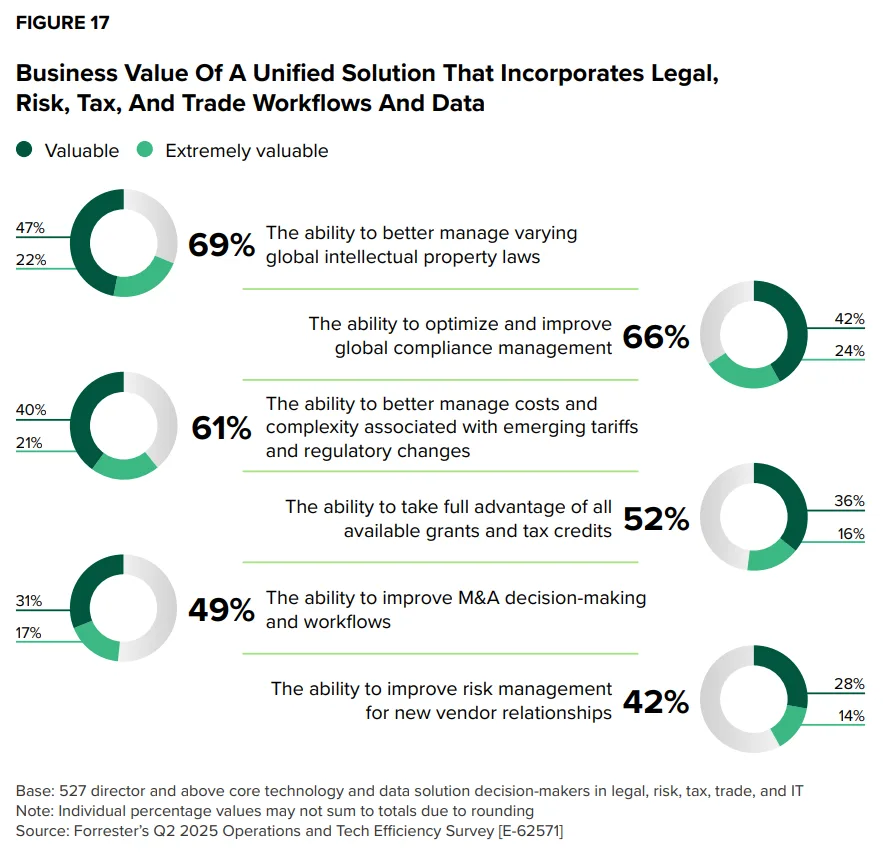
Cross-functional intelligence. When legal, risk, and business teams engage on integrated AI platforms, they cultivate a shared understanding of the regulatory ramifications for strategic initiatives. As in Figure 17 from the Forrester thought leadership paper, business leaders recognize considerable value in integrated solutions that connect legal, risk, tax, and trade workflows, with many citing substantial benefits in key operational areas ².
We’ve been able to streamline and become more efficient in our operations, ensuring compliance with US laws and regulations. Thomson Reuters has provided us with a one-stop solution across legal, tax, and trade.
Forrester TEI study
Scalable growth. Organizations can explore new markets by utilizing compliance automation. Tools for denied party screening and export support ensure regulatory conformity, facilitating confident entry into additional geographies and customer bases¹.
The executive framework for implementation
Phase 1: Foundation assessment (0-6 months)
-
-
- Assess the existing governance technology stack and calculate the costs of manual processes.
- Establish a cross-functional AI governance team with members from legal, risk, IT, and business units.
- Initiate pilot programs targeting high-impact areas identified in operational efficiency evaluations.
-
Phase 2: Strategic integration (6-18 months)
-
-
- Implement integrated AI-powered solutions for collaboration within critical governance functions.
- Create intelligent workflows connecting compliance activities with business strategies.
- Train leadership teams on decision-making enhanced by AI.
-
Phase 3: Competitive advantage (18+ months)
-
-
- Utilize AI insights for strategic regulatory positioning.
- Employ predictive capabilities to shape industry standards and regulatory developments.
- Expand successful models across global operations.
-
The evidence points in one direction
Organizations poised for success in the coming decade will view governance and compliance as strategic advantages. The 2025 Forrester Total Economic Impact™ study demonstrates that modern collaborative platforms deliver substantial, measurable value, enabling companies to respond more swiftly and confidently.
With a documented 199% ROI and fraud reductions of up to 95%, a pressing question emerges: can contemporary enterprises afford to rely on outdated governance models that hinder responsiveness to market changes? More importantly: can your organization risk allowing competitors to secure a strategic edge while you’re entangled in manual, fragmented governance processes that accrue costs and yield minimal strategic worth?

Special Paper
Discover how integrated governance and compliance technology enhances collaboration, expedites decision-making, and increases agility.
Sources: ¹ Forrester Consulting, “The Total Economic Impact™ of Thomson Reuters ONESOURCE+,” commissioned by Thomson Reuters, October 2025.
² Forrester Consulting, Thought Leadership Paper “AI Meets Governance And Compliance: Enabling Cross-Functional Intelligence To Accelerate Strategic Execution,” commissioned by Thomson Reuters, October 2025.
Disclaimer
Thomson Reuters is not a consumer reporting agency, and none of its services or the data contained therein constitute a ‘consumer report’ as defined by the Federal Fair Credit Reporting Act (FCRA), 15 U.S.C. sec. 1681 et seq. The data provided may not be used as a factor in consumer debt collection decisions, determining a consumer’s eligibility for credit, insurance, employment, government benefits, or housing, or for any other purpose authorized under the FCRA. By accessing one of our services, you agree not to use the service or data for any purpose authorized under the FCRA or in relation to taking adverse actions concerning consumer applications.