Chinese coffee giant Luckin opened its first flagship with premium drinks as the company takes on Starbucks Reserve.
Luckin Coffee
BEIJING — China’s Luckin Coffee is setting its sights directly on Starbucks‘ upscale roastery chain with the establishment of a new flagship store in southern China, which features premium beverages.
This marks a significant shift for Luckin Coffee, which initially focused on budget-friendly coffee kiosks—a strategy that enabled it to surpass Starbucks in the number of locations within China.
As Starbucks divests most of its struggling operations in China to a local investment firm, Luckin demonstrates its resilience following the fraud allegations that tarnished its reputation in 2020, leading to its Nasdaq delisting.
The newly inaugurated Luckin Coffee Origin Flagship is located in Shenzhen, near the Hong Kong border, and spans two floors.
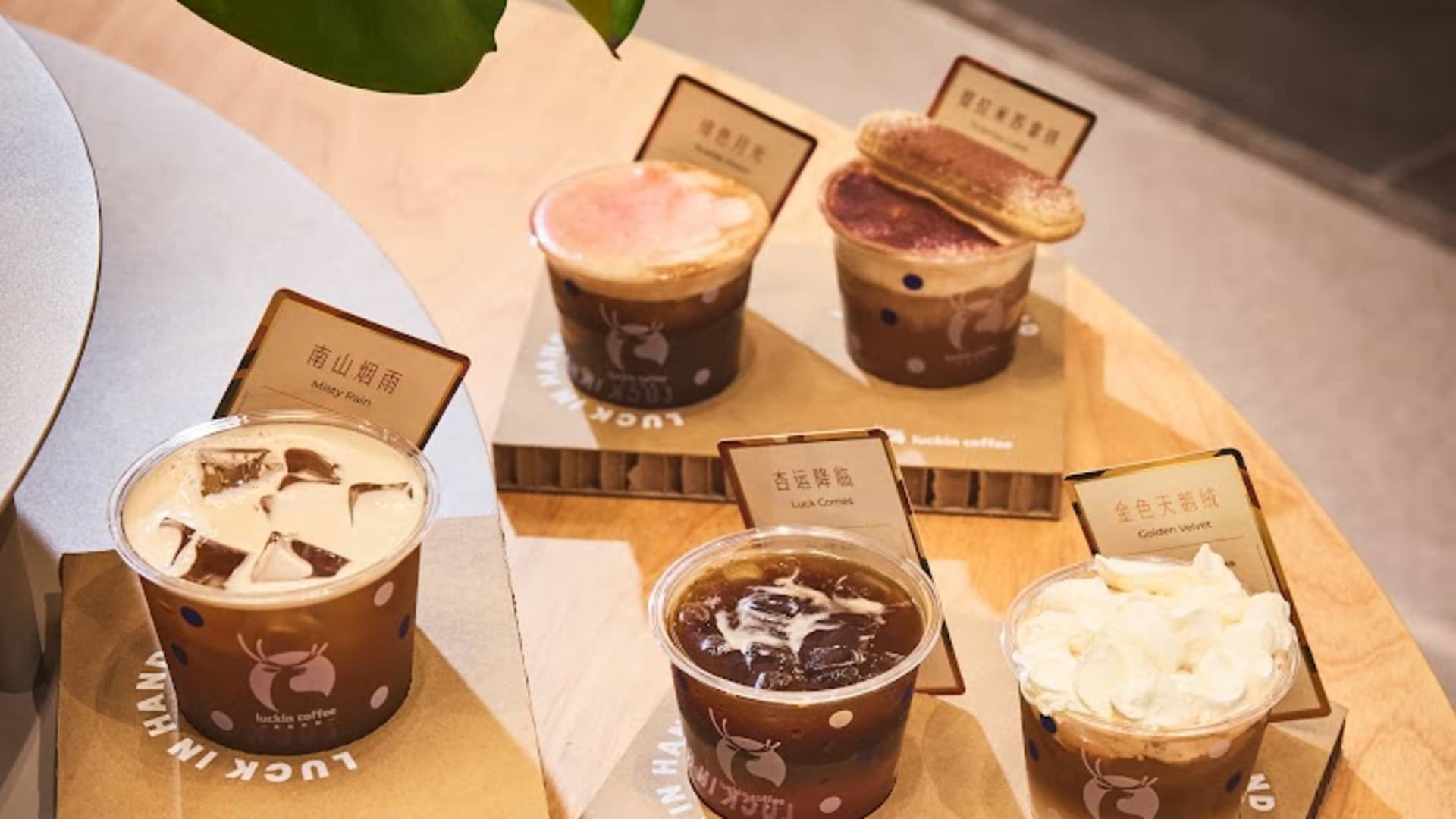
In this flagship location, prices for drinks range slightly higher than the usual $1 or $2 for an Americano or latte, offering a variety of pour-over and cold brew options. Customers can select from beans sourced from Brazil, Ethiopia, or China’s Yunnan province, in line with the “origin” theme popular among other premium coffee brands.
The flagship also features unique beverages, such as a “tiramisu latte” topped with a pastry, as noted by users on the Chinese social media platform Xiaohongshu. Since its soft launch on January 20, people have reported waiting between one to three hours for these drinks.

Covering 420 square meters (4,521 square feet), the new store reflects the increasing competition Starbucks faces in China. In 2017, the American coffee giant chose Shanghai for its second Reserve Roastery, after introducing the concept in Seattle just three years prior.
As coffee culture flourishes in China, a traditionally tea-drinking nation, Starbucks now competes against numerous challengers, from artisanal cafes to chains such as Cotti Coffee and Manner, which frequently offer lower prices than Starbucks.
For the three-month period ending September 30, 2025, Luckin reported revenue of $1.55 billion, representing an impressive nearly 48% growth year-over-year.
This figure is derived from its self-operated locations, which make up more than half of Luckin’s establishments in China and most of its limited overseas outlets. The Shenzhen flagship is celebrated as Luckin’s 30,000th store, with a total of 29,214 stores globally reported as of September 30.
Pictured here is the second floor of Luckin’s new flagship in Shenzhen, China, that officially opened on Feb. 8, 2026.
Luckin
In contrast, Starbucks operates just over 8,000 locations in China and about 16,900 in the United States, its largest market.
The Seattle-based coffee chain reported a 6% increase year-over-year in China net revenue, reaching $831.6 million for the quarter ending September 28. Their comparable same-store sales, an industry benchmark, rose only 2%, but improved to 7% for the quarter ending December 28.
Starbucks has not disclosed its latest quarterly net revenue for China. The company is expected to finalize a deal in spring to transfer 60% of its China business to Boyu Capital while retaining a 40% interest. Upon announcement in November, Starbucks valued its Chinese operations at $13 billion, inclusive of anticipated licensing fees.
Luckin remains listed over-the-counter in the U.S. and had a market value of approximately $10.46 billion as of Thursday.
Re-listing and expansion plans
Last year, Luckin’s CEO Jinyi Guo hinted at potential plans to re-list the company in the U.S. though no specific timeline was provided. Founded in late 2017, the company achieved a $2.9 billion valuation within just 18 months and listed on the Nasdaq in May 2019. However, following the admission of substantial fraudulent sales one year later, Luckin faced delisting.
Throughout this period, the company continued to operate many stores while retaining its branding.
Moreover, Luckin has successfully engaged consumers through timely collaborations with premium brands such as Moutai, Minions cartoon characters, and the popular video game Black Myth: Wukong following its rise in popularity.
Analyst Mingchao Xiao of Zhimeng Trends Consulting notes that Luckin provides a unique user experience by directing traffic through its smartphone ordering app, allowing customers to select and pay for their drinks independently.
China’s coffee market is undergoing rapid transformation, Xiao observes, with young consumers increasingly eager to explore new experiences and seeking emotional gratification, which can be fulfilled through inter-industry collaborations.

Subscribe now
In line with its growth strategy, Luckin is also expanding its international presence.
Last summer, the company opened its first stores in the United States, launching its 10th location in New York City on February 6.
Additionally, Luckin operates 68 stores in Singapore, having entered the market nearly three years ago, and it has 45 joint locations in Malaysia.
Key Takeaways
- Luckin Coffee has opened its first premium flagship store in Shenzhen, China, competing directly with Starbucks Reserve.
- The new flagship marks a strategic shift from budget-priced kiosks to higher-end offerings.
- Customers can select from diverse bean origins such as Brazil and Ethiopia for their drinks.
- Luckin has maintained impressive revenue growth, reporting a 48% increase year-over-year.
- The company plans to expand further, including potential re-listing in the U.S. and increased store openings internationally.
FAQ
What is Luckin Coffee’s new flagship store concept?
Luckin’s flagship store features premium beverages and a refined selection of coffee drinks, marking a departure from its budget-focused model.
Where is the new flagship store located?
The new flagship is situated in Shenzhen, China, close to the Hong Kong border.
How does Luckin Coffee plan to expand?
Luckin aims to grow its international footprint by opening additional stores in the United States and other markets like Singapore and Malaysia.
What sets Luckin Coffee apart from Starbucks?
Luckin leverages a strong mobile app for ordering, allowing for a streamlined and user-friendly experience compared to traditional counter service.
What challenges does Starbucks face in China?
Starbucks is encountering increased competition from both boutique cafes and other chains offering lower-priced options, making the market more challenging.