The government has finally come clean: it plans to roll out a universal digital ID known as “Britcard” — primarily as a smartphone application.
For our regular UK readers, this news may not come as a surprise. On July 5, 2024, following Keir Starmer’s election as Prime Minister with a notable majority while securing a mere 33.8% of the vote, we published an article titled “Will a Keir Starmer Government Make Digital Identity a Reality in the UK?” The takeaway was clear: the government would certainly make an effort to implement it, likely stumbling along the way, given the UK’s long-track record of IT-related failures.
Our forewarning came from two main insights:
- Almost every nation around the globe, whether impoverished or affluent, including BRICS allies and NATO members, is hastily working to establish a nationwide digital identity system. Organizations like the United Nations, the World Economic Forum, and the World Bank have been advocating for digital IDs for years.
- The UK government, similar to Ireland and the US, would face more challenges as it lacks a national ID card scheme. Yet, Starmer has always been set to emulate his tech-centric mentor, Tony Blair, who previously tried and failed to implement a national ID system. As anticipated in May 2024, Blair’s influence over Starmer’s administration has grown significantly:
Many vital positions in Starmer’s government are occupied by members of the Blairite faction of the Labour Party. This faction has devoted the past four years to purging the party of its authentic left-wing voices, including former leader Jeremy Corbyn and renowned filmmaker Ken Loach. Veteran US journalist Robert Kuttner notes that Starmer “has outsourced virtually his entire program to Tony Blair” and his aptly named non-profit, the Tony Blair Institute for Global Change (often abbreviated as TBI).
This arrangement offers Blair a means to extend the reach of his global consultancy empire, which is currently shaping the future in post-genocide Gaza without consulting its inhabitants, while also controlling the strings of the Starmer administration, likely to benefit his consultancy’s elite donors, notably US tech billionaire Larry Ellison.
The situation has unfolded even more unfavorably than we anticipated. In early September, The New Statesman posed the question: “Is This Keir Starmer’s Government or Tony Blair’s?” Highlighting how “[t]here is no comparable instance of a former prime ministerial court overshadowing a successor’s rule.”
Indeed, the only notable political setback Blair faced in the last 15 months was the recent dismissal of his associate, Peter Mandelson, from his role as the UK ambassador to the US due to earlier ties with Jeffrey Epstein, which had been widely known even when he was appointed.
As previously discussed, Blair’s swift return to political prominence is crucial to the UK’s prospects, largely owing to his obsession with digital and AI technologies:
Blair’s Digital Vision
Blair exhibits an almost fervent devotion to digital advancements, including biometrics. His technocratic proposals naturally advocate for the extensive rollout of “digital public infrastructure” (DPI), currently underway in various Global South nations, often backed by World Bank loans and funding from billionaire philanthropists like Bill Gates and Pierre Omidyar.
Despite his earlier failures during his premiership, Blair has consistently lobbied for the development of a digital identity system in the UK. At a 2020 World Economic Forum event titled “Cyber Polygon,” he asserted that digital identity would become an “inevitable” feature of the digital environment surrounding us, urging governments to collaborate with tech firms for regulation.
Fast forward fourteen months, and the Starmer administration is now openly acknowledging its objective: to launch a universal (and likely soon mandatory) digital identity system. This initiative has been branded “Britcard,” which, at its core, is a smartphone application. The political justification for “Britcard” will ring familiar to US audiences: illegal immigration. From the FT:
Sir Keir Starmer is moving forward with plans for digital IDs, with an announcement anticipated as early as his party conference this month, as he seeks to present a viable plan to tackle illegal migration.
Officials revealed that Starmer is eager to advance the digital ID initiative, notwithstanding Sir Tony Blair’s costly and unsuccessful attempt at mandatory ID cards in the 2000s.
The announcement may occur during the Labour party conference later this month, as confirmed by two sources familiar with the matter. They caution that the finer details are still being finalized and the timeline may shift.One model being considered is to assign a digital ID to every individual legally residing in the UK—whether through citizenship or legalized immigration status, according to one of the sources.
The success of the digital ID program hinges on universal participation; otherwise, the government would have to manage a fragmented combination of paper and digital systems.
Advocates for civil rights contend that a mandated digital identity system will not effectively address illegal immigration—many European nations already possess national identity systems, including some with government-regulated digital identities, yet continue to grapple with the same issues of illegal immigration as the UK. Concurrently, these digital systems threaten a broader range of human rights.
“Any digital ID system aimed at reducing irregular migration will not resolve the issues its proponents claim but will raise numerous broader human rights concerns,” stated Sam Grant, Director of External Relations at Liberty. “Many countries have mandatory ID systems, yet there is no clear link between the irregular migrant population, underground economies, and ID policies.”
A 2022 report from NYU School of Law titled “Paving the Digital Road to Hell: A Primer on the Role of the World Bank and Global Networks in Promoting Digital ID” warned that the emerging digital identity frameworks funded by the World Bank in Global South nations have been “associated with severe and widespread human rights violations impacting social, civil, and political rights.”
The Role of Labour Together
Interestingly, the proposed plans for a “progressive” (believe it or not) Britcard seem to be directly lifted from a paper authored by Labour Together, a neoliberal think tank closely aligned with the government. The paper’s abstract states:
To function as a progressive society, collective agreement on who can join is essential. To exclude those who cannot join, proof of belonging must be provided. The UK presently lacks this framework. Our conflicted historical approach to issuing identity credentials has resulted in a situation indicative of the worst of both worlds. We are currently unable to effectively prevent unauthorized residency and work within our borders nor do we efficiently empower legal citizens and residents to assert their rights.
This paper advocates for the introduction of Britcard: a mandatory national digital identity issued free to all individuals entitled to live or work in the UK, be they British nationals or legal migrants. The Britcard would serve as a verifiable digital credential, downloadable to a user’s smartphone, which employers or landlords could verify instantly using a free app.
Labour Together was founded by Morgan McSweeney, a key figure credited with orchestrating Starmer’s rise to power. Its supporters also hold significant roles within Starmer’s cabinet. Additionally, Labour Together was instrumental in ousting Jeremy Corbyn from the party leadership, bolstered by financial support from City of London financiers like Lord Myners, a former Rothschild director, and the prominent businessman Trevor Chinn.
Much of this funding has gone undisclosed, with Labour Together now under scrutiny for its financing, as highlighted in an upcoming book titled The Fraud. According to The Times:
The Fraud is expected to raise concerns regarding Morgan McSweeney’s leadership of Labour Together and its failure to disclose donations amounting to several hundred thousand pounds…
During McSweeney’s tenure, Labour Together neglected to report donations exceeding £700,000 from venture capitalists and businessmen.
This included £147,500 while McSweeney managed Starmer’s campaign for Labour leadership in 2020, all while maintaining his position as company secretary of Labour Together.
Such revelations have spurred accusations against Labour, suggesting that the UK’s Prime Minister might have attained office due to an illegal slush fund.
Currently, Blair and McSweeney seem to be collaborating to construct the political rationale for a digital identity system. A recent piece in The Observer notes that “an internal paper from the Tony Blair Institute, commissioned by Morgan McSweeney, Starmer’s chief of staff, is reportedly ‘forceful’ in advocating for digital ID to address voter concerns and counter the threat posed by Reform UK.”
While the government believes that public fears regarding immigration, largely inflamed by politicians and media, will help push its digital ID legislation through, the ultimate goals for digital identity are far broader. According to the FT article:
Earlier this year, former technology secretary Peter Kyle announced the launch of a new gov.uk app that would enable Britons to access a multitude of public services from their smartphones.
He also confirmed that by year’s end, a digital wallet will be launched, allowing individuals to maintain driving licenses and veteran ID cards on their smartphones.
A government representative stated: “We are dedicated to leveraging technology to simplify interactions between citizens and the state, learning from other countries on best practices for delivery.”
As previously detailed, a comprehensive, government-backed digital identity system could impact nearly every aspect of our lives, from healthcare (including vaccinations) and financial management to business activities, personal and public communications, accessed information, government interactions, dietary choices, and purchasing behaviors.
Lurking behind the now-infamous WEF infographic is the notion that navigating life without a digital identity may soon prove increasingly difficult.
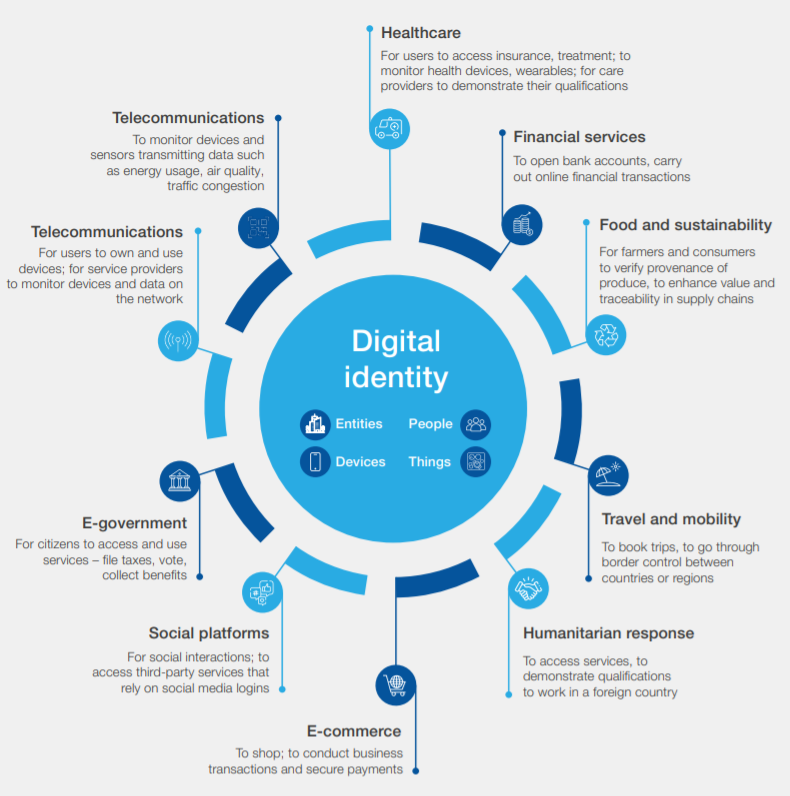
If governments such as the UK’s, Australia’s, and those within the EU successfully impose comprehensive online age verification systems on their citizens, biometric-supporting digital identities could soon function as our gateway for internet usage.
Furthermore, digital identity systems are deemed necessary for the introduction of central bank digital currencies, as we have extensively covered. CBDCs are not only traceable digital cash, which can monitor transactions based on who spent what, where, and when, but they are also programmable, potentially restricting funds for specified purposes. Restrictions might include expiry dates or account deactivation based on user behavior or location.
Inherently Exclusionary and a Potential Bonanza for Hackers
Despite often being touted as tools for social and financial inclusion, digital identity systems are fundamentally exclusionary. As the World Economic Forum acknowledges, while verifiable identities “generate new markets and business opportunities,” particularly for tech companies managing these systems and harvesting data, they also (emphasis added) “open up (or close off) the digital world for individuals.”
As one FT reader pointed out in the comments, “the essential idea is to mandate smartphone ownership and constant possession.”
Major security issues also surround the extensive data collected through the digital identity system. The UK has already faced significant financial consequences from data breaches in recent years, including the Afghan data leak, for which the government presently cannot estimate the total costs, which likely extend into the billions.
As we cautioned in May, the government’s reckless stance on security concerning its evolving digital governance systems should alarm all UK citizens. A recent poll revealed that two-thirds of UK residents do not trust the government to safeguard their data. What’s particularly astonishing is that one-third of respondents expressed trust:
🆔”A digital ID scheme not only threatens civil liberties but also poses a considerable cybersecurity risk.” – @M_feeney
63% of Brits do NOT trust the government to keep their digital ID data secure, a @YouGov poll we commissioned reveals.
Read⤵️… pic.twitter.com/8SOg9EPuUw
— Big Brother Watch (@BigBrotherWatch) September 22, 2025
Another FT reader echoed these concerns, predicting that digital identity under the UK government would result in a costly IT debacle:
It will be intrusive, requiring proof of identity far more often than currently.
It will create chaos for the countless individuals likely to encounter system errors.
It will undergo mission creep, amassing increasing amounts of data, facilitating all sorts of unwanted social engineering in the future.
Disregard the authoritarian fantasies. Consider what your least-favorite government could do with it.
Since assuming power just 14 months ago, Starmer’s somewhat nascent government has already enacted (and continues to expand) the following policy measures:
- Introduced plans to extend the use of live facial recognition technology, coinciding with an EU law broadly prohibiting real-time surveillance technology. Authorities are reportedly experimenting with permanent facial recognition cameras in specific areas of London, already one of the world’s most monitored cities.
- Advocated for the establishment of digital health passports for NHS patients, provoking backlash over concerns regarding digital privacy and the potential sale of patient data to third-party firms—a policy that Tony Blair and former Conservative leader William Hague lobbied for shortly before the elections.
- Enacted new powers to automate surveillance of bank accounts. The Public Authorities (Fraud, Error and Recovery) Bill will compel banks to continuously monitor individuals’ financial transactions, ostensibly to detect potential welfare fraud or government mistakes. As Big Brother Watch’s Director Silkie Carlo states, “This will transform Britain’s once-compassionate welfare system into a digital surveillance system.”
- Outlined plans to trial a Central Bank Digital Currency by 2025, continuing Rishi Sunak’s contentious Digital Pound initiative, with a “blueprint” expected by Christmas.
- Intensified a crackdown on lawful speech. Journalists and hundreds of campaigners have been arrested for voicing opposition to Israel’s actions in Gaza—actions Starmer, a former human rights lawyer, denies are even happening. A pro-Palestine NGO has been labeled a terrorist organization. The Online Safety Act has been passed, threatening to dismantle online privacy and limit available content. British authorities have also sought to undermine encryption and have experimented with AI for reviewing asylum applications.
Even the New York Times recently inquired whether Britain has exceeded its limits regarding digital controls under Starmer, labeling the country’s adoption of digital surveillance and internet regulations as “one of the most sweeping” among Western democracies. When even the NYT signals that a national government is overreaching with its surveillance tactics, it’s a clear indication that boundaries have long been crossed.
This accelerating shift toward digital authoritarianism is part of a broader trend among purportedly “liberal democracies.” As economic conditions decline, public dissatisfaction rises, and advancements in AI technologies occur, governments are increasingly tempted to leverage these new surveillance and control mechanisms. Additionally, the potential benefits for Big Tech are substantial. Notably, the UK finds itself at the forefront of this growing phenomenon.