In a world increasingly influenced by artificial intelligence, the demand for reliable tools to distinguish between genuine and AI-generated content is growing. A recent survey from the Human Clarity Institute revealed that 93% of participants are seeking stronger verification mechanisms for online media. Addressing this concern, students from the University of Georgia (UGA) are developing solutions in real time.
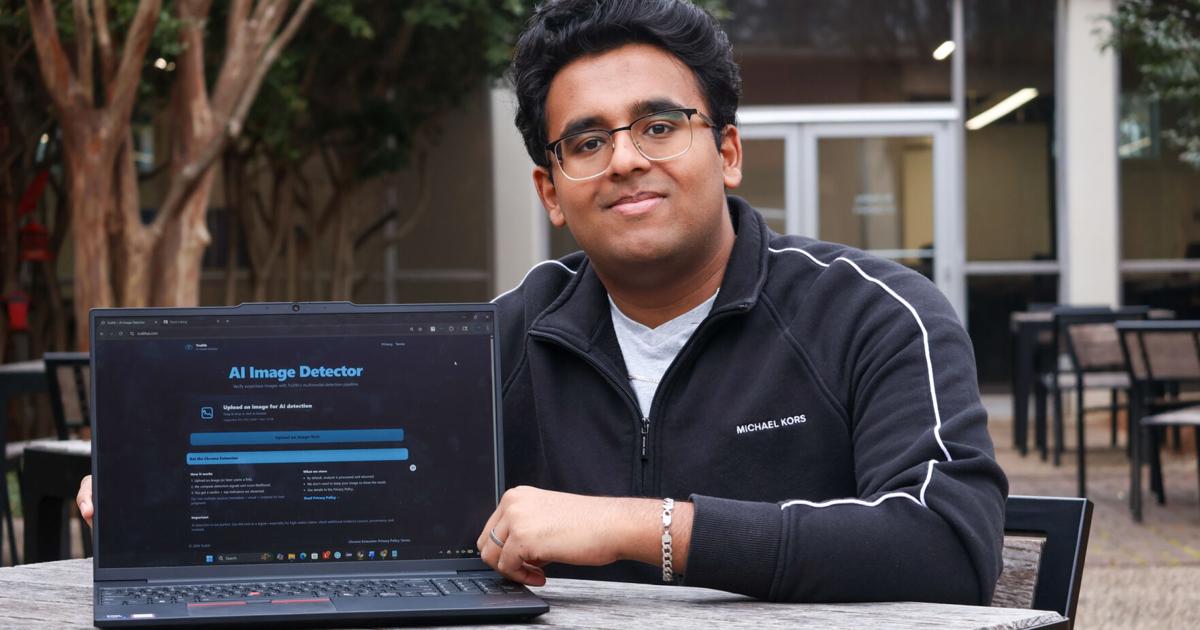
Tanish Murali Reddy, a freshman majoring in computer systems engineering, established Trulith AI in October 2025. This startup includes both a website and a browser extension dedicated to identifying content created by artificial intelligence.
Users can upload any image to Trulith, where it undergoes analysis. The platform provides a percentage likelihood that the image is AI-generated, along with indicators explaining the reasoning behind this determination.
The inspiration for Trulith arose from Reddy’s observation of the limited tools available for detecting AI-generated photos and videos. “The only tools that exist are text,” he mentioned. “So I thought, instead of creating a typical AI tool, why not develop a content checker for images?”
Reddy collaborates with a team primarily made up of fellow UGA students, who must balance their academic commitments with their contributions to this project.
Having started multiple ventures since his senior year of high school, Reddy initiated Trulith with funding from UGA. “Managing a startup while in college is quite challenging. You have to juggle classes, maintain your GPA, participate in clubs, and focus on your startup,” he explained. “I rely heavily on Google Calendar to keep track of my weekly tasks.”
To ensure Trulith remains effective as AI technology advances, Reddy and his team continuously train the platform using the latest AI models. They strive to reduce false-positive reports by comparing their results with other AI detection tools available in the market.
“It’s impossible to be 100% accurate,” Reddy admitted. “However, we have observed that Trulith has one of the lowest rates of false positives among current detectors.”
Currently, Reddy is financing the startup entirely out of his own pocket.
As they approach the completion of the program, Reddy and his team have shifted their focus to marketing, beginning with UGA students. Partnering with the UGA Institute of Electrical and Electronics Engineers, they aim to raise awareness through collaboration and social media initiatives.
Tanishka Jadhav, a freshman studying biochemistry, oversees Trulith’s social media. Her focus is on building trust with users and showcasing Trulith’s potential for making a positive impact.
“Students are both heavy consumers and creators of AI content. Detection tools reinforce academic integrity, media literacy, and responsible use of AI,” Jadhav stated. “It’s not about punishment; it’s about helping students understand the distinction between support and originality.”
Reddy’s ultimate ambition for Trulith is to develop a mobile app that facilitates AI detection on popular platforms like TikTok, Instagram, and YouTube.
“I envision us becoming one of the top AI detectors on the market,” Reddy concluded. “The possibilities are truly limitless.”