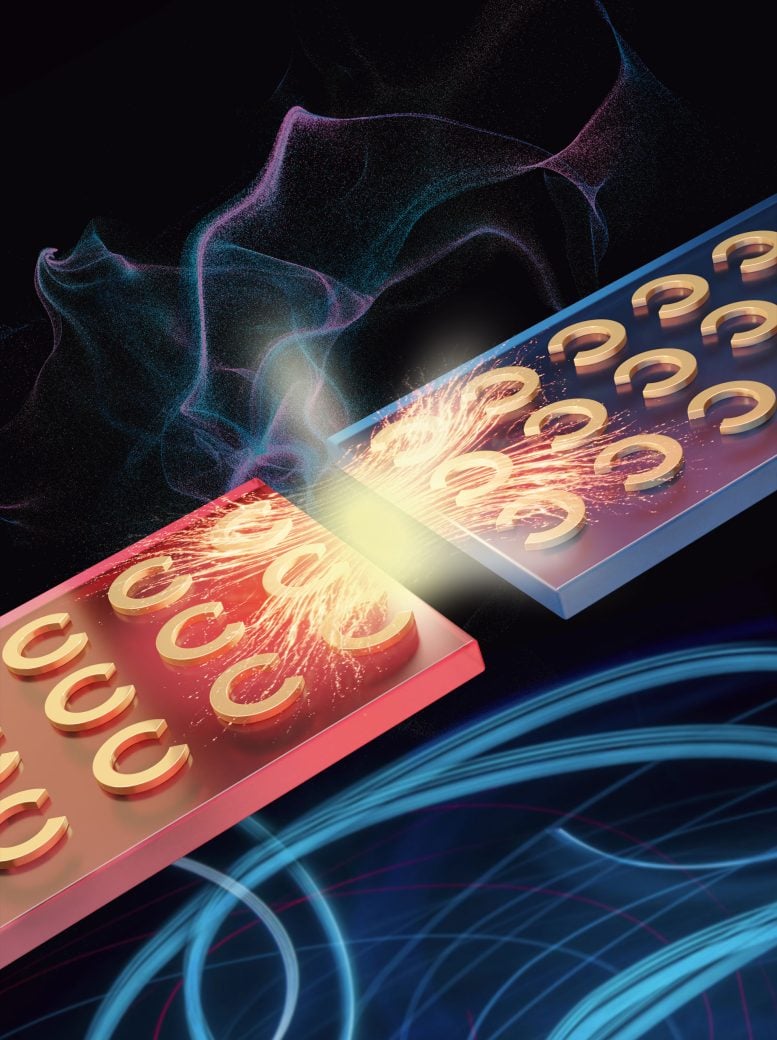
Enhanced Heat Transfer Using Metamaterials
Researchers have developed a way to significantly enhance heat transfer across nanoscale gaps through engineered metamaterials. This innovative approach has the potential to improve cooling strategies for chips and high-performance systems, as detailed in a study published in Nature by scientists from Carnegie Mellon University, Stanford University, and Purdue University.
Key Findings
-
Nanoscale Efficiency: The study demonstrated that heat can cross tiny vacuum gaps much more efficiently than previously believed. Metamaterials—artificial materials engineered with intricate patterns—can amplify near-field radiative heat transfer by up to four times compared to conventional setups.
-
Near-Field Effects: At very small distances (a few hundred nanometers), heat transfer mechanisms shift from traditional methods (conduction, convection, thermal radiation) to electromagnetic interactions, allowing for increased energy transfer through near-field effects.
-
Resonance Mechanism: The enhancement is not merely a result of additional thermal pathways. Instead, the patterned gold structures engage with surface phonon polaritons—waves associated with atomic vibrations—creating resonance that facilitates more effective thermal energy movement.
-
Implications for Technology: The ability to control heat flow at this level could revolutionize electronics by aiding in heat management as components shrink and demand for cooling rises. It could also enhance technologies like thermophotovoltaics and infrared sensors.
-
Future Applications: While the findings currently apply to controlled laboratory conditions, they suggest a future where heat can be manipulated similarly to electricity and light, potentially leading to new technology paradigms.
Research Reference
- Title: “Metamaterial-enhanced near-field radiative heat transfer”
- Authors: Zexiao Wang et al.
- Publication: Nature
- DOI: 10.1038/s41586-026-10595-4
Conclusion
This breakthrough highlights the importance of engineering materials to enhance fundamental physical processes, paving the way for advanced technological applications in cooling, energy conversion, and thermal sensing.


