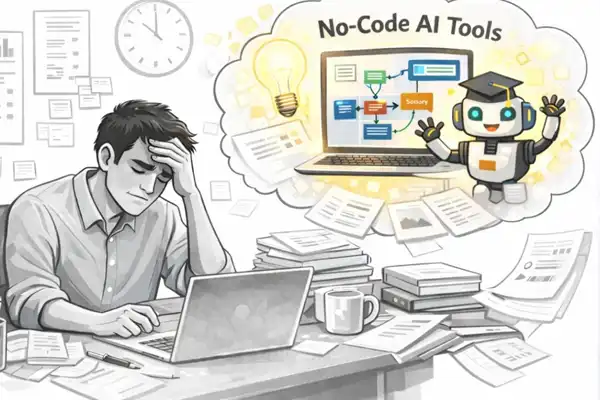
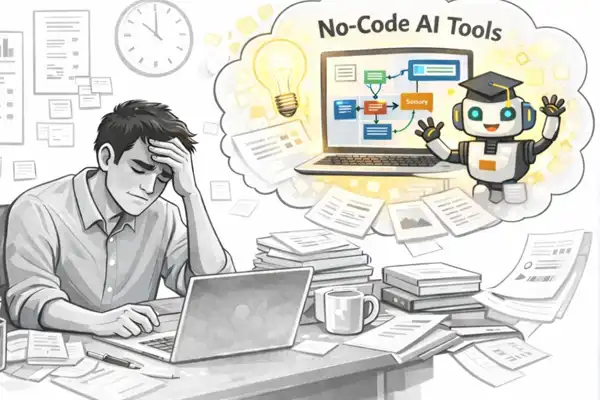
No-code AI tools help reduce workloads and increase productivity in both academic and professional settings.
Artificial intelligence (AI) and machine learning (ML) are progressively transforming day-to-day activities in education, research, and institutional management. These technologies facilitate tasks such as data analysis, automation, academic documentation, and research support, firmly embedding AI tools into regular academic routines. Yet, traditional AI development typically requires programming skills, extensive software configurations, and significant computational resources, which can pose challenges for students, educators, and non-technical individuals.
In academic settings, people often invest excessive time on repetitive tasks like report preparation, course outcome mapping, literature reviews, workflow management, and institutional documentation. Despite the transformative potential of AI in these areas, many remain hesitant to adopt it, stemming from the misconception that advanced coding skills and costly infrastructure are prerequisites. As a result, manual processes continue to dominate academic and professional workflows. To address this disconnect, no-code AI tools have emerged. These enable users to harness the power of AI through intuitive visual interfaces, workflow builders, and prompt-driven interactions, all without requiring programming expertise. Examples of such tools include beginner-friendly AI training platforms, agent-based automation systems, academic assistants, and research support tools focused on literature reviews and knowledge organization.
A curated selection of no-code AI tools that align with practical academic and professional needs is discussed below, highlighting four essential areas: AI model training for beginners via Google Teachable Machine, task automation through AI agents, academic documentation support, and research writing assistance.
Google Teachable Machine: No-code AI for Rapid Learning
For many newcomers, the primary hurdle in AI and ML isn’t grasping the concepts but knowing how to start. Students often need to build a basic AI model, such as one for image or gesture classification, without any prior coding experience. Traditional machine learning workflows involve programming, library installation, and error management, which can become obstacles rather than avenues for learning.
In scenarios tailored for students, the key requirement is to swiftly train a model, test its predictions, and grasp the fundamental concept of classification in a limited time. Google Teachable Machine effectively addresses this challenge. This browser-based, no-code platform is designed for rapid experimentation, letting students tackle three kinds of problems: image classification, audio classification, and pose classification. By gathering sample data via a webcam or microphone, assigning it to classes, and training the model with one click, students can create functional AI models in mere minutes. This approach allows learners to concentrate on conceptual understanding and practical application, sidestepping technical complexities.
AI Agents for Task Automation: Streamlining Daily Workload
In academic and professional environments, a significant portion of time is consumed by repetitive tasks rather than meaningful analytical or creative work. Activities such as email management, spreadsheet updates, reminders, report generation, and form handling are often performed manually, leading to increased workload and the potential for human error.
A common scenario involves students or faculty juggling multiple digital platforms simultaneously. Assignment submissions, progress monitoring, notifications, and periodic reports demand ongoing attention, even though these tasks do not require human intellect. This is where AI agents provide valuable assistance by automating routine tasks. AI agents monitor inputs, execute predefined logic, and perform actions autonomously. Created using no-code platforms, these agents can run continuously in the background without programming knowledge.
Key features of no-code AI agents include:
- Monitoring events such as emails, form submissions, or file uploads
- Applying rule-based or AI-driven logic
- Executing actions like document updates, notifications, or workflow triggers
- Reducing manual effort and execution delays
- Enhancing consistency and efficiency
- Popular no-code AI agent tools include:
- n8n
- Zapier
- Make.com
- Flowise
- Relevance AI
No-code AI for Research Writing and Literature Review
Research writing stands out as one of the most challenging tasks in academia, especially for students and early-stage researchers. The main hurdle often lies not in generating ideas but in managing a substantial volume of research papers. Activities such as literature searching, identifying key findings, comparing methodologies, and summarizing results require considerable time, particularly for novices unfamiliar with systematic review practices.
For instance, when a student is tasked with writing a review section for a project or research paper, locating credible sources, understanding previous contributions, and supporting arguments with evidence can be daunting when faced with numerous papers to read manually. This often leads to shallow reviews or incomplete references.
No-code AI research assistants tackle this issue by simplifying the discovery and analysis of literature. These tools empower users to search and analyze academic papers using natural language queries, automatically extracting structured information like methodologies, datasets, findings, and limitations. This streamlines the comparison of studies and facilitates the identification of research gaps while upholding academic integrity.
Popular no-code research writing tools include:
In essence, no-code AI research assistants enhance productivity rather than generating content. By minimizing the time spent on literature exploration and evidence collection, they enable researchers to focus their efforts on interpretation, discussion, and contribution. This makes them indispensable support tools in contemporary research writing workflows.
Improving Originality in AI-Generated Content
Maintaining originality is crucial for students and researchers in academic writing. While AI-assisted tools can aid in structuring and drafting content, the resulting output may sometimes come across as overly generic or machine-generated. Consequently, plagiarism and AI detection systems may flag such content, creating submission uncertainties. To mitigate this concern, it is essential to refine AI-assisted text and ensure its originality before final submission.
Reducing AI-generated content involves refining and rewriting text while maintaining its original meaning, logic, and academic tone. Content refinement tools assist in rephrasing sentences, enhancing readability, and eliminating repetitive AI-like patterns without generating novel research material.
Commonly utilized tools for content refinement include:
- QuillBot
- AI Humanizer
- Paraphraser.io
- Grammarly
Following content refinement, verifying originality through plagiarism and AI detection tools is essential. These tools help identify similarities, AI-generated patterns, and sections that may need further revision or proper citation.
Commonly used tools for plagiarism and AI detection include:
Beyond Core Tools: The AI Ecosystem
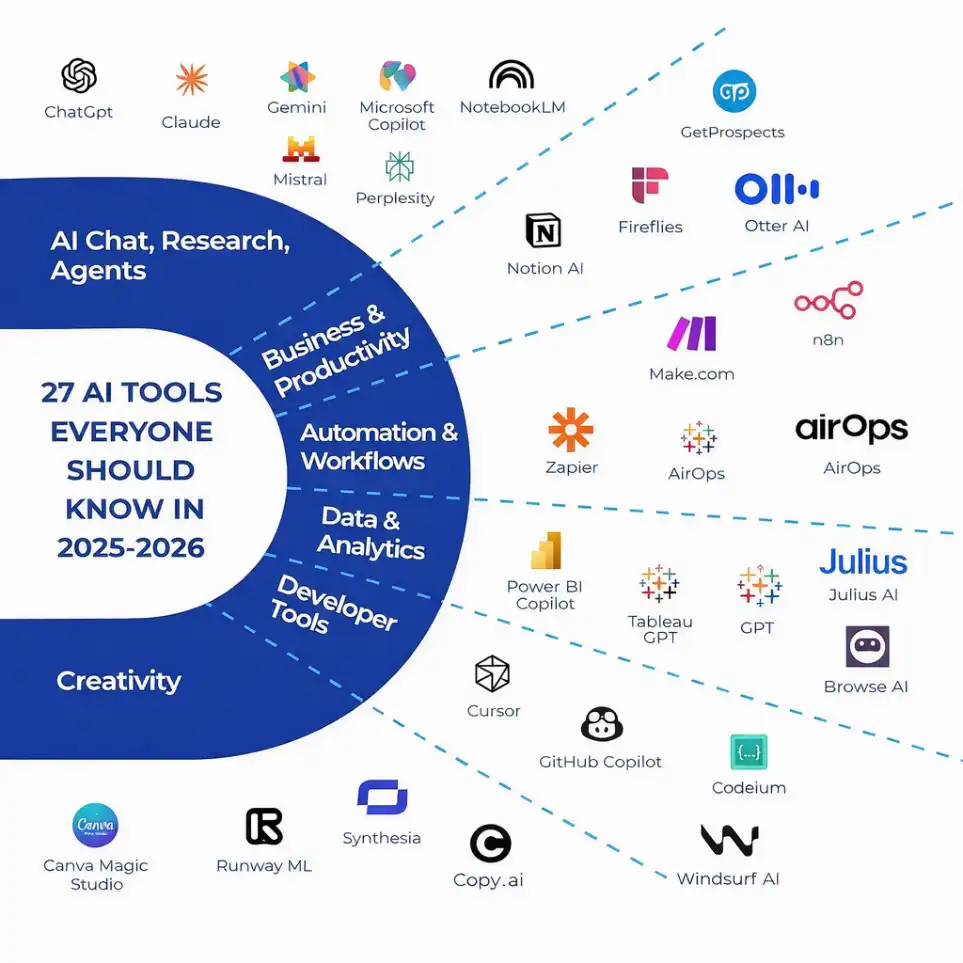
Figure 1 illustrates a vast ecosystem of AI tools that can be surveyed for various academic and professional tasks. It emphasizes how AI is contributing across multiple domains such as research support, automation, productivity, analytics, and creative work. Rather than concentrating on a single tool, the image encourages users to familiarize themselves with the available landscape and explore tools that best suit their workflows and needs. This overview aids in making informed decisions when adopting AI in practical scenarios.
The growing integration of artificial intelligence into academic and professional workflows marks a significant shift towards more efficient and accessible work practices. No-code AI tools are pivotal in this evolution by enabling students, educators, and professionals to utilize AI without technical barriers. They assist with various tasks, including model training, automation, research writing, academic documentation, and content refinement—all without replacing human judgment. When used thoughtfully, no-code AI tools diminish repetitive tasks, enhance productivity, and allow users to concentrate on analysis, creativity, and informed decision-making, making them valuable allies in contemporary academic and professional settings.