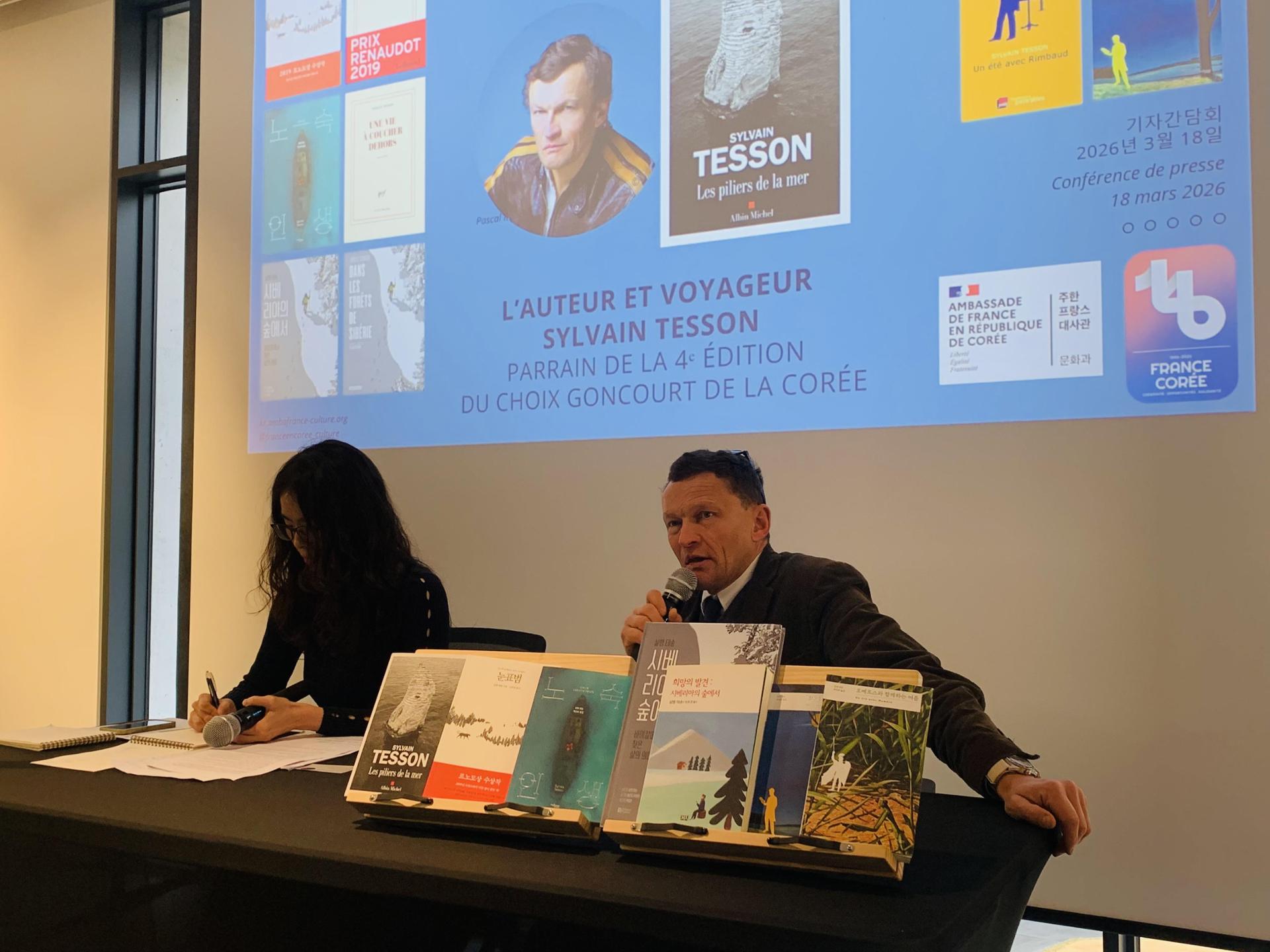
Sylvain Tesson speaks at a press conference at the French Embassy in Seoul, Wednesday. Korea Times photo by Anna J. Park
In an era where artificial intelligence (AI) is reshaping human experiences, French author and adventurer Sylvain Tesson emphasizes that the true challenge lies not in technological advancement, but in maintaining a harmony between culture and our innate human instincts.
Tesson, a distinguished recipient of three of France’s major literary awards— the Prix Goncourt (2009), Prix Médicis (2011), and Prix Renaudot (2019)—shared insights on his philosophy regarding travel and literature, while contemplating humanity’s intricate bond with nature, during a press conference held at the French Embassy in Seoul on Wednesday.
Born in 1972 and educated in geography, Tesson embarked on extreme adventures from an early age, publishing his first book in his twenties. He gained acclaim for his explorations in harsh environments, including a ski crossing of the Alps, which served as a backdrop for his evocative writing. Much of his work revolves around reconciling the opposing forces of civilization and nature, underscoring the complexities of the human experience.
Reflecting on his enduring passion for travel and writing, Tesson characterized travel as the cornerstone of his existence, with writing acting as the reverberation of those journeys.
“Many assume that those guided by natural instincts are uninterested in culture, while those who appreciate culture are detached from nature,” Tesson noted. “However, I believe both elements must exist in harmony. They are essential to what it means to be human.”
Cover of the Korean edition of “The Snow Leopard” by Sylvain Tesson, winner of the 2019 Prix Renaudot / Courtesy of BookRecipe
He further explained that the quest for equilibrium between culture, literature, and a profound appreciation for nature is a recurrent theme in his work.
“There exists an ongoing dialogue between the power of nature and the necessity of maintaining a societal existence,” he reflected. “My writing metaphorically seeks a balance between these two poles—the instinctual state of nature and the pursuit of culture and civilization.”
Tesson’s journey took a significant turn in 2014 when he suffered a fall from a rooftop, resulting in 26 fractures. After spending a month in a coma, enduring six months in the hospital, and undergoing a year of rehabilitation to regain his mobility, he faced an intense personal challenge.
Rather than becoming more conservative or subdued post-accident, Tesson found that his adventurous spirit intensified, along with his appetite for risks and new experiences.
“I wouldn’t say the accident transformed my life completely, but it certainly fortified my desire to live,” he recalled. “I aimed to move past the misfortune quickly and continue embracing life.”
Expressing skepticism regarding the effects of technology and AI, Tesson articulated his views on their implications for humanity.
“What truly benefits humanity are tools that we can control and that genuinely support us,” he asserted. “While a tool should enhance human abilities, I believe AI functions contrary to this. Instead of supporting, it breeds new desires and highlights deficiencies. We find ourselves in a reversed relationship where we become the tools of AI.” He contrasted this with the grounding experience of travel, which keeps people connected to reality.
Tesson finds fulfillment in arduous journeys motivated by his love for nature, immersing himself in both artistic and natural beauty.
“True happiness for humanity lies in art and the splendor of nature,” he said. “What we need is to reclaim ancient wisdom and our innate connection to nature, not rely on algorithms.”
His visit to Seoul aligns with his role as a promotional ambassador for the fourth Prix Goncourt Korea, a collaborative initiative between the French Embassy in Korea and the Académie Goncourt. This program encourages Korean students studying French to read and discuss four finalist works chosen for the Prix Goncourt, which celebrates the best and most imaginative French prose annually, before selecting a winner over five months.
During this engagement, Tesson imparted a piece of wisdom to the participating students.
“Reading is one of the greatest joys in life and a gateway to knowledge,” he remarked. “Opening a book is akin to opening a door that allows a fresh breeze to enter—it is an invitation to discover something extraordinary.”