In an innovative stride toward enhancing privacy in the realm of artificial intelligence, three researchers from Purdue University have created a patent-pending system designed to safeguard personal identity during AI-based photo editing. This groundbreaking technology is specifically aimed at minimizing AI’s ability to recognize distinguishing features such as eye color and facial hair.
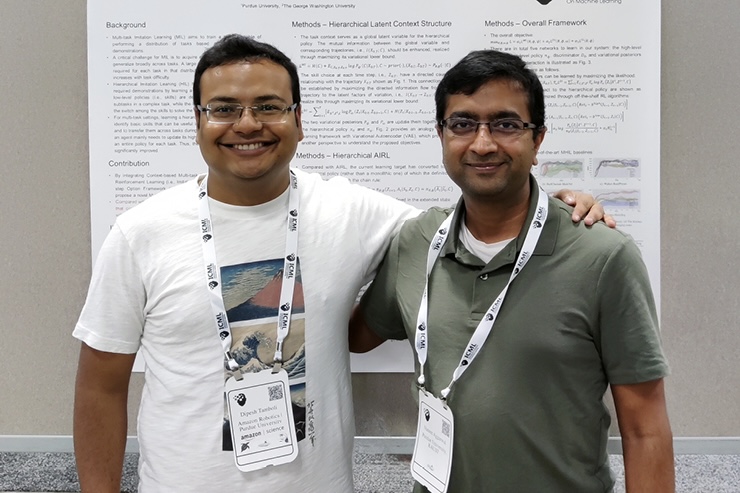
Developed by Vaneet Aggarwal, Dipesh Tamboli, and Vineet Punyamoorty, this system operates both before and after images are uploaded to an AI editing platform, as detailed in a media release from the university in West Lafayette, Indiana.
The researchers aim to assist not only consumers but also businesses and institutions in editing and sharing profile photos, ID images, and personal pictures, all while preventing external platforms from accessing sensitive personal information.
“Validation tests reveal that we can maintain editing quality while significantly diminishing what AI models can learn about an individual’s identity,” said Aggarwal. “This is an essential step toward ensuring reliable generative AI.”
Read: Indian American entrepreneur Aman Gottumukkala joins xAI
This research has been published in the peer-reviewed journal, IEEE Transactions on Artificial Intelligence.
Aggarwal serves as a University Faculty Scholar and holds the Reilly Professorship in Industrial Engineering, with additional roles in the departments of Computer Science and Electrical and Computer Engineering. Both Tamboli, a doctoral alumnus, and Punyamoorty, a doctoral candidate in computer and electrical engineering, were previously part of Aggarwal’s research group.
“Our system enables users to mask critical areas of their photo, such as the face, before sending it to an AI editing service,” explained Tamboli. “This masking is done locally on the user’s device using a precise outline of the region.”
According to Tamboli, only the masked version of the image is transmitted to the AI platform. “After the AI completes the editing, our system seamlessly reintegrates the sensitive area back into the modified image using geometric alignment and blending techniques,” he added.
Aggarwal highlighted that this Purdue innovation is pioneering in delivering full privacy, as the sensitive data never leaves the user’s device. Moreover, it generates seamless, natural-looking results compatible with any commercial generative AI model, eliminating the need for retraining.
“It’s privacy by design,” he emphasized. “With our system, the AI platform never accesses the actual face, yet the final edited image retains a completely natural appearance.”
The team has disclosed their innovative system to the Purdue Innovates Office of Technology Commercialization, which is actively pursuing a patent to secure the intellectual property.
Read: Indian American students create health care guide for new immigrants
In addressing the privacy challenges associated with modern AI editing tools, Tamboli pointed out that while these tools can produce remarkably realistic edits, they necessitate the upload of complete, unmodified images to cloud-based systems, thus exposing private details, such as facial features.
“Uploading full, unaltered images poses significant privacy and security risks,” he stated. “Once a photo is shared, users forfeit control over their biometric data, including its storage and potential misuse.”
Tamboli further explained that earlier privacy strategies, which included blurring sensitive areas, locking portions of images, using stylistic filters, or entirely avoiding cloud uploads, have proven inadequate in fully protecting individual identity.
The research team has conducted extensive validation of their system by comparing how well leading AI foundational models can infer biometric characteristics from both masked and unmasked images. Their findings indicate that the Purdue system considerably curtailed AI’s ability to identify attributes like eye color, facial hair, and age, with accuracy in attribute classification falling by over 80% in some instances, showcasing robust protection against identity theft.
Looking forward, the research team is actively working on making this technology available for real-world application, including efforts to broaden the system’s capabilities to safeguard additional sensitive features, such as medical details, identification documents, and other critical privacy considerations.