Harnessing AI to Tackle Agricultural Nutrient Pollution in the Chesapeake Bay
Artificial intelligence holds incredible promise in agriculture, especially in addressing environmental challenges. One such initiative aims to mitigate over-fertilization in crop production, a significant contributor to nutrient pollution in the Chesapeake Bay. This article explores an innovative AI program, PlantMap3D, and how it benefits farmers and the environment alike.

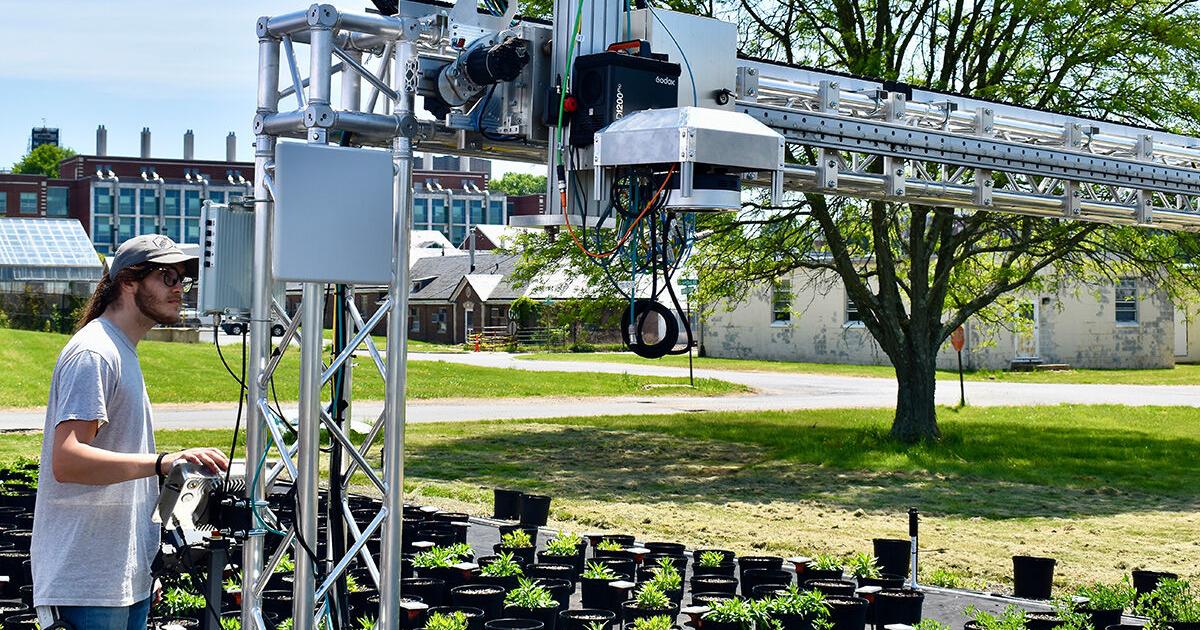
U.S. Department of Agriculture technician Zack Grzywacz programs a camera to identify plants at the Beltsville Agricultural Research Center in Maryland on April 29, 2025. (Matt Kane/The Nature Conservancy)
Over-fertilization can lead to nutrient runoff, severely impacting water quality in the Chesapeake Bay. However, a new AI tool called PlantMap3D aims to assist farmers in optimizing fertilizer usage by supplementing nutrients left by cover crops.
Cover crops are typically grasses and legumes planted during the off-season, which help to prevent nutrient pollution by reducing soil erosion and capturing nutrients, making them available for subsequent crops.
The AI technology assesses the amount of nutrients contributed by cover crops prior to planting the main cash crops. Environmental advocates hope this will lead to lower nutrient pollution in the Bay’s waterways, while also showcasing the potential limits of cover crop nutrients. This spring, farmers in three states within the Bay watershed will begin implementing the program.
Excess nutrients from fertilizers can create “dead zones” in the Bay, where aquatic life suffers from oxygen depletion. The Chesapeake Bay Program model suggests that conservation efforts, including the use of cover crops, have led to a 15% and 22% reduction in nitrogen and phosphorous entering the Bay, respectively, since 2009. Nonetheless, there are doubts about the model’s real-world accuracy.
Mike Twining, Vice President of Innovation at Willard Agri-Service, which plays a crucial role in implementing the AI tool, noted that while some conservation goals have yet to be achieved, significant progress is evident. He emphasizes that technologies like PlantMap3D will guide further improvements.

A camera mounted to farming equipment in Beltsville, MD, records plant diversity as it passes over cover crops on April 29, 2025. (Matt Kane/The Nature Conservancy)
The Nature Conservancy collaborates with Willard Agri-Service, Growmark FS, North Carolina State University, and the U.S. Department of Agriculture to implement the AI program across 150,000 acres in Delaware, Maryland, and Pennsylvania.
With approximately $16 million funded by the USDA’s Natural Resources Conservation Service and an additional $11 million from partners, the program will be available at no cost to eligible farmers. Those who experience a decline in production will receive compensation of up to $50 per acre.
Different types of cover crops interact with nitrogen in diverse ways. For example, legumes like peas are considered nitrogen-fixing crops, converting atmospheric nitrogen into ammonia within the plant’s roots through soil bacteria. Conversely, grasses such as rye and oats act as nitrogen scavengers, absorbing soil nitrogen and returning it to the soil upon decomposition.
Farmers often use a blend of cover crops to maximize benefits, as one species can enhance the effectiveness of another. For instance, combining grass and legume crops can balance decomposition rates, allowing microbes to metabolize nutrients effectively. However, sometimes one species may dominate, resulting in uneven nutrient distribution.
“Cover crops are a valuable tool with inherent complexity,” stated Chris Reberg-Horton, a professor at North Carolina State University.

A camera mounted to farming equipment in Beltsville, MD, records plant diversity as it passes over cover crops on April 29, 2025. (Matt Kane/The Nature Conservancy)
Utilizing PlantMap3D, cameras on farm machinery capture images of cover crops as farmers drive through the fields. The AI software identifies the plant species in these images, generating a comprehensive map of biomass for each species.
Simultaneously, Reberg-Horton integrates soil chemistry data, weather patterns, and plant species growth stages into the model. Ultimately, farmers receive a map that indicates which areas require more or less fertilizer.
The Nature Conservancy anticipates that this program will help prevent three million pounds of nitrogen from entering fields that could otherwise run off into the Bay. Variations in fertilizer application have been observed in experimental farms using this technology.
Twining believes that the program will deepen farmers’ understanding of cover crop biology. “This deeper insight,” he explains, “will foster a win-win situation—enhanced environmental outcomes along with increased profitability for Mid-Atlantic farmers.”
Charlie White, a nutrient management professor at Penn State University, cautioned that while PlantMap3D is valuable, it may not consider all nitrogen sources, particularly those available from the soil itself. Farmers still need to estimate their fertilizer requirements based on previous practices.
Nonetheless, White acknowledges the importance of the program in assisting farmers to comprehend the immediate nutrient impacts of their cover crops. “A variety of tools are essential,” he adds, expressing gratitude that PlantMap3D generates discussions on refining nitrogen fertilizer recommendations, which is crucial for sustainable agriculture.
In conclusion, the integration of AI in agriculture, exemplified by the PlantMap3D program, stands to offer significant improvements in nutrient management. By enabling precise fertilizer application, it not only supports farmer profitability but also plays a crucial role in protecting water quality in the Chesapeake Bay.