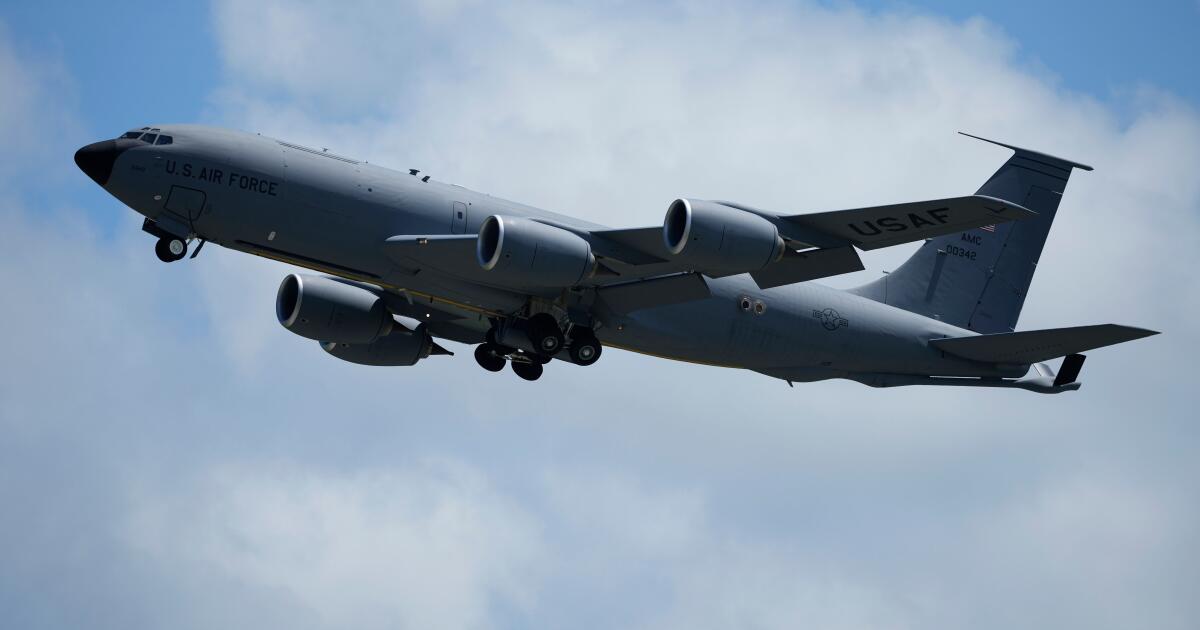
WASHINGTON — The ongoing conflict involving U.S. and Iranian forces has taken a tragic turn, with the recent death of six American airmen due to a refueling aircraft crash in western Iraq. This incident raises the U.S. death toll in the military campaign to 13. Defense Secretary Pete Hegseth has since ordered a deployment of Marines to the region, anticipating the most significant round of airstrikes to date.
Details of the Incident
The crash involved two planes within “friendly airspace,” as stated by the Pentagon, which confirmed that the other aircraft landed safely. This downed KC-135 refueling tanker marks the fourth U.S. aircraft to crash since the onset of the conflict.
“American heroes, all of them,” Hegseth remarked during a press briefing at the Pentagon. He reiterated the nation’s commitment to honor these heroes during their return at Dover and underscored the resilience needed for the mission ahead.
Central Command noted that investigations are ongoing, and the crash was not attributed to hostile or friendly fire.
Escalation of Military Action
Defense Secretary Hegseth announced plans for the heaviest airstrikes in two weeks of U.S.-Israeli operations targeting Iran, which have reportedly resulted in significant civilian casualties. Iranian officials have indicated that at least 1,348 civilians have lost their lives as a result of these strikes.
“No quarter, no mercy for our enemies,” Hegseth emphasized.
On the military front, the USS Tripoli amphibious assault ship and approximately 2,500 Marines are preparing to set sail from Japan to the Middle East to fortify ongoing operations in the area.
Strategic Implications
Amid speculation about the potential for a ground invasion of Iran’s Kharg Island—crucial for oil exports—President Trump remarked that while it is “not high on my list,” he retains the flexibility to change priorities quickly. Later, he indicated through social media that U.S. forces had executed bombing raids aimed at military assets on Kharg Island, vowing to reconsider any decisions should Iranian interference escalate in the Strait of Hormuz.
Despite Hegseth’s assertions regarding military objectives, President Trump’s statements have sparked uncertainty about the alignment between the White House and the Pentagon regarding mission goals.
When questioned about the war’s potential conclusion, Trump simply stated, “When I feel it — feel it in my bones.”

An Iranian man makes a wish as he blows out a candle during a small birthday party at a cafe at night in Tehran on March 13, 2026.
(Morteza Nikoubazl / NurPhoto)
Iran’s Response and Global Impact
During the briefing, Hegseth described Iranian leaders as desperate, stating they are hiding underground. He claimed that Iran’s Supreme Leader Ayatollah Mojtaba Khamenei is “wounded and likely disfigured,” though no evidence was provided. Khamenei, who has remained out of public view, issued a statement vowing retaliation against U.S. and Israeli actions, promising to continue efforts to disrupt global oil routes through the Strait of Hormuz.
“Our revenge will be never-ending, not only for the late supreme leader but for the blood of all our martyrs,” Khamenei declared.
The situation has invoked significant worries about oil supply disruptions worldwide, with the International Energy Agency reporting that the conflict has resulted in the largest supply disruption in history. Oil prices have surged dramatically, impacting economies globally.
Currently, around 1,000 ships are stranded in the Persian Gulf, unable to deliver vital oil and gas exports due to Iranian threats. Incidents in the region have reportedly escalated, with 20 reported threats to vessels as of March. These shipping disruptions are also provoking severe threats to global fertilizer supplies, which could lead to increased agricultural costs.

Secretary of Agriculture Brooke Rollins speaks with members of the press before she and a small group of National Finals Rodeo winners meet President Trump and tour the White House on Friday.
(Roberto Schmidt / Getty Images)
Government Responses
U.S. Agriculture Secretary Brooke Rollins acknowledged that the conflict has financial implications for farmers but expressed optimism about a swift resolution. She noted that most farmers have procured their fertilizer for the planting season, although around 25% have not, thus necessitating a thorough understanding of current market conditions.
Continued drone and missile attacks threaten to broaden the conflict’s scope. A recent Iranian drone strike resulted in minor property damage in Dubai, demonstrating the regional repercussions of ongoing hostilities. Additionally, Europe is becoming more deeply involved, with U.S. long-range bombers conducting missions from British airbases, despite earlier opposition from U.K. Prime Minister Keir Starmer.
As military operations continue, the Israel Defense Forces stated that their strikes in Lebanon and Iran are “continuing and intensifying.” Subsequent attacks have resulted in civilian casualties, further complicating an already delicate situation.
Key Takeaways
- Six U.S. airmen died in a refueling aircraft crash in Iraq.
- The U.S. military conflict with Iran has resulted in a total of 13 American fatalities.
- Heavy airstrikes against Iran are in progress, with significant civilian casualties reported.
- Concerns over global oil supply disruptions are escalating, impacting economies worldwide.
- U.S. Agriculture Secretary addresses farmers’ fertilizer supply issues due to the conflict.
- Increased military actions and international involvement are heightening tensions in the Middle East.
FAQ
What caused the aircraft crash in Iraq?
The crash involved a KC-135 refueling tanker, which was reported to be in “friendly airspace,” and investigations are ongoing to determine the exact cause.
How has the conflict impacted global oil prices?
The ongoing military actions and threats in the Strait of Hormuz have resulted in a 40% increase in oil prices, causing significant economic concern globally.
What measures are being taken to address food security?
U.S. Agriculture Secretary Brooke Rollins has indicated that most farmers have purchased their necessary fertilizer, but efforts are underway to monitor and address supply chain issues.
What is the state of military operations currently?
Military operations are ongoing, with U.S. forces executing airstrikes and preparing for increased troop support in the Middle East. Escalating tensions are leading to an increase in strike frequency.
Conclusion
The situation in the Middle East remains fluid and complex, with escalating military actions and political ramifications. As the conflict unfolds, both domestic and international implications continue to grow, emphasizing the need for careful monitoring and response strategies.