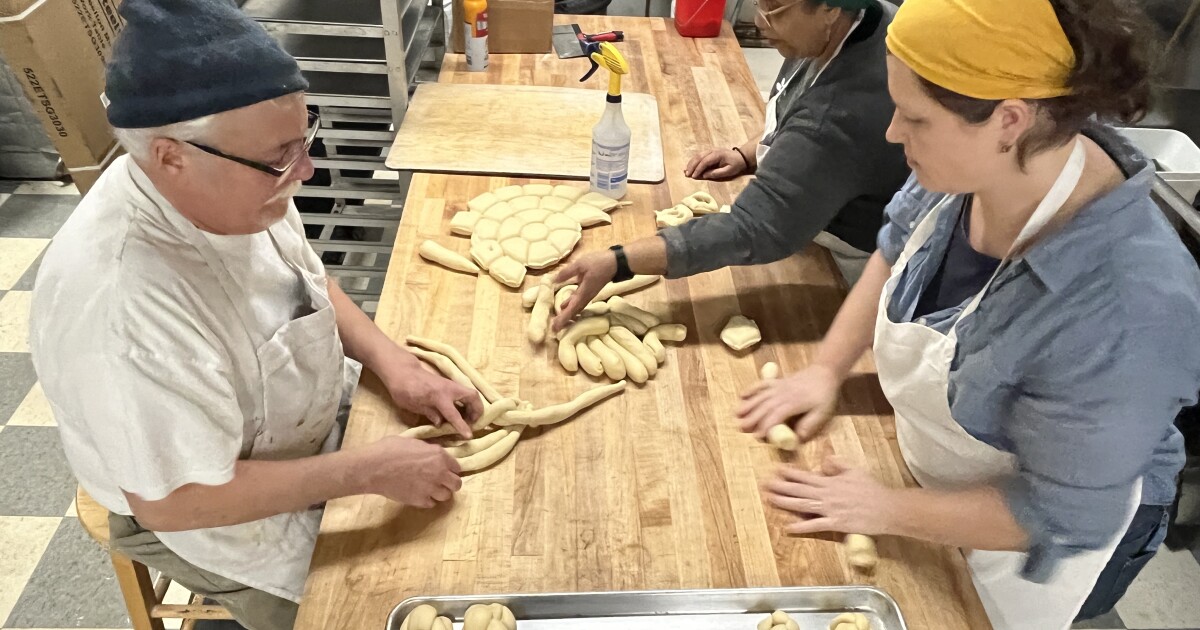
In the bustling backroom kitchen of Malek’s Bakery, head baker Tom Quinn skillfully weaves together strands of dough, crafting one challah loaf after another. The air is filled with the warmth of freshly baked goods and a sense of camaraderie.
“Do you want me to do it blindfolded?” he jokes, prompting laughter from two colleagues who are also busy preparing bread at the table. The kitchen, where history intertwines with craft, is more cramped than usual today, as repairmen work diligently to diagnose a malfunctioning oven.
For over fifty years, this bakery on Monroe Avenue in Brighton has been known as Malek’s, previously serving the community under another name. Operators note that its slicers date back to the 1950s, and the oven bears a serial number of just 2. When it breaks down, food preparation must temporarily relocate to one of the local synagogues to ensure that challah and other essentials are ready for Shabbat.
Malek’s stands as the sole kosher bakery in the Rochester area, mirroring Lipman’s, the neighborhood’s only kosher meat market.

Both establishments are cornerstones of the local Jewish community. Plans are currently in motion to combine these businesses into a single location near Twelve Corners, creating a “Jewish food hub” that will feature cooking classes, culinary lectures, a small market or grocery, and a cultural area, along with an outdoor space dedicated to Holocaust survivors. This new facility promises updated amenities and greater space for operations.
The new site is a single-story building, formerly used as a medical facility, located at 885 S. Winton Road, a mere five-minute stroll from Malek’s. “Location is key,” remarked Naftali Hanau, who, along with his wife, Anna, recently acquired and began managing the two shops.
“The kosher-keeping community centers around the Monroe Avenue corridor,” he explained. “Between Twelve Corners and Culver, we have four synagogues. We have to be accessible, so people can walk or send their kids to pick something up; otherwise, it won’t work.”
‘The Community Needs This’
In a world increasingly focused on health and food transparency, the demand for kosher food is growing nationally and globally. At Malek’s, the customer base often includes a majority of non-Jewish patrons, especially at the beginning of the week. However, larger food brands like Manischewitz, Empire Kosher, and Nestlé U.S. are capturing that growth in the market.
In contrast, Malek’s and Lipman’s face challenges despite Greater Rochester hosting the largest Jewish community in New York State outside of New York City, with Brighton being its heart.
“We often find ourselves operating at a loss,” Hanau admitted, recalling his childhood visits to these shops. “We aim to build these businesses together because the community absolutely needs them. Yet, under the current model, it’s not sustainable.”

The proposal for the new, combined market is scheduled for a public hearing before the Town Board later this month. The initiative has garnered support from the Farash Foundation, the Jewish Federation of Greater Rochester, and numerous local rabbis.
“To cultivate a vibrant Jewish community, it’s crucial to have key institutions, and kosher businesses are among them,” said Rabbi Peter Stein of Temple B’rith Kodesh. Rabbi Stein, along with seven other rabbis from congregations in and around Brighton, signed a letter of support directed to town Supervisor Bill Moehle. Their correspondence also highlighted the importance of the Hillel Community Day School, expressing that without these establishments, “Rochester would become a non-starter for any observant individual considering relocation to our city.”
There was once a time when the thriving Jewish community supported numerous butcher shops, bakeries, and other businesses along Joseph Avenue in the city. However, in recent years, the population has shifted towards the suburbs and has diminished.
“The Jewish community of Rochester has certainly evolved over time,” Stein acknowledged, noting demographic changes and shifts in religious practices. However, he also mentioned that his congregation is experiencing growth among both children and adults. “This advocacy effort is essential to ensure the strength of our community, and these businesses are a piece of that puzzle.”
‘Nothing More Powerful’
Prior to operating Malek’s and Lipman’s, the Hanaus resided in Brooklyn for twenty years, founding and managing a kosher meat company, Grow & Behold Foods. Therefore, they arrived in Rochester with a solid understanding of community rhythms surrounding holiday celebrations. “Food is integral to these community traditions,” Anna Hanau highlighted.
“When we decided to take a break from New York City and try Rochester, this felt like the perfect fit because this is what we do; we feed people,” she explained.
As she and Quinn worked in the back kitchen of Malek’s on a typical weekday, customers flowed in and out, browsing the display cases stocked with an array of cookies, fruit pastries, muffins, knishes, babkas, and various breads.

“In the bakery, we produce most of our items in-house, and we have no desire to change that,” Naftali Hanau remarked. “People are very attached to our cherished traditions.”
“For instance, this is the birthday cake I’ve ordered for my child,” Anna added. “Our intention is to preserve what customers love while improving what can be improved.”
They have introduced innovative products, enhanced catering services, and even adapted to offer online pickups and deliveries. Nevertheless, both businesses continue to operate from outdated spaces, designed around what Naftali Hanau calls “an antiquated operational model.”
Each location only features four parking spaces, and the display cases necessitate staff to personally hand each item to customers, as there is insufficient room for pre-packaged products or prepared foods. All these issues are set to be addressed with the new building.
However, maintaining tradition remains a priority. In the proposed combined market, Anna hinted at plans for a historical display detailing the narrative of Jewish food history in the region.
“It’s essential for us to create a link to the past,” she said. “Yes, the new venue represents a shift, yet it embodies the rich traditions of Jewish culture in Rochester and beyond.”

Rabbi Stein recognizes the broader significance of this connection and opportunity.
“There’s nothing more powerful than breaking bread together,” he noted. “These kinds of facilities not only meet the needs of the Jewish community but also serve as a cultural center, uniting diverse individuals through shared food experiences, alongside the rich traditions that accompany them.”
This vision encompasses the essence of two small shops that may soon become one.
“Although I didn’t grow up here, returning feels like a weighty responsibility—like I’m holding something precious,” Anna Hanau remarked, highlighting how these businesses serve as communal pillars during significant life events like shivas, brises, and baby naming ceremonies. “It’s vital for our family to ensure their success, but it’s deeply tied to serving the community and its rhythms of life.”