Balendra Shah, a former rapper turned politician, is poised to become Nepal’s next prime minister following a historic victory for his party, the Rastriya Swatantra Party (RSP). Marked by a surge of support from the younger generation, this election signifies a paradigm shift in the country’s political landscape.
Party Victory
Shah, popularly known as Balen, led the RSP to an exceptional landslide victory in Nepal’s first election since the youth-led protests that resulted in significant political upheaval and unrest.
Ramesh Paudyal, a senior leader of the RSP, expressed that “It is the victory of hope and change. The true tribute to the gen Z martyrs will be demonstrated through the dedicated work of the government led by Balendra Shah.”
This electoral outcome reflects widespread public dissatisfaction with longstanding political leadership, resulting in major losses for veteran parties and their representatives. Founded merely three years ago by a former television executive, the RSP has achieved an outright majority in an unprecedented manner.
Nepal’s hybrid electoral system, which blends the first-past-the-post and proportional representation methods, often results in fragile coalition governments. As the vote counting approached completion, RSP had claimed at least 122 out of 165 direct seats, positioning the party for its largest electoral majority in Nepal’s democratic history.
The anticipated final election results, inclusive of additional seats assigned through proportional representation, are expected shortly.
This election cycle has been regarded as one of the most consequential and engaging in recent memory, showcasing a clash between entrenched political figures and a vibrant, youth-driven initiative aimed at eradicating corruption and fostering renewal.
Despite his newcomer status in the political arena, Shah, aged 35, emerged as a frontrunner with a lively campaign that resonated with the aspirations of young Nepalis.
An engineer by education, Shah gained fame as a rapper whose lyrics focused on societal issues such as poverty, unemployment, and corruption. In 2022, he transitioned to public service, successfully running for mayor of Kathmandu. His administration began major reforms, including the dismantling of unauthorized structures and addressing waste management.
Shah’s rise to national fame originated from a youth uprising last September, which ignited in reaction to a ban on social media, fueled by broader discontent over limited economic opportunities. The government’s harsh response resulted in the tragic loss of 19 protesters.
The upheaval snowballed into extensive unrest and destruction, leading to 70 fatalities and the resignation of the administration led by four-time prime minister KP Sharma Oli and his Communist party.
The rapid dissolution of the government shocked many within the movement. Initially, Shah, favored by the gen Z protest leaders for an interim prime minister role, opted to wait for the official elections set for March 5.
In a symbolic contest against established politics, Shah ran for election in the Jhapa-5 constituency, going up against the 74-year-old Oli.
Shah’s decisive victory was confirmed on Saturday night, winning 68,348 votes to Oli’s 18,724. As the former prime minister conceded, he expressed his wishes for Shah to have “an uninterrupted five-year term, heartfelt best wishes.”
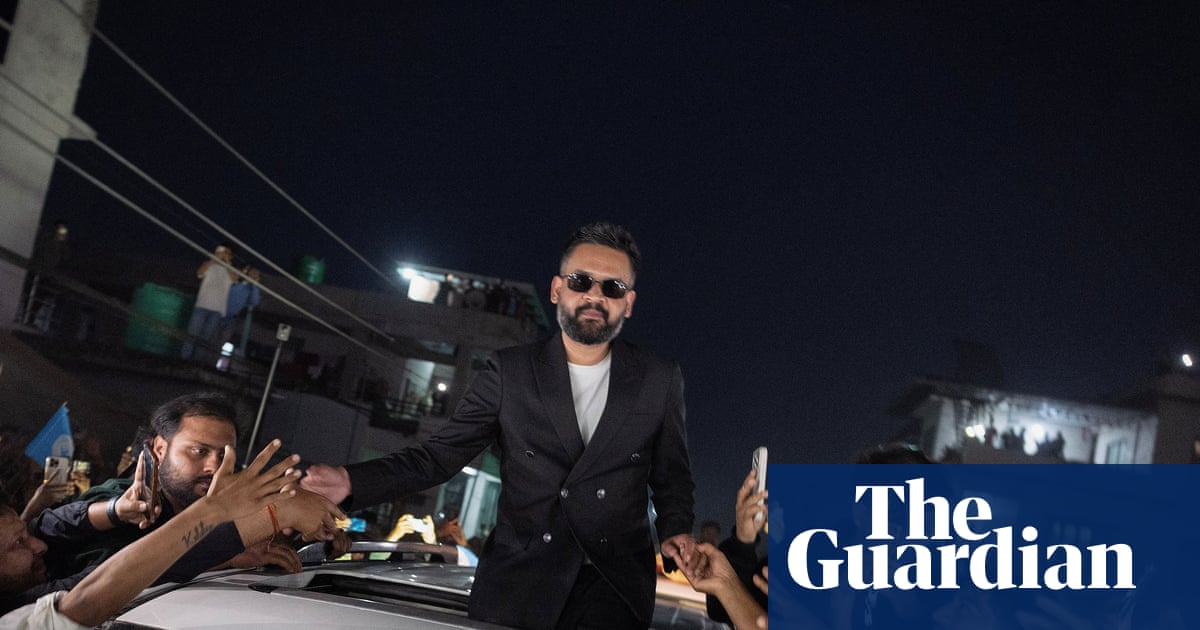
When picking up his election certificate, Shah appeared in his trademark dark sunglasses and black blazer, emerging from his vehicle’s sunroof to display a banner proclaiming: “Congratulations to all of you, this is your victory.”
The atmosphere in Jhapa-5 was festive following his win. “One of the main figures behind the gen Z movement, KP Oli, has been defeated. It feels like justice for the martyrs,” remarked Aditya Karna, 23. “There is now hope that Balen will steer the country toward a brighter future.”
Bhawana Raut, another leader within the gen Z initiative in Jhapa, commented that this outcome may lead to much-needed “healing” following the violence of the September protests. “This sends a strong message to those in power: accountability is essential,” she asserted. “Even leaders who have emerged from major struggles can be dismissed by voters in an instant. The government should serve the people, not rule over them.”
However, analysts caution that Shah confronts significant challenges ahead, particularly in meeting the high expectations of the younger populace. His campaign pledges included investigations into past leaders for systemic corruption and holding the former Oli government accountable for the deaths of gen Z protesters.
“The public has myriad hopes and desires,” stated political analyst Lok Raj Baral. “While there is a positive mandate, fulfilling these aspirations is quite a challenge in a country like Nepal. The bureaucracy remains unchanged; only the political leadership has shifted.”
With Nepal’s strategic position between India and China, the new prime minister’s foreign policy approach will be crucial for national interests.
Baral added: “The RSP won largely by convincing citizens of their commitment to effective governance, which is commendable. However, from the very start of his tenure, Balen will encounter significant obstacles.”
Key Takeaways
- Balendra Shah likely to become Nepal’s next prime minister after leading the RSP to a historic electoral victory.
- The election represents a shift in political power from veteran leaders to a younger generation seeking reform.
- Shah aims to tackle systemic corruption and improve governance in response to public demands.
- The rapid changes in Nepal’s political scenery have raised both hope and expectation among young voters.
- Shah’s leadership may face significant challenges due to longstanding bureaucratic structures.
FAQ
Question
What prompted the recent protests in Nepal?
The protests were largely driven by a ban on social media and broader frustrations over limited economic opportunities.
Question
Who is Balendra Shah?
Balendra Shah, known as Balen, is a former rapper and the leader of the Rastriya Swatantra Party, advocating for youth-driven reforms.
Question
What challenges does Shah face as he takes office?
Shah must navigate high public expectations, investigate past corruption, and manage a complex bureaucratic landscape.