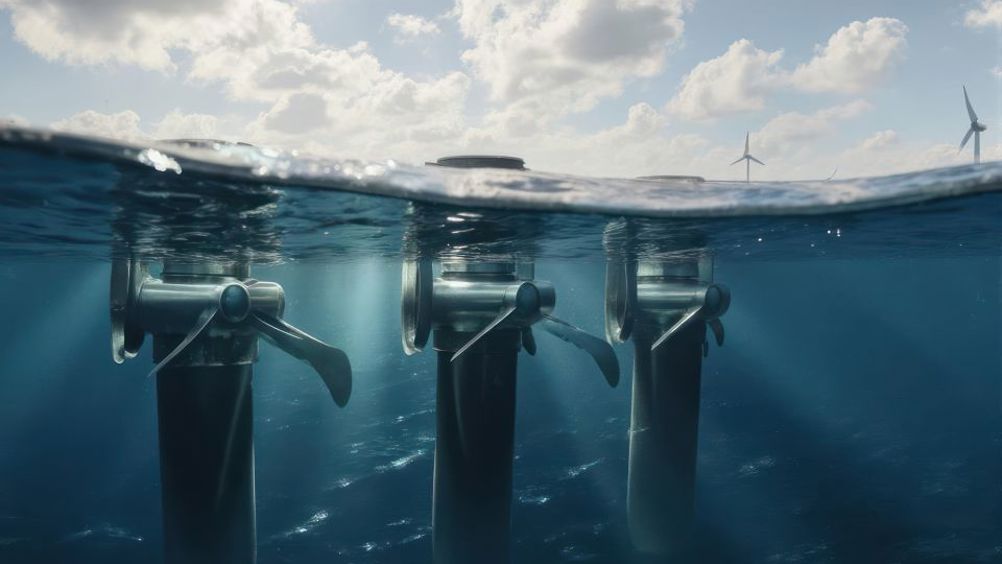
As the UK gears up for a significant expansion in tidal energy, a groundbreaking project known as (not)NOISY (Propagation of NOISe generated by tidal arraYs and its environmental impacts) aims to develop sophisticated tools for predicting the cumulative underwater noise generated by tidal turbine arrays before their construction.
Researchers at Manchester University have stated that this initiative will bolster the efforts of the industry, regulators, and policymakers, enhancing the evidence base used in environmental assessments and facilitating more informed and balanced decision-making as the sector progresses.
As the industry shifts toward larger deployments, specifically turbine arrays featuring ten or more units, evaluating environmental impacts becomes increasingly vital. This is especially true regarding potential collisions with marine megafauna and the spread of underwater noise, which could propagate up to 8 km through ocean waters.
Research lead Dr. Pablo Ouro, a Research Fellow in the Department of Civil Engineering and Management at Manchester University, emphasized: “Tidal stream energy holds significant promise for supporting the UK’s Net Zero ambitions. However, its long-term success relies on our capability to accurately assess and mitigate environmental impacts, thereby expediting project permitting and licensing.”
“Noise generation remains one of the foremost uncertainties confronting tidal projects today. Unfortunately, reliable tools for estimating cumulative acoustic outputs with high confidence have yet to be developed. As the number and size of tidal arrays are projected to increase, we need predictive tools that can evaluate their cumulative acoustic impact prior to deployment. (not)NOISY will provide just that.”
MORE FROM ENERGY & ENVIRONMENT
The research team will create advanced high-fidelity computer models and AI-assisted rapid tools that reflect real-world tidal stream site conditions. This will enable researchers to accurately quantify how noise from tidal turbines disperses throughout various marine environments.
The models will be tested in both near- and far-wake regions under a range of turbine styles (including floating and bottom-fixed) and environmental settings at four prominent European sites: EMEC and MeyGen in Scotland, the Normandie Hydroliennes tidal site situated in Raz Blanchard between France and the Channel Islands, and Morlais in Wales.
The research outcomes will lead to the creation of PyTAI (Python Tidal-Array Induced acoustics), an open-source, AI-driven tool designed for the rapid prediction of tidal turbine noise under various operational conditions.
Dr. Ouro remarked: “By enhancing the reliability of marine noise predictions, we hope this project will expedite the development of the next generation of tidal-stream solutions, supporting clean energy initiatives while safeguarding marine ecosystems, thus cultivating an industry of national significance.”
(not)NOISY is funded by the UKRI Engineering and Physical Sciences Research Council Supergen Offshore Renewable Energy Impact hub and unites three European turbine manufacturers, along with UK and French tidal project developers, policymakers, and academic partners.