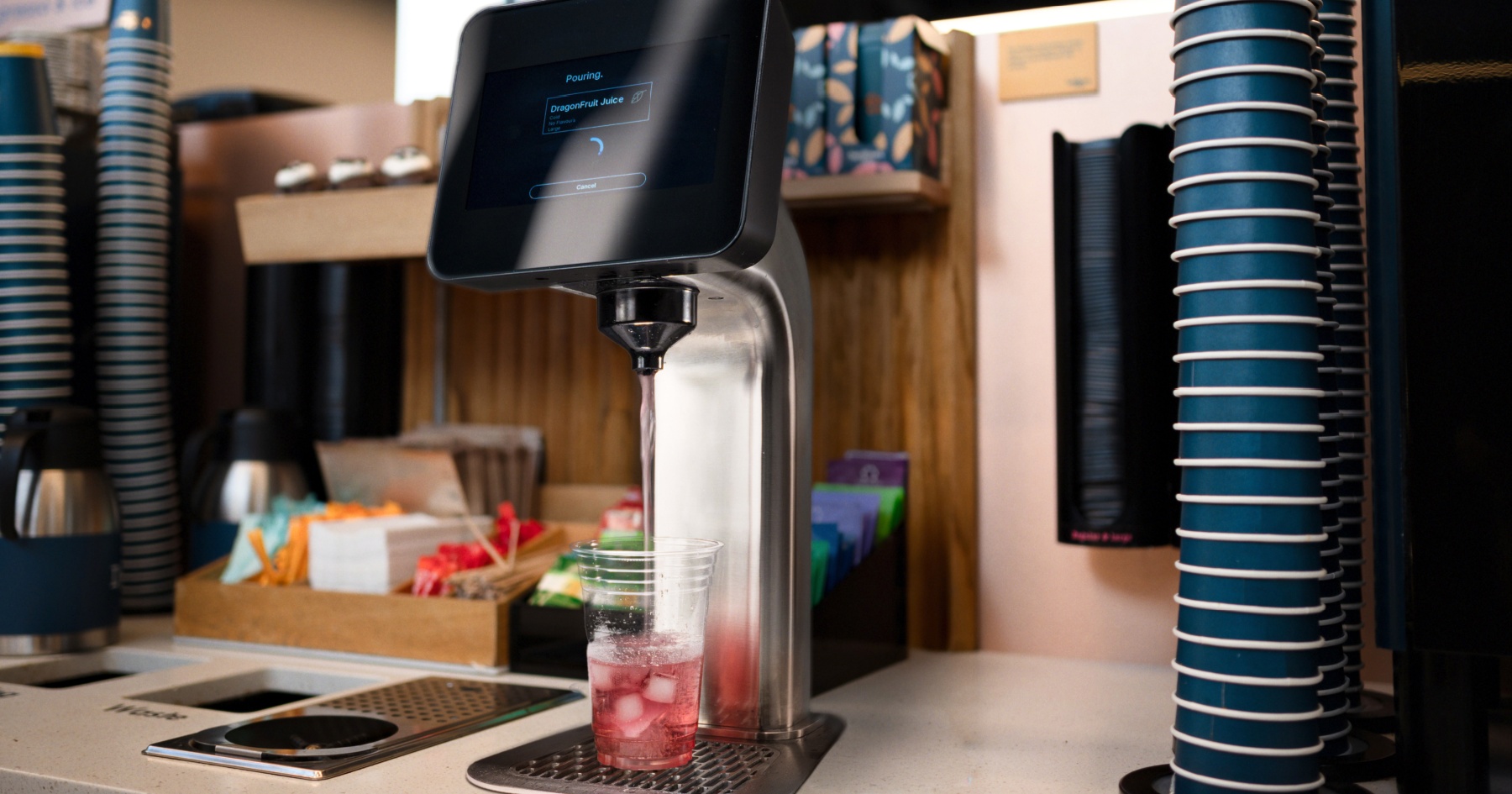

The Sypp machine from Marco Beverage Systems specializes in refreshers. | Photo courtesy of Middleby Corp.
In today’s dynamic dining landscape, beverages have become a focal point, influencing menu designs and customer preferences. As the demand for innovative drink options rises, businesses are turning to advanced equipment solutions to keep pace with consumer expectations.
Phil McKee is a self-proclaimed oven guy. Back in the early 1990s, he invented the TurboChef, a high-speed ventless oven that would revolutionize foodservice for cafes and convenience stores. He would go on to develop other cooking equipment over the years, such as Ovention conveyor-belt ovens.
But more recently, the oven guy felt himself being pulled in a new direction: beverages.
Emphasis on pulled.
“Everything we did for 30 years was what I call ‘technology push,’” McKee said, meaning he would come up with an idea, develop it and bring it to market. “That is completely the opposite of what’s going on in beverages. We got sucked into beverages by customers [saying], ‘I want stuff that equipment manufacturers are not enabling operators to provide.’”
Beverages are the hottest menu segment in the restaurant industry right now, driven by demand for creative drinks such as dirty sodas, refreshers, blended coffees and more.
The evidence is everywhere. Beverage chains like Dutch Bros, 7 Brew and Swig are booming. Large brands such as Chick-fil-A and Taco Bell are spinning off their own drink-focused concepts. And trendy sips are showing up in unexpected places: Perkins, the old-school breakfast chain, now serves boba.
But this new generation of beverages comes with new operational challenges for restaurants. The drinks tend to be more complex to make than standard coffee or dispensed soft drinks. They’re customizable and often require multiple ingredients and steps.
“It’s a very manual process,” said James Pool, chief technology and operations officer for Middleby Corp., on the production of craft beverages. “They have gallon containers of juice that they’re filling cups with and adding various flavors into to basically concoct this very special beverage.”
“It’s a very imprecise way to dispense beverages, and you would not settle for that with any other aspect of your kitchen operation.”
For brands that want a piece of the beverage action, the old-fashioned soda fountain probably isn’t going to cut it. And some are turning to their equipment suppliers for help.

QuikTrip’s new tea machines allow for more customization. | Photo courtesy of Appliance Innovation
For McKee, one of those operators was QuikTrip (QT), the Tulsa-based convenience store chain. QT is known for its robust tea program, with six brewing machines and 12 urns offering sweetened and unsweetened tea, hot or cold, in each store.
But QT had a problem: Tea goes bad quickly. After tea is brewed and sitting in an urn, it begins to cool. At a certain temperature, microbes proliferate, which makes the tea taste stale. That meant QT had to throw out a lot of tea in order to keep the product fresh. It was wasteful and created more work for employees.
So McKee and his team at Appliance Innovation spent the past several years developing a new way to brew and serve tea that would keep it fresher for longer. The final product, a brewing machine called SimpliciTea, can keep tea fresh for days, rather than hours, using a patented system that rapidly cools brewed concentrate so that microbes don’t have a chance to grow. The concentrate is then stored at 40 degrees and dispensed to order.
The machine automatically monitors tea supply and brews more when necessary; it also cleans itself once a week, easing the workload for staff.
And it allows customers to easily customize their beverages. Using a touchscreen ordering display, they can choose different flavors and sweeteners for their tea.
“The options for the consumer are kind of limitless now to make their own custom beverage, versus before, they were fixed to whatever was in that urn,” McKee said.
QT is halfway through rolling out SimpliciTea at its 1,200 stores, he said, and Appliance Innovation is now marketing the machine to other operators, including a smaller version with fewer tea options.
QT wasn’t the only c-store giant looking to upgrade its beverage equipment. Around the same time QT came to McKee about tea, 7-Eleven also approached with a separate beverage-focused request.
“They said, ‘We’ve fallen behind in coffee. We used to be where America went for coffee on their way to work. But Starbucks has taken away a lot of our business,’” McKee recalled. He said the chain had tried specialty coffee equipment, but it was too much work for its busy operators to maintain.
So 7-Eleven asked McKee: “Can you guys figure it out?”
The result is COFU, short for Coffee of the Future. The machine is designed to produce barista-quality coffee drinks in a small footprint, including hot and iced coffee, lattes and cold brews. Like SimpliciTea, everything is customizable; the machine even has a barcode printer that allows it to charge for extra shots and other add-ons. 7-Eleven is testing COFU now in about 13 units in Dallas.
“Young people have said, ‘I want what I want, the way I want it, at the time I want it, in the location I want it,’” McKee said. “‘You guys in the foodservice equipment industry, get your act together, because we are in force.’ That’s what’s going on right now.”
A similar story has been unfolding at Dallas-based Middleby. The company, which today owns TurboChef and many other equipment brands, worked with Taco Bell parent Yum Brands to develop a high-tech new drink dispenser called FizzBot.
The FizzBot features a proprietary valve that allows restaurants to quickly swap different products in and out of the machine. Traditional valves, on the other hand, need to be calibrated for different beverages and maintained over time.
With the FizzBot, “We have the ability to serve Coke out of a valve one day, or a juice the next day, alcohol the day after that,” Pool said. “These valves are incredibly flexible, and they’re all menu driven.”
That means brands like Taco Bell and Yum-owned KFC can quickly add new limited-time offers or other beverages systemwide.
“Today, for a major restaurant chain to add a new flavor, it can take up to six to nine months to add because they physically have to go touch every dispensing machine in the market,” Pool said.
The FizzBot is fully automated and connects to the restaurant’s POS system so it can begin producing drinks as soon as they’re ordered, dropping the cup and filling the ice and beverage. It also has the ability to seal cups, which is a key issue for delivery orders.
“Customers are excited about cup-sealing because they want to start selling beverages again to their online customers,” Pool said. “Traditionally with soda cups, they’ve been reluctant to do that.”
Though FizzBot was developed in partnership with Yum, it will be available to other brands, Pool said.

The Gravity dispenser from Newton. | Photo courtesy of Middleby Corp.
Through its Newton brand, Middleby is offering a similar machine called Gravity that features the same valve technology as FizzBot but without the POS connection. Gravity allows operators to offer up to 48 different beverages, syrups and flavors—“anything that is viscous,” Pool said—so customers or operators can concoct dirty sodas and other specialty drinks. It’s designed to replace the traditional self-service soda fountain.
A third new Middleby product marketed by Marco Beverage Systems is aimed at serving the market for refreshers—non-carbonated, juice-based drinks that may contain fresh fruit or other mix-ins, almost like a cocktail without the alcohol.
This machine, called Sypp, can be stocked with eight different syrups or other ingredients and can produce pre-programmed drinks at the press of a button.
“I like to think of these platforms as the first truly future-proof beverage machine that’s been introduced to the market,” Pool said, given their ability to dispense just about any liquid. “It could literally be the last soda machine or beverage dispenser that you buy until it wears out.”
Key Takeaways
- The beverage segment is rapidly evolving, driven by consumer demand for innovative drinks.
- Operators face new challenges in preparing complex, customizable beverages.
- Advanced machines like SimpliciTea and COFU enable convenience stores to enhance their beverage offerings.
- FizzBot and Gravity technologies streamline beverage dispensing and customization.
- Future-proof beverage machines are being developed to meet diverse customer needs.
FAQ
What is the SimpliciTea machine?
The SimpliciTea machine is designed to brew and serve tea while keeping it fresh for days instead of hours by using a patented cooling system.
How does the FizzBot work?
The FizzBot features a proprietary valve system that allows restaurants to quickly swap out beverages and automatically connect to POS systems for streamlined order processing.
What are dirty sodas?
Dirty sodas are a beverage trend featuring soft drinks mixed with flavored syrups and cream, creating a customizable and unique product.
As beverage trends continue to shape the dining experience, the foodservice industry must adapt to meet growing consumer expectations. Innovative equipment is proving essential for businesses to thrive in this evolving landscape.