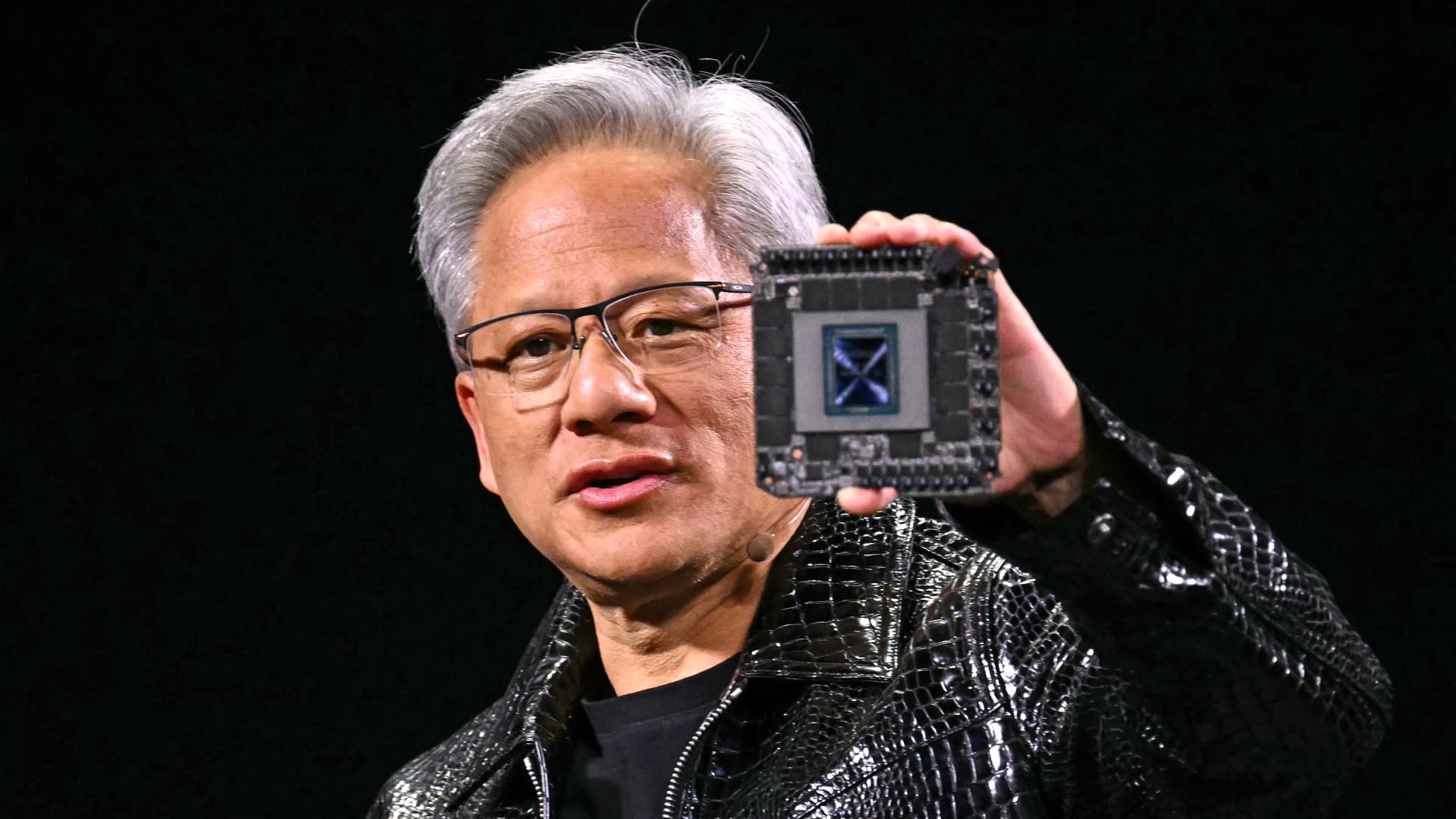
Nvidia CEO Jensen Huang delivers a keynote address at the Consumer Electronics Show in Las Vegas, Nevada, on Jan. 6, 2025.
Patrick T. Fallon | Afp | Getty Images
In a recent statement, Nvidia CEO Jensen Huang emphasized that the markets have undervalued the role of AI agents in the software industry. This assertion came just hours after his company released a positive sales outlook, driven by robust AI demand.
During an interview with CNBC’s Becky Quick, Huang expressed skepticism regarding concerns that AI could undermine enterprise software companies. He believes that a significant number of software firms will leverage AI to enhance their offerings and improve operational efficiency.
Huang presented a “counterintuitive” perspective, asserting that AI agents will not replace existing software tools but will utilize them instead.
“That’s why we also say agents are tool users,” he noted.
He provided examples such as the internet browser and Microsoft‘s Excel as pivotal tools that AI agents will effectively employ.
“All the tools we utilize today, whether it’s Cadence, Synopsys, ServiceNow, or SAP, exist for good reasons. These intelligent AI agents will effectively utilize these tools to enhance our productivity,” Huang remarked.
“No one performs service better than ServiceNow. They will develop agents specifically optimized for the tasks associated with their tools,” he added.
“Ultimately, we need these tools to complete tasks and rel
ease the information in a comprehensible manner,” he concluded.
These comments were made following Nvidia’s announcement that its revenue for the fiscal fourth quarter surged 73% to $68.13 billion, surpassing analysts’ estimates of $66.21 billion.
The company also provided an optimistic outlook, predicting first-quarter revenue of $78 billion, plus or minus 2%, well above analysts’ expectations of $72.6 billion.
Investor concerns have been mounting that the substantial expenditures on AI hardware may not be sustainable, raising fears of a potential bubble in the sector.
Software service providers have seen significant declines in their stock prices recently. While some analysts warn that AI will “disrupt” software in the long run, opinions on this risk and the underlying reasons for the recent sell-off appear mixed.
In after-hours trading following Huang’s remarks, software stocks experienced varied movements. Synopsys dropped by 3.6%, Cadence fell by 0.9%, ServiceNow remained stable, while SAP saw a slight increase of 0.3%.
“Historically, all major advancements — be it railroads, canals, or the internet — often experience overbuilding. Eventually, we discern the winners and losers,” remarked Dan Niles, founder and portfolio manager of Niles Investment Management, in response to Huang’s interview.

Niles cautioned that not all companies will survive the wave of AI-driven automation, which could streamline workflows, reduce prices, and facilitate the entry of new competitors.
“Some established companies might ultimately fail in the software sector,” he stated. He highlighted that those most likely to thrive will be in the database and cybersecurity fields.
Nvidia’s shares experienced an increase of up to 2% in after-hours trading following the release of the quarterly earnings report.
However, the recent downturn in software stocks has impacted the S&P 500 software and services index, which has dropped nearly 23% as of Wednesday’s market close.
CNBC’s Jim Cramer, however, dismissed the apocalyptic forecasts, suggesting that fears about an AI-driven threat to software firms may be exaggerated. He believes the reality is less alarming.
“Software companies are survivors. They have the capability to merge, adapt, and make the necessary adjustments to remain viable,” Cramer stated during his segment on “Mad Money.”
“Their valuations are overly optimistic, however. They seem to possess an almost chaotic quality that investors typically avoid,” he added.
In summary, Nvidia’s CEO Jensen Huang argues that AI will enhance, not eliminate, traditional software tools. Despite market fears, Nvidia’s strong performance indicates a promising future for AI integration in the software industry. As companies navigate the evolving landscape, adaptability will be crucial for survival.