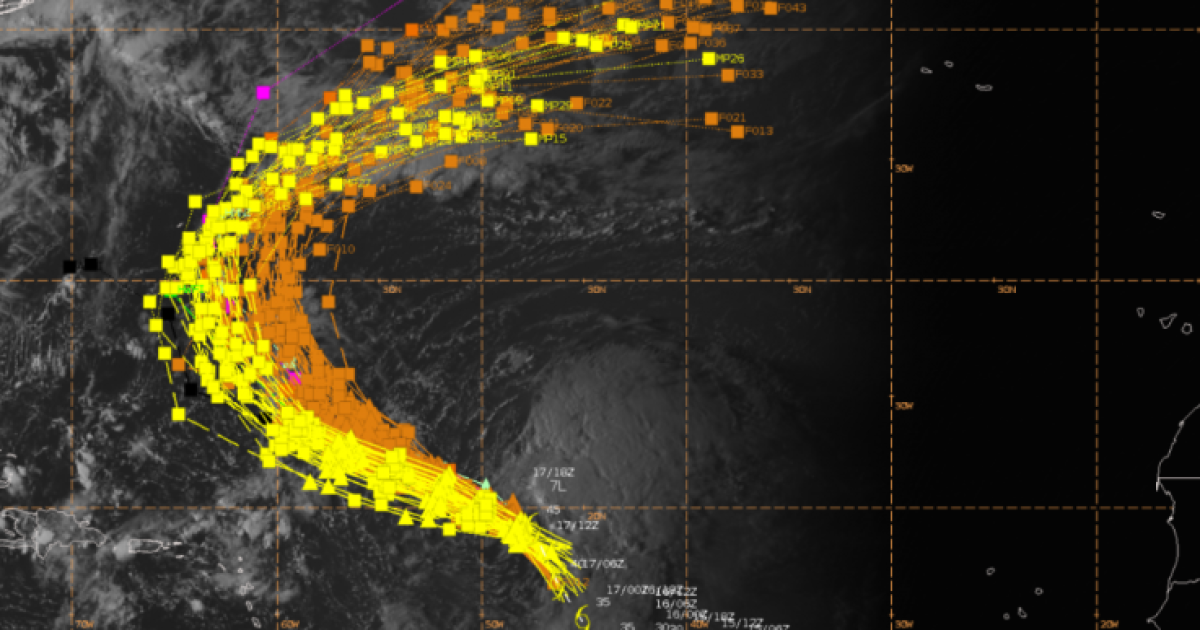
As the official start of the Atlantic hurricane season approaches, with less than 100 days to go, scientists at the National Hurricane Center reveal that tropical weather forecasting is entering a new era, significantly enhanced by the integration of artificial intelligence.
While AI has been around in various forms for some time, Wallace Hogsett, a science operations officer at NOAA, notes that the agency has intensified its use of newly developed AI tools during the 2025 hurricane season.
“Last season focused on experimentation, working closely with our partners to conduct thorough verifications and testing before we integrated AI tools into operational decisions. As forecasters gained more experience, NHC began incorporating these new AI weather prediction (AIWP) systems into our operational forecasts alongside our established tools,” Hogsett explained during a recent Q&A session.
The use of AI products was part of a broader toolkit, which includes traditional weather forecasting models, satellite analyses, and the expertise of seasoned forecasters.
Some of the AI systems being assessed were Google’s DeepMind and a framework created by the European Centre for Medium-Range Weather Forecasts.
Looking ahead, Hogsett anticipates that more AI tools will be rolled out in the coming years, each subject to rigorous evaluation before they are officially integrated into the agency’s operations.
Most AI models are trained using decades of global weather observations. Once deemed operational, they apply insights from historical data to forecast future weather events.

National Hurricane Center
A significant example showcasing this new technology was Hurricane Melissa during the 2025 season.
Melissa rapidly intensified into one of the most powerful hurricanes recorded in the Atlantic, achieving sustained winds of approximately 185 mph and a minimum central pressure of 892 millibars.
This Category 5 hurricane made landfall in Jamaica, marking itself as one of the most devastating storms the island has faced.
The NHC reported that AI models successfully predicted the cyclone’s likely track and intensity earlier than some traditional forecasting tools, although forecasters advised against overemphasizing the successes or failures of individual events.
Despite the rapid advancements in technology, Hogsett emphasized that AI systems will not replace human forecasters.
“None of the models are flawless, and they never will be. Now more than ever, we need trusted experts to interpret and synthesize vast amounts of information. While AI can assist in organizing data efficiently, expert oversight is crucial to evaluate, integrate new tools, and convey clear, risk-based messages to safeguard lives and property,” Hogsett stated.
The 2026 hurricane season is set to commence on June 1 and will continue through November 30.
Some cyclone names slated for this year’s list include Arthur, Bertha, Cristobal, and Dolly.
Typically, the first named storm in the Atlantic basin forms around June 20, while the first hurricane usually develops around August 11.

As we move forward into the 2026 hurricane season, the integration of AI in tropical weather forecasting offers exciting possibilities. With human expertise still playing a crucial role, the future of forecasting looks promising as technology continues to evolve and enhance our ability to predict storm behavior accurately.