Scientists have long relied on analyzing the light emitted by distant stars to gain insights into the universe. Now, researchers at the Missouri Botanical Garden are employing a similar approach using spectral data to investigate dried plant specimens housed in their herbarium.
“The physics governing light reflection applies universally, whether you’re examining an herbarium specimen or a far-off celestial body,” explained Matt Austin, Curator of Biodiversity.
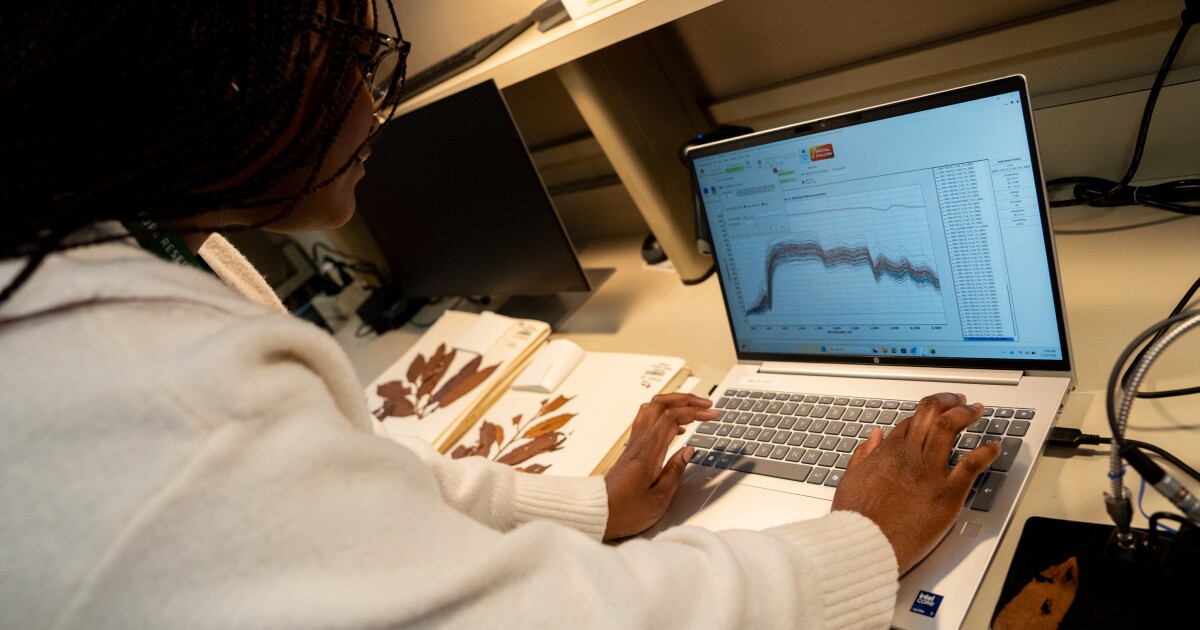
The Missouri Botanical Garden Herbarium operates like a library, containing pressed plants from across the globe. On a recent afternoon, hyperspectral scanning assistant Naeemah Anderson focused a specialized light on a tree leaf collected in Peru in 1991.
A spectrum of data appeared on her computer screen—a spectral scan showing the light reflected from the leaf.
“The light reflected from a leaf reveals significant information about the plant, as different chemical properties absorb light at varying wavelengths within the electromagnetic spectrum,” Austin noted.
Each plant species has its own unique spectral profile. “A hyperspectral scan effectively serves as a spectral fingerprint for that species,” Austin added.

Brian Munoz
/
St. Louis Public Radio
Austin is part of an international effort to expand knowledge of herbarium collections through spectral measurements, called the International Herbarium Spectral Digitization Working Group. This group originated at Harvard University and is directed by Jeannine Cavender-Bares, who oversees the Harvard University Herbaria. She noted that while using spectroscopy on living plants is not a new idea, applying this method to herbarium specimens is a recent development.
Cavender-Bares expressed optimism about the potential of this research: “Many specimens in herbaria no longer exist in their original locations. These records reflect historical biodiversity, enabling us to understand how it is evolving. Spectral data will provide insights into the chemical makeup and functions of these plants, revealing aspects we previously overlooked and allowing us to model changes through time and evolutionary history.”
In St. Louis, Austin’s team is employing these spectral fingerprints to develop an artificial intelligence tool aimed at identifying plant specimens in herbaria. The goal is to expedite the identification of the considerable backlog of pressed plant specimens awaiting analysis worldwide.
However, Austin stressed the importance of human expertise in this field: “This model is not intended to replace taxonomists. We will always need their expertise. Our goal is to enhance their efficiency, allowing them to focus on the more complex specimens that require human insight.”
Given the shortage of taxonomists, part of this initiative involves training new specialists, including Anderson, who is developing a focus on African plants alongside her mentor.

Brian Munoz
/
St. Louis Public Radio
“Currently, my focus is on plants from the African diaspora, which has been fascinating as I analyze specimens that have remained untouched in our collections,” Anderson said. “My next step will involve narrowing down a specific region in Africa to specialize in.”
This ambitious project receives funding through a generous $14.4 million anonymous grant, which supports both the development of the AI tool and the digitization of the herbarium collection.