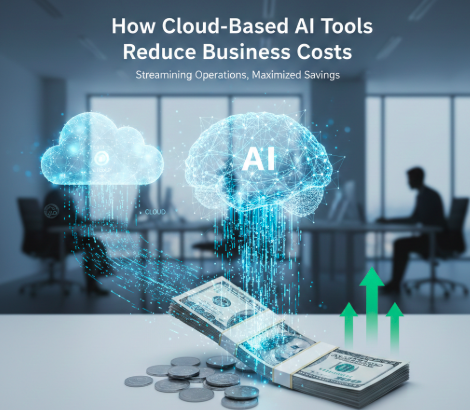
In today’s fast-paced business environment, companies face the dual challenge of reducing expenses while boosting efficiency. A highly effective solution lies in the adoption of cloud-based AI tools. Combining the flexibility of Software as a Service (SaaS) with the sophistication of artificial intelligence, these tools enable businesses to automate tasks, minimize overhead costs, and enhance their decision-making processes.
1. No Expensive Hardware or Infrastructure
Traditional software often necessitates:
- Dedicated servers
- IT maintenance teams
- Regular software installations and updates
- Effective security management
Cloud-based AI tools eliminate these expenditures. As everything operates on the provider’s remote servers, businesses can forgo hefty investments in hardware and infrastructure.
Instead, you simply pay a manageable monthly or annual subscription fee. This consistent pricing model simplifies budgeting and alleviates the burden of large upfront costs.
2. Reduced IT and Maintenance Costs
Maintaining conventional on-premise systems can prove costly. You often need:
- IT specialists
- Security patches
- System upgrades
- Backup solutions
With cloud-based AI SaaS tools, updates and maintenance are managed automatically by the provider, significantly lessening the need for a substantial internal IT team.
This transition can save small and medium-sized businesses thousands of dollars each year.
3. Automation of Repetitive Tasks
One of the most prominent benefits of AI tools is their capability for automation.
Cloud-based AI can handle:
- Customer support (via AI chatbots)
- Data entry
- Email marketing
- Lead qualification
- Invoice processing
- Content creation
By automating these tasks, businesses can reduce reliance on manual labor and minimize human errors. Instead of expanding their workforce, companies can enhance their operations through AI-driven processes.
This leads to lower payroll costs and boosts productivity.
4. Scalable Pricing Models
Cloud-based AI tools typically offer flexible pricing structures:
- Freemium
- Subscription-based
- Usage-based
Organizations only pay for what they utilize. As your business expands, you can easily upgrade your plan without needing to acquire new infrastructure.
This scalability helps prevent over-investment and assists companies in managing operational expenses effectively.
5. Improved Decision-Making Through Data
AI-powered SaaS platforms can analyze vast arrays of data in real-time. This capability allows businesses to:
- Spot cost inefficiencies
- Enhance marketing campaigns
- Anticipate sales trends
- Minimize waste
- Optimize inventory management
Better decision-making processes lead to fewer financial missteps, ultimately decreasing unnecessary expenses over time.
6. Remote Work and Collaboration Savings
Cloud-based AI tools facilitate remote work, allowing teams to operate from any location. Companies can save costs related to:
- Office space
- Utilities
- Travel
- On-site hardware
AI-powered collaboration tools also streamline workflows, reducing delays and minimizing miscommunication.
7. Faster Implementation = Faster ROI
Conventional enterprise software can take months, if not years, to implement. In contrast, cloud-based AI tools can often be up and running within hours or days.
This rapid implementation yields:
- Increased productivity
- Quicker revenue generation
- Swifter return on investment
The increased speed substantially lowers the overall costs associated with digital transformation.
Industry Insight on SaaS and Cloud-Based AI
Asfand Ali, creator of the Height Comparison Chart and AI name combiner tool, notes that SaaS and cloud-based AI tools are democratizing access for small businesses.
He highlights that cloud AI solutions empower startups and independent entrepreneurs to leverage advanced technologies that were historically accessible only to large organizations. By avoiding heavy infrastructure investments, businesses can concentrate on innovation and enhancing customer experiences.
Ali underscores that the true value of SaaS and cloud AI lies in their scalability and accessibility, enabling companies to experiment, test solutions, and grow without incurring significant financial risks.
8. Lower Risk and Better Security
Cloud providers allocate significant resources toward security infrastructure, often surpassing what individual businesses can afford to implement.
This investment mitigates the risks associated with:
- Data breaches
- Compliance penalties
- Recovery costs
Enhanced security measures translate into fewer unexpected financial losses.
Final Thoughts
Cloud-based AI tools transcend mere technological trends; they represent a strategic approach to reducing costs.
By eliminating infrastructure expenses, lowering labor costs, automating processes, enhancing decision-making, and facilitating scalability, AI-powered SaaS platforms empower businesses to function more efficiently while maintaining financial oversight.
For organizations seeking to remain competitive in 2026 and beyond, investing in cloud-based AI tools is not just advisable; it is a prudent financial strategy.