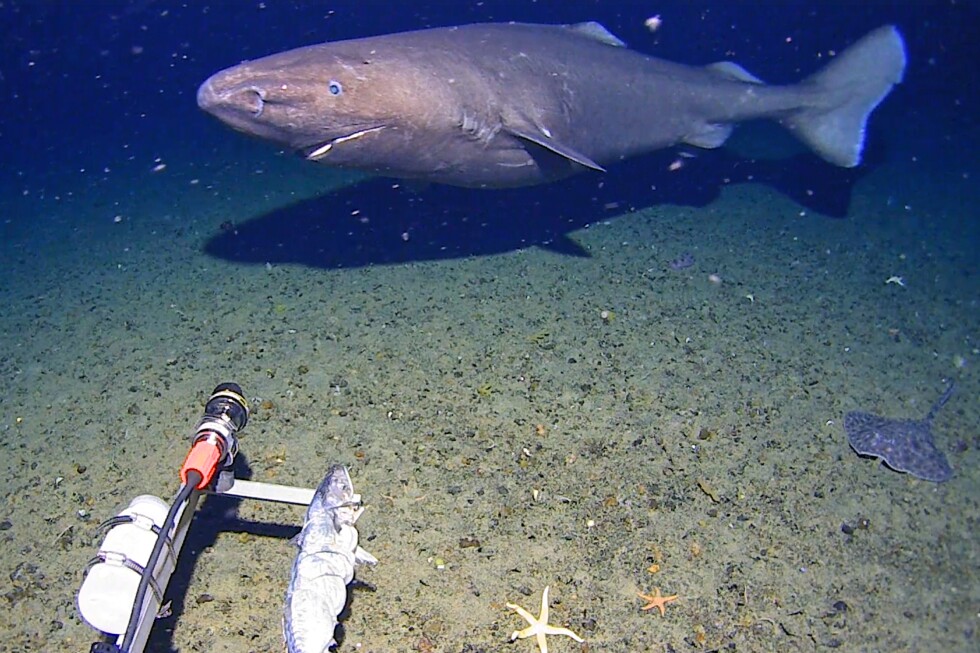
In a remarkable discovery, researchers have captured footage of a sleeper shark inhabiting the icy depths of the Antarctic Ocean, challenging long-held beliefs about shark distribution in these frigid waters. This unexpected sight sheds light on the lesser-known marine life residing in the deep sea.
Unexpected Find in Antarctic Waters
MELBOURNE, Australia (AP) — An ungainly barrel of a shark cruising languidly over a barren seabed far too deep for the sun’s rays to illuminate was an unexpected sight.
Many experts had thought sharks didn’t exist in the frigid waters of Antarctica before this sleeper shark lumbered warily and briefly into the spotlight of a video camera, researcher Alan Jamieson said this week. The shark, filmed in January 2025, was a substantial specimen with an estimated length of between 3 and 4 meters (10 and 13 feet).
“We went down there not expecting to see sharks because there’s a general rule of thumb that you don’t get sharks in Antarctica,” Jamieson said.
“And it’s not even a little one either. It’s a hunk of a shark. These things are tanks,” he added.
The camera operated by the Minderoo-UWA Deep-Sea Research Centre, which investigates life in the deepest parts of the world’s oceans, was positioned off the South Shetland Islands near the Antarctic Peninsula. That is well inside the boundaries of the Antarctic Ocean, also known as the Southern Ocean, which is defined as below the 60-degree south latitude line.
The center on Wednesday gave The Associated Press permission to publish the images.
Deep-Sea Footage
The shark was 490 meters (1,608 feet) deep, where the water temperature hovered near freezing at 1.27 degrees Celsius (34.29 degrees Fahrenheit). A skate appeared in frame, motionless on the seabed and seemingly unperturbed by the passing shark. The skate, a shark relative that resembles a stingray, was no surprise, as scientists already knew their range extended that far south.
Challenging Existing Knowledge
Jamieson, who is the founding director of the University of Western Australia-based research center, stated he could find no record of another shark found in the Antarctic Ocean. Peter Kyne, a conservation biologist at Charles Darwin University and independent of the research center, agreed that no shark has been documented this far south before.
Climate change and rising ocean temperatures might be prompting sharks to venture into the colder waters of the Southern Hemisphere, although limited data exists regarding range changes near Antarctica due to the region’s remoteness, Kyne noted. The slow-moving sleeper sharks could have long existed in Antarctica without being observed.
“This is great. The shark was in the right place, the camera was in the right place, and they got this great footage,” Kyne said. “It’s quite significant.”
The sleeper shark population in the Antarctic Ocean is likely sparse and challenging for humans to detect, Jamieson explained. The photographed shark was maintaining a depth of around 500 meters (1,640 feet) along a seabed that sloped into much deeper water. This marked depth is because it corresponds to the warmest layer among the various water layers stacked toward the surface.
Unique Ocean Layers
The Antarctic Ocean is highly stratified to a depth of approximately 1,000 meters (3,280 feet), due to the contrasting properties of colder, denser water from below not mixing readily with the fresh water flowing from melting ice above.
Jamieson believes other Antarctic sharks may inhabit similar depths, feasting on the carcasses of whales, giant squids, and other marine organisms that sink to the ocean floor. However, there are few research cameras positioned at such specific depths in Antarctic waters. Those that do exist can only operate during the Southern Hemisphere summer months, from December through February.
“The other 75% of the year, no one’s looking at all. And so this is why, I think, we occasionally come across these surprises,” Jamieson said.
Key Takeaways
- A sleeper shark was filmed off the coast of Antarctica, challenging previous assumptions about shark distribution in these cold waters.
- The scientist estimates the shark measured between 3 and 4 meters (10 and 13 feet) in length.
- The discovery suggests that other species could inhabit Antarctic waters unnoticed.
- Climate change may be affecting marine life migration patterns to colder regions.
- The Antarctic Ocean is characterized by its complex layered structure, influencing marine ecosystems.
- Limited research is conducted in these deep regions, especially outside the summer months.
FAQ
What kind of shark was filmed in Antarctica?
A sleeper shark was filmed, a species previously thought to not inhabit these cold waters.
How deep was the shark located?
The shark was filmed at a depth of approximately 490 meters (1,608 feet).
Why is this discovery significant?
This finding challenges existing knowledge about shark habitats and suggests that more species could exist in previously unexplored regions.
What factors could be influencing shark movement?
Climate change and warming ocean temperatures may be driving sharks further south into colder waters.
Are there other sharks in the Antarctic Ocean?
It is believed that there could be other sleeper sharks at similar depths, but they are difficult to detect due to the remote nature of the region.