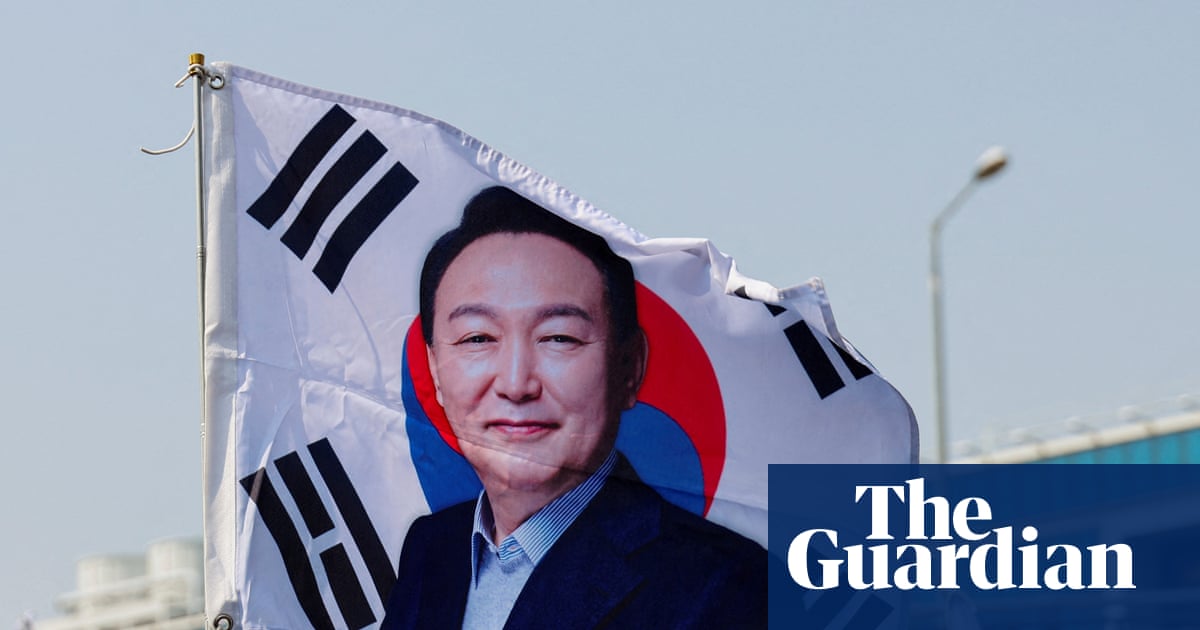
South Korea stands on the brink of a pivotal judicial decision this week, as the court prepares to announce the outcome of insurrection charges against former president Yoon Suk Yeol. The prosecutors are seeking the death penalty, a significant demand that has captured national attention.
On Thursday, Yoon will appear in courtroom 417 of Seoul’s central district court to hear the verdict, which will be broadcasted live. Interestingly, this is the same courtroom where the military dictator Chun Doo-hwan was sentenced to death three decades prior. The nature of the charges is strikingly similar—a previous verdict took nearly 17 years amid a democratic transition, while this case has progressed relatively quickly, settling in just 14 months. Chun’s original death sentence was later commuted to life imprisonment, and he eventually received a presidential pardon.
According to South Korea’s criminal code, leading an insurrection can result in one of three penalties: death, life imprisonment with labor, or life imprisonment without labor. Since 1997, the country has not conducted any executions, meaning that a death sentence today would effectively exclude a convict from society permanently, with no option for parole.
As the ruling looms closer, a palpable sense of fatigue and division permeates South Korean society, reflecting the long, drawn-out saga that has seen 27 individuals indicted related to the martial law crisis.
Dowon Kim, a 32-year-old office worker in Seoul, has stopped discussing politics with friends, some of whom still support Yoon. “Society is too exhausted,” he comments, “and my energy feels wasted trying to persuade them.”
In recent years, South Korea has witnessed the impeachment of two presidents within a decade. Kim articulates a desire to move beyond the cycle of political turmoil: “Those who should be punished should be punished, and we need to move forward.”
Song Ji-won, a 24-year-old student from Incheon, expresses a similar sentiment. “What happened is a national embarrassment. I just want to stop hearing about it.”
The K-pop light stick protests, which once drew millions to the streets, have diminished significantly. Likewise, pro-Yoon rallies have become less prominent, dwindling in attendance. What was anticipated to be a gathering of 2,300 supporters recently saw only about 20 attendees. The political consequences have been severe for the People Power party, struggling to detach itself from Yoon’s legacy, polling at just 22% last week, according to Gallup Korea, compared to 44% for the ruling Democratic party.
From martial law to impeachment in 11 days
On the night of 3 December 2024, prosecutors allege Yoon declared martial law, attempting to utilize military force to subdue the legislature, arrest political opponents, and seize authority over the national election commission. Yoon justified his actions by claiming he was eliminating “anti-state forces” and alleging election fraud.
Prosecutors assert that Yoon had been planning this for over a year, strategically positioning loyalists within high military ranks. This martial law declaration marked the first emergency of its kind in 44 years, challenging the belief that military rule was simply a relic of South Korea’s authoritarian past.
The response to Yoon’s declaration was quick. Within hours, 190 lawmakers managed to breach police and military barriers surrounding parliament and passed an emergency resolution to revoke martial law. Yoon was impeached within 11 days, and four months later, the constitutional court removed him from office. Throughout the investigations by three different special prosecutors, over 120 individuals were indicted, including Yoon, cabinet ministers, military leaders, and intelligence officials.
Despite the prelude of calm leading up to this week’s court ruling, the significance of the moment remains evident to the South Korean populace. Over recent weeks, the courts have established important legal precedents through related cases.
On 16 January, Yoon was sentenced to five years for obstructing his own arrest. Shortly after, former prime minister Han Duck-soo was sentenced to 23 years in a ruling that officially identified the events of 3 December as insurrection, describing it as a “self-coup” by legitimate authority that carries greater risks than traditional uprisings. This sentence surpassed the prosecutors’ initial request of 15 years, indicating a judicial willingness to impose strict penalties.
On 12 February, the former interior minister Lee Sang-min was sentenced to seven years for his involvement in the insurrection, including communicating Yoon’s directives to disrupt media outlets by cutting off their power and water supply.
However, the verdict on Thursday will be determined by a different presiding judge. While the prior insurrection findings are noteworthy, they do not set a precedent for this case. This judge will assess whether the events of December 3 meet the legal criteria for insurrection.
Sangchin Chun, a sociology professor at Sogang University, remarked that the ultimate impact on Yoon’s political standing may hinge less on the verdict itself and more on whether citizens perceive improvements in their daily lives under President Lee Jae Myung. “The focus seems to have shifted from legal implications to practical economic factors,” he noted. Lee, who emphasizes essential issues like cost of living and housing, maintains a strong approval rating of 63%.
In Yoon’s last court appearance, he characterized the investigation as a “political conspiracy,” suggested that the martial law had “enlightened” citizens, and did not express any remorse. At one point, he seemed to laugh when prosecutors requested the death penalty. Prosecutors have cited his lack of remorse as an aggravating circumstance since, under South Korean sentencing laws, true repentance is a key consideration.
He is also faced with additional legal challenges ahead: six more criminal trials, two of which arise from the martial law crisis, including a treason charge for allegedly ordering drone incursions into North Korean airspace to instigate a confrontation justifying military rule.
For South Korea, the upcoming verdict will serve as a landmark moment, representing one of the most extensive moments of democratic accountability against a former leader in the nation’s history. The court will also issue rulings against seven co-defendants, including high-ranking officials from the military and police connected to the alleged plot.
Many observing the proceedings will have experienced the authoritarian regime of the 1980s, which the 2024 martial law declaration starkly recalled. The democratic safeguards once fought for are now being scrutinized. By Thursday afternoon, the nation will understand if these safeguards remain intact.
Key Takeaways
- The court will rule on insurrection charges against former president Yoon Suk Yeol.
- Prosecutors are seeking the death penalty, a first since 1997.
- The case calls back to South Korea’s historical struggles with military rule.
- Public sentiment reflects fatigue over ongoing political turmoil.
- Democracy’s resilience is being tested amid legal proceedings against a former leader.
FAQ
What are the possible outcomes for Yoon Suk Yeol?
The court can impose a death sentence, life imprisonment with labor, or life imprisonment without labor.
When was the last time South Korea executed someone?
The last execution in South Korea took place in 1997.
How many people have been indicted in relation to the martial law crisis?
Over 120 individuals have been indicted in connection with the events surrounding the martial law crisis.
What was the context of the martial law declaration?
Yoon Suk Yeol declared martial law to allegedly suppress opposition and control the legislative process, citing election fraud.
What impact does public sentiment have on the ongoing legal proceedings?
The public’s perception of improvements in their daily lives may influence the political dynamics surrounding the verdict.