Concerns Surround AI Chatbot Raina in Bend La-Pine Schools
Last month, a technology company focused on serving educational districts made the decision to withdraw an AI chatbot named Raina from all platforms used by students. This action was taken due to rising concerns about the potential for children to form unhealthy attachments to the chatbot.

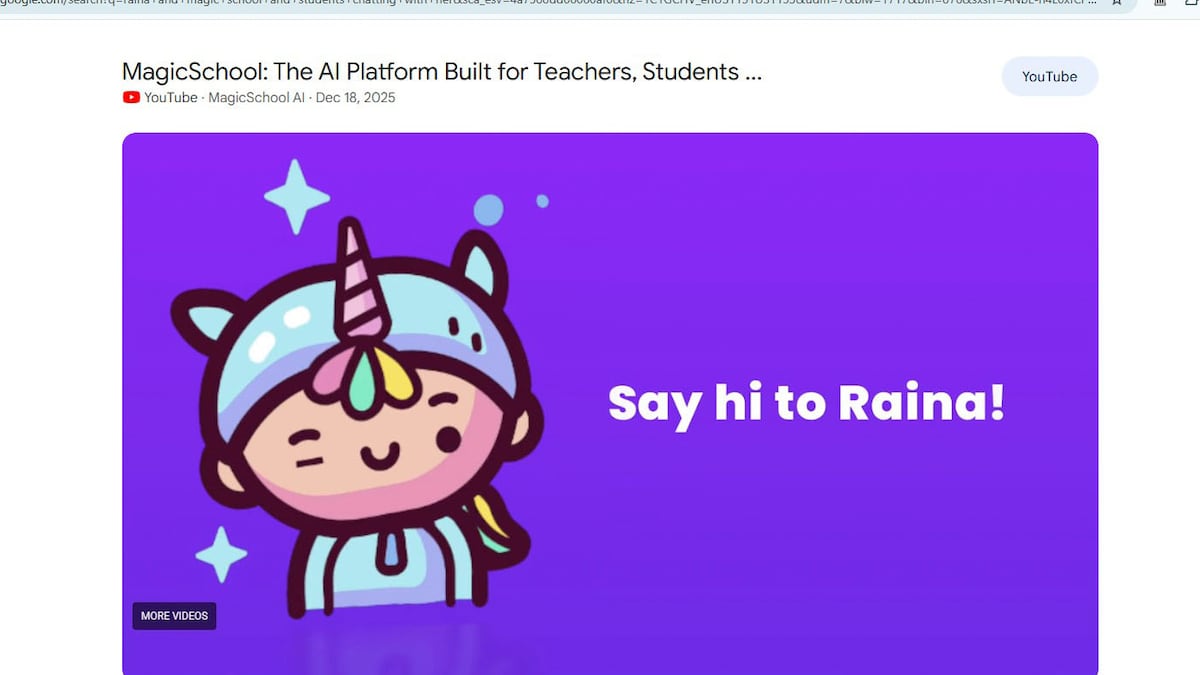
A YouTube screenshot of a MagicSchool promotional video showing AI chatbot, Raina, Feb. 12, 2026.
Screenshot
Earlier this year, Bend La-Pine Schools introduced Raina into classrooms. However, the district’s technology leader was unaware of the chatbot’s discontinuation on January 28, even as he defended its use following public uproar.
During a school board meeting on February 10, parents raised concerns about Raina’s usage. In interviews following the meeting, Scott McDonald, the district’s IT director, emphasized that their approach to technology was methodical. He supported the use of generative AI chatbots, unaware that Raina had been deactivated on student iPads by MagicSchool, the tech firm based in Boulder, Colorado.
A coalition of parents has recently launched a petition against what they consider the overly rapid integration of technological tools in Bend La-Pine Schools, which is the largest school district in Oregon outside the Willamette Valley. The role of AI in education remains a contentious issue across the country, with various districts taking differing stances. In Oregon, each district sets its own policies, and concerned parents assert that Bend’s expansive AI policy shifts the responsibility of child safety to tech companies, while the district maintains that teachers have the final say.
MagicSchool did not disclose how many other districts had Raina engaging directly with students. In a statement, the company acknowledged that the parental concerns echoed reasons for Raina’s removal from student-facing platforms.
Kirsten Underwood, a spokesperson for MagicSchool, commented, “The concerns expressed by Bend La-Pine parents regarding chatbots fostering unhealthy relationships during critical developmental phases are valid. This is exactly why we removed Raina from student interfaces last month; it is now strictly a tool for teachers.”
A ‘New Best Friend’
MagicSchool’s initial marketing showcased Raina, a character adorned with rainbow hair and a unicorn beanie, as a “new best friend” for both teachers and students.
It was revealed through OPB’s reporting that the district’s top technology official discovered Raina’s status during recent communications and interviews.
Before being contacted by OPB, McDonald claimed that Raina could still be activated for students by their teachers. However, it turned out that the chatbot had been inactive for weeks.
According to McDonald, Raina had mixed usage among students, enough to justify continued investment in the tool. The entire AI platform supplied by MagicSchool costs Bend La-Pine Schools approximately $4 annually per student. With over 16,000 enrolled students, the annual cost is estimated to exceed $64,000.
McDonald disagreed with the parents’ criticisms regarding the rapid adoption of new technology.
“We have been meticulously evaluating all potential tools for our schools, and we have deliberately approached the integration of AI to the extent that most of it is currently restricted on student devices,” he stated.
He added that well-known tools like ChatGPT and Google’s Gemini are not allowed on student iPads.
McDonald confirmed that MagicSchool did inform district officials about changes to Raina in a January newsletter from the company.
The chatbot remains accessible to teachers; however, students can only interact with a version that is impersonal and features a neutral robotic voice.
McDonald elaborated that teachers still have the ability to create and assign a chatbot that does not access live internet data but instead utilizes curated content from MagicSchool alone.
At the crowded school board meeting in Bend, parents presented a letter expressing their deepening concerns regarding the reliance on screen time in classrooms. This included the prevalence of one-to-one iPads, educational applications, and student-facing AI tools. The parent coalition managed to gather over a thousand signatures in support of their initiative in just three weeks.

Parents pack a Feb. 10, 2026 Bend La-Pine Schools board meeting to push the district to reconsider technology and screens in the classroom.
Jen Baires / OPB
Interestingly, both parents and the district’s tech leaders were unaware of Raina’s prior removal before the contentious school board meeting.
“The fact that the district was uninformed about this rollback further undermines the credibility of those who insist that the products provided to our students are safe and thoroughly vetted,” stated Natalie Houston and Annelise Cappy, two leading parents in the effort, in an email communication to OPB.
Houston, a licensed professional counselor working with children and adults in Bend, highlighted her concern, saying, “One of my major worries is that children interacting with chatbots may easily believe in something that is not real, particularly if it exhibits human-like traits.”
‘Hitting a Brick Wall’
In 2023, the Oregon Department of Education unveiled guidelines for generative AI in schools, becoming the first state education agency in the United States to take such a step. However, these guidelines are not mandatory, and the state does not monitor which AI tools are being used by districts, according to a spokesperson.
Currently, state lawmakers are proposing a bill to regulate AI programs, emphasizing youth access in discussions. The proposed legislation requires programs like ChatGPT to frequently remind users that they are conversing with a machine, not an actual human being, as reported by the Oregon Capital Chronicle.
Bend La-Pine Schools implemented its own AI policy last year, granting teachers significant discretion in determining what is suitable for students.
During the February 10 meeting, school board member Amy Tatom expressed her concerns about the role of technology in classrooms, citing the misuse of iPads and their distractive nature as prevalent issues.
Tatom suggested that the advisory group shaping the district’s technology policy should include more experts, especially parents like Houston who are knowledgeable about the potential drawbacks of AI.
“As someone involved in the IT stakeholder work group,” Tatom voiced, “it seems the insights and expertise of the people in that room are not being fully utilized.”
Brendan Bouffard, a father of two and an attorney for Fairplay, a national nonprofit focused on children’s online safety, is also part of the district’s IT stakeholder group. He echoed Tatom’s sentiments, suggesting that while the district appears to be receptive to concerns, they do not take meaningful action.
“It feels like at every turn, in every effort to diminish technology use, we encounter resistance. The response is always to continue pouring more money into technology instead of fostering genuine human connections. It’s incredibly frustrating,” Bouffard remarked.
Parents like Houston and Bouffard advocate for greater options for families wishing to reduce their children’s technology exposure, such as monitoring iPad usage in school and limiting screen time during lessons.
The district has stated that it is currently collecting data on student iPad usage; however, it does not yet have a method to track individual screen time.
The ongoing discourse around technology use in education underscores growing concerns among parents and educators. As schools navigate the integration of AI tools, the focus remains on ensuring that children’s wellbeing and safety are prioritized in these digital learning environments.