New Form of Superionic Ice Discovered
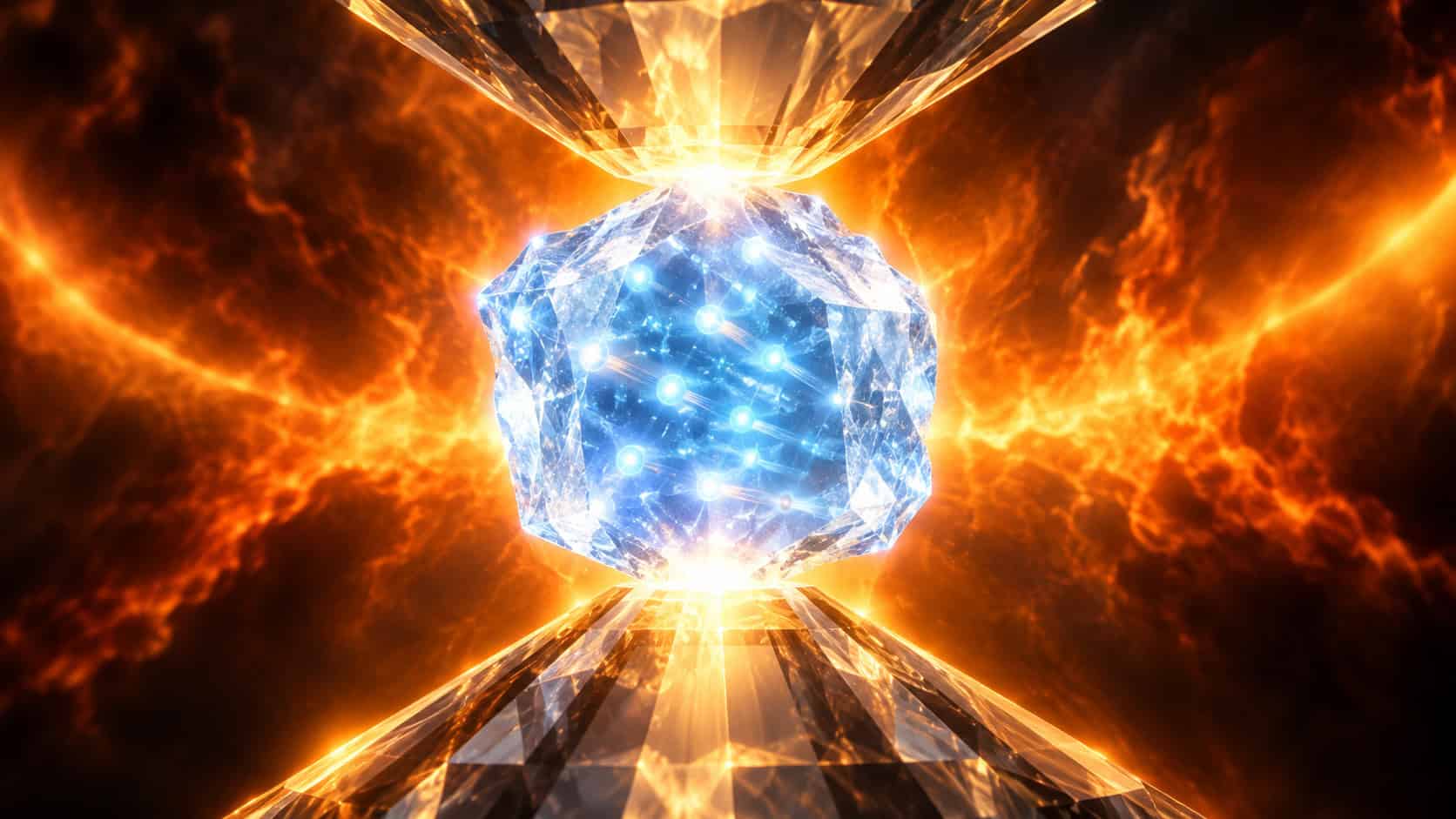
Researchers have made a groundbreaking discovery involving water subjected to extreme conditions between two diamond tips. By applying immense pressure—over two million times that at Earth’s surface—and heating it above 2,000 degrees Celsius, they created a previously unobserved crystalline structure of ice, termed hexagonal close-packed (hcp) ice.
Key Findings:
-
Superionic State: The study revealed that under these conditions, the oxygen atoms in water arranged themselves into a new crystal lattice, while hydrogen nuclei moved freely, behaving more like liquid particles. This unique combination allows the material to conduct electricity.
-
Deep Planetary Implications: This form of superionic ice may exist in the interiors of Uranus and Neptune, potentially influencing our understanding of their unusual magnetic fields. Unlike Earth’s magnetic field, which is relatively orderly, these planets exhibit significant tilting and non-axisymmetric features.
-
Experimental Techniques: The researchers utilized diamond-anvil cells to trap small water samples and heated them with lasers. They precisely probed the sample’s structure using X-ray beams at the European Synchrotron Radiation Facility.
Importance of hcp Ice:
The transition of water to hcp superionic ice suggests variations in electrical conductivity and thermal properties could exist within planetary interiors. It could affect models of electrical charge movement, crucial for understanding how these gas giants generate their magnetic fields.
The next step for researchers is to determine the stability of hcp ice in different conditions and how ionic conductivity behaves in this unique state.
Conclusion
This discovery not only enhances our understanding of water’s behavior under extreme conditions but also opens up new avenues for investigating the inner workings of icy planets in our solar system. Researchers are eager to delve deeper into the properties of superionic ice and its implications for planetary science.


