
Economics surrounds us in various aspects of life, often in unexpected contexts. Take Valentine’s Day, for example. While it might seem primarily about romance, there are interesting economic principles at play. Let’s explore some less conventional insights.
Some economists view “marriage” through the lens of joint production functions, conceptualizing it as a “firm” that generates “goods” such as “household services.”
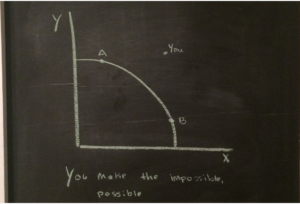
For instance, in our home, I handle the lawn care since I’m physically capable of managing the mower on steep terrain. My wife, a surgeon with high cleanliness standards, takes charge of keeping our space organized. But can we accurately say that we “trade” these “services” with each other? If that’s the case, we might want to renegotiate the terms of this unspoken agreement.
Other economists, including Lloyd Shapely, who shared the 2012 Nobel Prize in Economics, have treated marriage as a matching game. Under certain assumptions, they demonstrated the existence of stable marital pairings. This framework has influenced the algorithms behind many popular dating apps. However, as anyone in a relationship will confirm, the challenges of finding a partner and maintaining a relationship are vastly different.
While these models offer valuable insights, they can feel a bit lacking. Phrasing like, “How about we specialize in certain household chores and exchange our services?” is unlikely to charm anyone on a date. Despite my best efforts, I haven’t prevailed in discussions with my wife by merely referring to economic theories.
Instead, I aim to share some economic principles that could benefit everyone, regardless of their relationship status, especially on this special day. I’ll delve into the concepts of signaling and thinking at the margin.
Understanding Signaling
Imagine someone you’re attracted to. How can you express your feelings? If you’re thinking like an economist, you might consider giving cash as a gesture.
Not quite.
Cash lacks a personal touch and does not convey your emotions; it could come from anyone. To illustrate your commitment, you need to provide something costly that demonstrates genuine investment of time, care, and effort, which can’t be easily faked.
High school students often surprise their crushes with creative prom proposals, and pop culture is filled with inspiring acts like boombox serenades and flash mob dances. Such displays require dedication and coordination, and they come with no guarantee of success.
However, a successful signal cannot just be expensive for the sender; it must also hold value for the recipient. (Attempting to express my love through a public performance would likely send my wife running for the hills.)
This is why gifting a special arrangement of your partner’s favorite flowers, particularly if they are rare, is a more meaningful gesture than giving generic flowers or, even worse, cash. Each thoughtful touch conveys, “I care enough to know what you like,” or, “I went out of my way for you!” These signals are difficult to counterfeit, enhancing their value.
People frequently express their desires. However, it requires effort to listen and understand their cues. The most heartfelt gestures aren’t necessarily pricey; they demonstrate genuine attention.
Thinking at the Margin
What does “the margin” really mean? Despite its significance in economics, it remains somewhat ambiguous. Essentially, “the margin” refers to “the next unit” or “the next decision.”
Let’s consider a hypothetical scenario. Suppose you have two potential dates—Pat and Devin—who both want to date you. Your expected marginal utility of these dates might look like this:
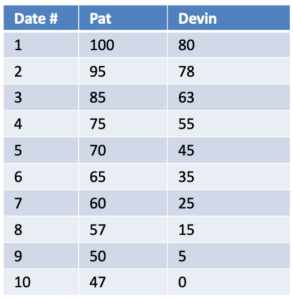
(Keep in mind, this scenario relates to dates rather than relationships.)
Based on the utility values shown, if you’re maximizing your utility, your decisions should focus on the next date available. You might date Pat three times, then enjoy two outings with Devin, and so on. This approach illustrates how someone might “date around” while considering marginal utility.
In casual dating, the margin is “the next date,” which could signify a single evening. Yet, when you meet someone special, the perspective shifts. The margin extends from “the next date” to a longer time frame. Eventually, it can become about “the rest of your life.” Instead of asking yourself, “Should I go on another date with this person?” you begin to ponder, “Do I want to build a life together?”
Taking another look at the table, framed within the possibility of a lifelong partnership, it becomes evident that Pat may be the better option. The cumulative benefits of a life shared with Pat outweigh those of a life with Devin. However, you wouldn’t realize this if you only focused on one date at a time.
Embracing Love
Economics often gets labeled as “the dismal science,” and based on the dry terms I’ve used, this reputation may hold some truth. Yet, the founding economist had valuable insights regarding love.
Before penning Wealth of Nations, Adam Smith was known for his moral philosophy work, The Theory of Moral Sentiments. In this earlier book, Smith proposed that our desires for love are coupled with a yearning to be lovely and worthy of love.
This distinction is crucial. Being loved is something that happens to you, while being lovely is a conscious effort made by you. It requires dedication, mindfulness, and a sincere concern for others’ well-being—these are the kinds of meaningful investments that produce authentic connections.
This Valentine’s Day, whether you’re in a relationship, hoping to start one, or simply appreciating those who matter in your life, the economic principle is clear. Focus on the individuals you care about, and show them through personal effort and attention that you truly value them. Commit not only to loving others but also to being deserving of their love.
In summary: love wholeheartedly and strive to be lovely.
Wishing you a Happy Valentine’s Day.