By Thomas Neuburger. Originally published at God’s Spies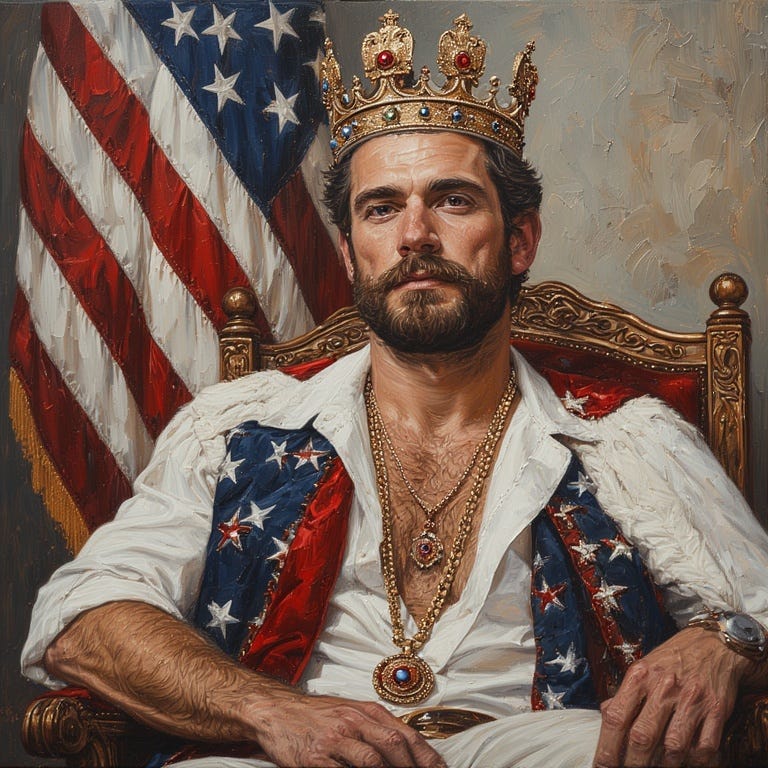
“When the president does it, that means it’s not illegal.”
—Richard Nixon
The fabric of American governance is undergoing a radical transformation. In a thought-provoking exploration, I recently argued that the United States is drifting towards a form of kingship, shaped by the actions of both major political parties. My ongoing series, titled “The Fourth American Constitution,” examines this unsettling trend.
This transition appears to have reached its conclusion, with the last puzzle piece firmly in place. While there are still exceptional scenarios to consider—situations that are unlikely to materialize—such as the hypothetical question of whether a president could commit acts of violence under the guise of national defense, the framework has been established. What lies ahead is a period of unchecked reconstruction.
Trump v. US
To support this argument, let’s revisit the significant Trump v. US ruling, which reinforces the trend toward near-absolute presidential power. This concept is not novel but rather an expansion of an existing idea; the evolution of the “imperial president,” which gained momentum in the latter half of the 20th century, is manifesting in its final form as we enter the 21st century. The shift began during the Bush-Cheney administration, which expanded the presidency’s dominion over Congress under the pretense of “war,” continued with Obama, who legitimized practices such as torture, and culminated in Trump’s era, marked by the implications of the recent Supreme Court decision.
Per the Brookings Institute, this ruling suggests that presidential immunity is “absolute with respect to a president’s exercise of his core Article II powers.” As I’ve articulated in “Our Lawless Elites,” this indicates that the president reserves the right to disregard legal boundaries when acting in an official capacity.
‘When the president does it, that means it’s not illegal’
Am I overstating this position? Not according to a recent analysis from Slate, which supports the contention:
Take, for instance, how the ruling scrutinizes Trump’s attempts to manipulate the Department of Justice post-2020 election. The Court acknowledges that Trump pressured the agency to investigate voting irregularities in critical states that Joe Biden won. This plan involved fabricating claims of election fraud, persuading state legislatures to appoint an “alternative slate” of electors in favor of Trump. When the then-acting Attorney General, Jeffrey Rosen, resisted, Trump threatened his job. Prosecutors focused on this scheme to substantiate allegations of unlawful conspiracy intended to obstruct Congress from certifying the election.
So, is this conspiracy illegal? According to Chief Justice Roberts, the answer is no.
Roberts determined that Trump’s demands for a false inquiry fell under constitutional protection, reasoning that the president possesses “exclusive authority over the investigative and prosecutorial functions of the Justice Department and its officials.”
Furthermore, Roberts stated this in Trump v. US, page 5: “The Executive Branch has ‘exclusive authority and absolute discretion’ to decide which crimes to investigate and prosecute, including allegations of electoral misconduct.”
The President Can’t Be Constrained by Congress or Courts
Roberts’s assertion is clear: when the president performs any duty defined in Article II of the Constitution, he cannot be prosecuted for his actions. Period. There will be no accountability.
In simpler terms, the combination of the Court’s alignment with the notion of a “unitary executive” and the granting of immunity to the president when fulfilling constitutional duties positions the office above the law.
Roberts elaborates:
In instances where a presidential act originates from constitutional authority, that power becomes “conclusive and preclusive.” When the president exercises such authority, neither Congress nor the courts can interfere. Consequently, an Act of Congress, whether aimed at the president or applicable broadly, cannot criminalize actions taken within the exclusive constitutional powers of the president. Likewise, courts cannot adjudicate cases involving such presidential conduct. Thus, the Court concludes that the President is absolutely immune from criminal prosecution for conduct pertaining to his exclusive constitutional authority.
This ruling not only legitimizes selective and fraudulent federal prosecutions but also extends prosecutorial power across all executive agencies. As noted by Slate:
Marty Lederman from Georgetown Law underscored this ruling as a “profound” shift, likely to be “weaponized” by “executive branch lawyers and officials for generations.” He also indicated that this principle isn’t confined to the Justice Department but likely extends to all federal agencies, many of which have law enforcement roles. Essentially, Roberts has suggested that Congress no longer holds the power to prevent the president from corrupting these agencies through fraudulent investigations or misleading the public. As Lederman warned, this represents “an extraordinarily radical proposition”—a loaded weapon that could easily be exploited by a corrupt president to undermine the rule of law.
‘An Unscrupulous President’
The critical notion here is “an unscrupulous president.” Bush II’s administration legalized torture through executive actions, and Obama upheld this power by failing to prosecute Bush. Obama also authorized the execution of an American citizen, a decision neither Trump nor Biden reversed. Meanwhile, both parties endorse calls for “increased security.”
These actions serve as a reminder that an unscrupulous president could manipulate the system at will. The unfortunate reality is that many, if not all, recent presidents embody this unscrupulous nature. What leads us to believe that power would only attract virtuous individuals? Alternatively, did our elites architect this situation to perpetuate a regression from the New Deal era, reminiscent of a time when the voices of the many had greater influence, to a system dominated by the interests of the wealthy few?
This latter perspective seems plausible; when someone relentlessly pursues an objective, one must assume that they are indeed aiming to realize it.
So, what lies ahead?
Next Steps
As we contemplate the future, the question of “what comes next” occupies our minds. This will involve testing various ideas and adapting them as necessary. Here are a few initial thoughts:
- It’s crucial to confront the reality of our situation without hesitation. The wealth and power enjoyed by the middle class during the 1950s and 60s—comparatively robust compared to previous years—are permanently lost. Systematically attacked by every administration from Reagan to the present, it will not return.
- On the whole, national Democrats provide minimal support. At best, they may slow the decline, but often they simply acquiesce.
- Any potential solution will likely emerge outside of traditional avenues.
Further exploration of (3) will follow. Numerous possibilities arise, from national disintegration due to climate change strain (which could prove beneficial) to scenarios resembling a gradual civil insurrection or a general strike.
One thing is for certain: at least one of these developments will happen. The pressing question remains which will occur first, and who will be poised to take action when the time arrives.
Being prepared for that moment is essential. More details on this will follow.