

Starbucks stands as a cultural icon, offering a diverse array of seasonal and customizable coffee drinks tailored to customer preferences. Many patrons find it useful to know their order before reaching the counter. Traditionally, if no specific milk was requested, baristas would use whole milk by default. However, a shift towards healthier choices among North American coffee enthusiasts prompted Starbucks to change this practice in 2007, establishing 2% milk as the standard for most espresso beverages. This move was not the first expansion of milk options at Starbucks, initiating a trend that began with the introduction of soy milk in 1997.
Before the introduction of 2% milk, a trend towards lower-fat milk options was gaining traction, and customers were seeking similar options at Starbucks. Former CEO Howard Schultz established whole milk as the default, inspired by traditional Italian coffee practices. For those who preferred a lower-fat beverage prior to the arrival of 2%, baristas often created a mixture of whole and skim milk, leading to a unique blend for each customer but lacking a precise recipe.
Starbucks offers various milks and non-dairy options for patrons
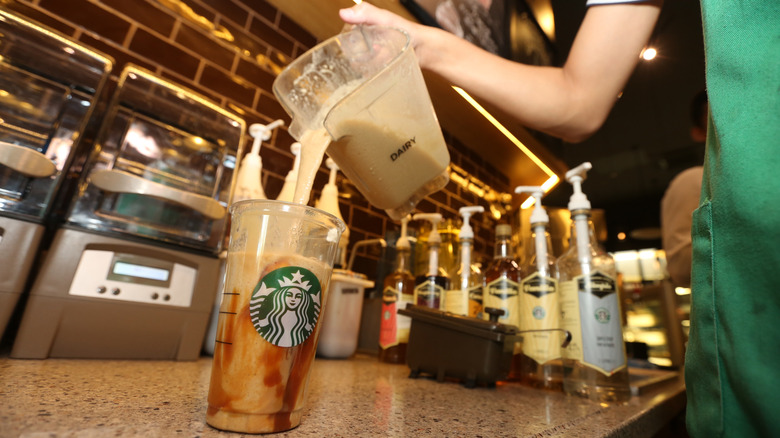
Alongside whole and skim milk, as well as the house-mixed 2%, soy milk was the only alternative available for many years. The switch to 2% marked a significant turning point in the variety of dairy alternatives offered. Nearly a decade later, Starbucks expanded its menu once again by adding coconut milk to its offerings in 2015. The following year introduced vanilla sweet cream cold brew, incorporating house-made cream as a dairy option. Additionally, almond milk was uniquely developed for the Starbucks menu around this time. Responding to a decline in traditional cow’s milk consumption, Starbucks began testing oat milk in select Midwest locations in early 2020, resulting in such favorable customer feedback that by March 2021, it became available across all U.S. menus.
It is important to note that not all menu items use 2% milk by default. For example, classic drinks such as the flat white and many Frappuccino variations are made with whole milk. Seasonal offerings also feature distinct non-dairy options; for instance, the Iced Hazelnut Oatmilk Shaken Espresso and the seasonal Pecan Crunch Oatmilk Latte rely on their stated non-dairy ingredient. Moreover, during the holiday season, the eggnog latte uses eggnog as its creamy base. However, Starbucks baristas are always happy to accommodate reasonable customization requests.
Key Takeaways
- Starbucks transitioned to 2% milk as the standard for most beverages in 2007.
- Whole milk was the initial default milk choice inspired by traditional Italian coffee culture.
- Options for non-dairy alternatives have expanded significantly since the introduction of soy milk in 1997.
- Coconut milk, almond milk, and oat milk have all been added to the menu in recent years.
- Some drinks, like flat whites and certain Frappuccinos, use whole milk by default.
- Holiday drinks often incorporate unique bases, such as eggnog.
FAQ
What type of milk does Starbucks use in most drinks?
Starbucks typically uses 2% milk as the standard for most espresso based drinks.
Are there non-dairy options available at Starbucks?
Yes, Starbucks offers several non-dairy alternatives including soy, coconut, almond, and oat milk.
Can I request a different milk alternative in my drink?
Absolutely! Starbucks baristas are happy to accommodate requests for different milk types.