The impact of generative AI on education is a topic of growing concern among educators. At Youngstown State University, Professor Mark Vopat has taken the bold step of prohibiting the use of such technologies in his philosophy classes. However, this hasn’t deterred some students from trying to leverage AI tools in their assignments.
“Several students actually plagiarized their data ethics papers by having an AI write them. Honestly, I was at a loss for words,” Vopat expressed.
Vopat believes that beyond issues of academic dishonesty, AI is hindering students from engaging with profound philosophical questions.
“I want them to grapple with the material; struggling is beneficial. It helps us transfer information from short-term to long-term memory,” Vopat said. “It fosters their ability to connect complex ideas.”

The rise of AI tools, like ChatGPT, is reshaping the higher education landscape. Recent surveys indicate that up to 90% of college students report using them for coursework. However, many professors find themselves struggling to adapt the traditional methods of education due to this upheaval. A recent national survey revealed that 95% of faculty are concerned that students’ reliance on AI diminishes critical thinking abilities and academic integrity.
As AI tools become increasingly advanced, Vopat raises questions about how educators will verify whether students have utilized these technologies. Typically, he deals with academic misconduct by failing assignments, but the situation is growing more complex.
“There are instances where the violation must be escalated to the university, potentially leading to suspension or expulsion,” he explained. “With AI, it’s tougher to prove the misconduct unless a student confesses. Without concrete evidence, they often claim, ‘I wrote that.’ The challenges in detection are significant.”
AI in the Classroom
In Ohio, universities possess broad policies that allow individual professors to determine how to integrate AI in their classes.
On one end of the continuum are instructors like Vopat. In contrast, Professor Stefanie Moore from Kent State University encourages her students to experiment with AI in her Digital Public Relations and Social Media course, emphasizing that they should cite its use. During a recent class discussion, students analyzed the effectiveness of a Coca-Cola AI-generated Christmas commercial and shared their experiences with the tools.
“Students are tasked with identifying a practical application of AI, exploring how they can automate a task or process,” Moore noted.
She believes that familiarity with AI is essential for modern PR professionals, and she aims to equip her students for success in a rapidly evolving landscape.

“We need to revisit our assignments and adjust them to emphasize critical thinking,” Moore added. “Perhaps we should encourage students to draft their own ideas and then use AI to enhance their work.” She noted that refining assignments in this way could facilitate deeper learning and creativity.
Senior Tate Bryan found AI tools like Claude useful for crafting a content strategy for her blog centered on Hollywood’s golden age.
“It outlines a content calendar, identifies key topics, creates a social media strategy, and handles SEO and growth,” she shared. “It’s tailored for the industry.” However, some students have encountered limitations in these AI applications.
Senior Busola Sobola attempted to leverage AI for a video marketing campaign aimed at African women, but was disappointed by the results.
“The AI-generated character seems more American than African,” she chuckled as she displayed an image. “It struggled with accents, too. Even when I asked for a more Nigerian perspective, it still did not quite capture the essence.”
Research indicates that AI tools can perpetuate biases across various domains, affecting everything from healthcare to language processing.
AI and the Future for Students and Professors
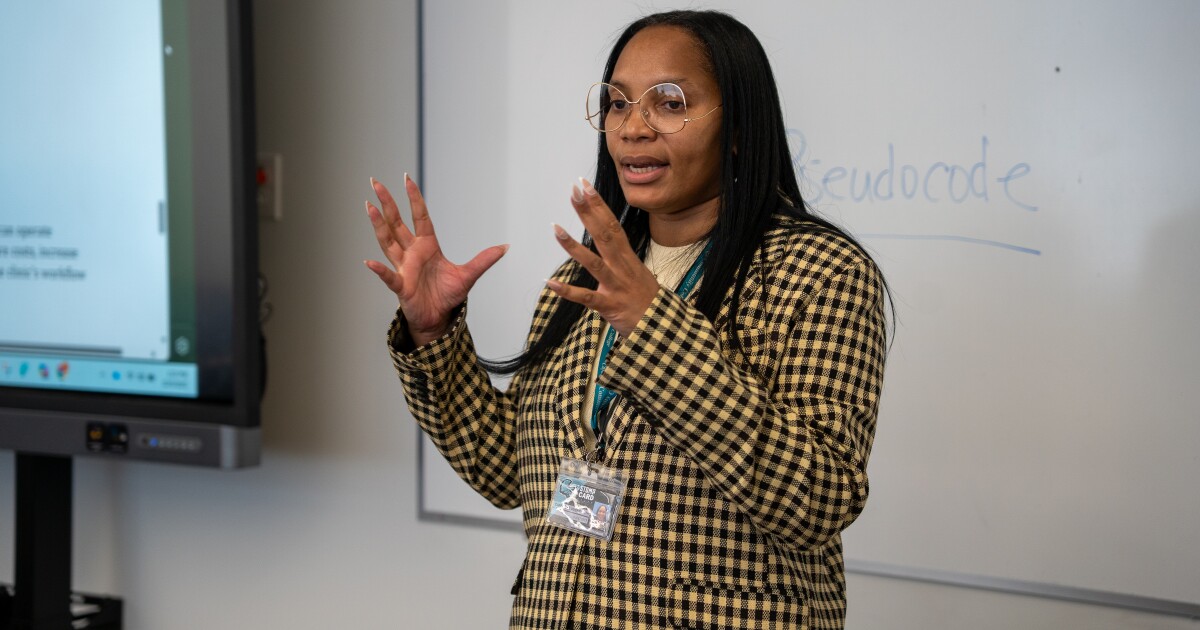
Despite its shortcomings, knowledge of AI is becoming increasingly important in the job market. Carelicha Duckworth, a preceptor at Cuyahoga Community College, redesigned her introductory computer science course last year to incorporate a variety of AI tools. One of the key assignments required students to devise a plan for enhancing the IT infrastructure of a fictional veterinary clinic.
This type of assignment mirrors real-world tasks many students could encounter in their future careers.

Ygal Kaufman
/
Ideastream Public Media
“For students to grasp and value technology, it’s imperative to foster innovation in our teaching. Therefore, implementing AI tools responsibly was an obvious choice,” Duckworth emphasized.
Diverse students, including both traditional college students and high-schoolers earning credits at Tri-C, bring varied perspectives to AI’s role in education. Some high schools entirely ban AI for assignments. Andre Donerson, a junior from Cleveland Central Catholic High School, mentioned his long-standing interest in computer science and how exposure to AI in the classroom is shaping his career aspirations.
“I’m now considering majoring specifically in AI,” Donerson remarked.
While some universities, like Bowling Green and the University of Akron, are establishing AI-centric programs, Ohio State University has committed to embedding AI in every course, aiming for every graduate to be “fluent” in its use. Vopat remains skeptical about this rushed approach.
“While many promote it as a fantastic tool, it’s merely a tool if one lacks the foundational knowledge to wield it effectively,” he cautioned. “I wouldn’t want AI composing for me if I don’t possess strong writing skills.” Vopat fears that if AI undertakes the bulk of students’ efforts, they may graduate without essential critical thinking skills, jeopardizing their potential to contribute positively to the world.