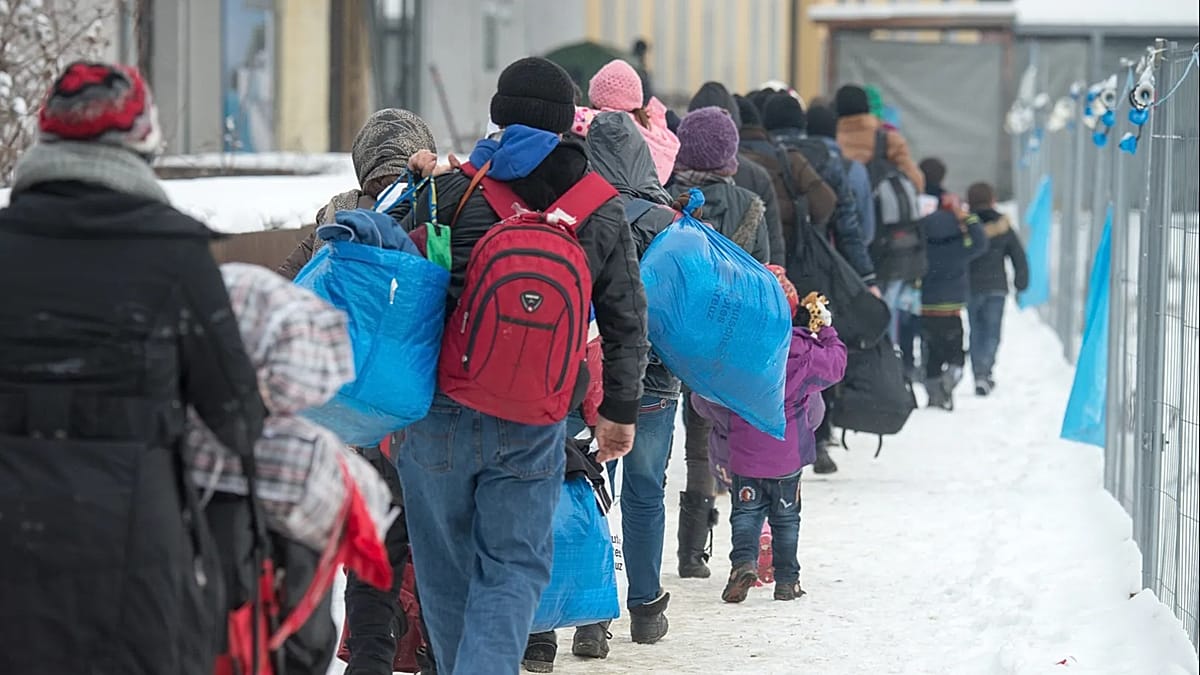
The recent approval by the European Parliament of a legislative change has significant implications for asylum seekers arriving in the EU. This adjustment to the “safe third country” concept may allow for the transfer of these individuals to countries they have no prior connection with, reshaping the migration landscape in Europe.
The change in the “safe third country” concept, included in the Asylum Procedure Regulation (APR), removed the requirement for a link between an applicant and a transfer country, allowing national authorities to move people to states they have never been to.
This paves the way for an agreement between EU states and foreign governments accepting migrants from Europe in exchange for money, similar to a scheme that the previous United Kingdom government pursued with Rwanda.
The UK’s top court blocked the project, and the current government scrapped it altogether.
The EU regulation now states that asylum seekers can be transferred to virtually any country in the world, provided there is an agreement or an arrangement in place with an EU state and that the country is considered “safe”, meaning a person seeking international protection there will be treated according to “international standards”.
Safeguards include the protection of asylum seekers from persecution and serious harm, respect for the principle of non-refoulement, the opportunity to receive effective protection under the Geneva Refugee Convention, and access to a functioning asylum system, with education and work permits granted in addition to residence rights.
This new provision will not be applied to unaccompanied minors, whose asylum applications will still be assessed by European countries or by countries with which they have a connection or through which they have transited.
“This vote will allow EU member states to really make use of cooperation with third countries in a different manner than before,” said German MEP Lena Düpont, who is the rapporteur for the file, claiming that the change is in line with international law and would avoid asylum claims running through the European countries’ asylum system for a long time.
Parliament splits
The change was approved by the European Parliament with 396 votes in favour, 226 votes against, and 30 abstentions.
The European People’s Party (EPP) teamed up with right-wing European Conservatives (ECR) and far-right Patriots for Europe (PfE) and Europe of Sovereign Nations (ESN) to pass the bill. On the other side, the Socialists and Democrats (S&D) and Renew Europe voted mostly against, with several defections.
The vote thus splintered the parliamentary alliance that supports Ursula von der Leyen’s Commission, a pattern that has played out in almost all the migration-related files in this legislature.
Some left-wing and liberal MEPs even stated a “minority position” that considers the new safe third country concept “particularly problematic”, claiming that eliminating the connection criterion would create “a risk of instrumentalisation by third countries”.
“Any country that wants some money would be willing to accept this kind of agreement or arrangement [with EU states]. We already saw what happens when these third countries then want more. They blackmail Europe,” S&D MEP Cecilia Strada told Euronews.
She argued that the legislative change is “not a good idea, not only for the fundamental rights of the asylum seekers, but for our democracies”.
Similar concerns have been raised by civil society organisations. The European Council on Refugees and Exiles (ECRE) estimates that the possibilities for asylum seekers to access adequate protection in third countries are questionable and that the new legislation heightens risks for vulnerable groups, such as survivors of violence and LGBTQ+ people.
ECRE has also criticised the removal of the automatic suspensive effect on appeals included in the new regulation, saying it could see people transferred outside the EU before a court has examined whether the law has been correctly applied or not.
On Tuesday, the Parliament also approved the first EU list of “safe countries of origin” for the purposes of asylum. It includes Bangladesh, Colombia, Egypt, India, Kosovo, Morocco and Tunisia, plus all the candidate countries to the EU except Ukraine.
The “safe country of origin” concept is different from the “safe third country” one, but it is also meant to speed up the asylum process in Europe.
Under EU law, the applications of migrants who are nationals of one of the states labelled as “safe countries of origin” will be assessed in fast-track procedures.
Key Takeaways
- The European Parliament’s vote allows asylum seekers to be transferred to unrelated countries.
- New arrangements may enable agreements with third countries to accept migrants.
- The shift aims to streamline asylum processes and enhance cooperation with countries outside the EU.
- Unaccompanied minors are exempt from these transfers and will still be assessed within Europe.
- Civil society groups have expressed concerns about the implications for vulnerable asylum seekers.
- The Parliament has also established a list of “safe countries of origin” to expedite asylum claims.
FAQ
What is the main change in the Asylum Procedure Regulation?
The regulation now allows asylum seekers to be transferred to any “safe” country without requiring a prior connection.
Are unaccompanied minors affected by this new regulation?
No, unaccompanied minors will continue to have their applications assessed in Europe or related countries.
What are “safe countries of origin”?
These are countries deemed safe for asylum seekers, allowing for faster processing of their applications.
What concerns have been raised about this change?
Civil society groups worry that the legislation may increase risks for vulnerable groups and could lead to exploitation by third countries.
How will this impact the asylum process in the EU?
The changes aim to streamline and expedite asylum procedures but have sparked significant debate regarding human rights implications.
In conclusion, the legislative changes adopted by the European Parliament represent a significant shift in how asylum seekers may be treated and processed within the EU. While aimed at improving efficiency, they have raised important questions about the welfare and rights of those seeking refuge.