The recent attack by Israel on Hamas senior leaders in Qatar on September 9 has raised significant concerns in Türkiye, where Hamas maintains a presence. The incident has prompted Turkish officials to express fears about potential Israeli military actions within Türkiye itself.
<p>Turkish authorities are rightly <a href="https://www.yahoo.com/news/articles/turkey-wary-israeli-threat-following-050154246.html" target="_blank" rel="nofollow">voicing apprehensions</a> that if Israel can target Hamas negotiators with U.S. approval in a country allied with the U.S., it may strike cities like Ankara or Istanbul next. The threat from Israeli Prime Minister Benjamin Netanyahu was unmistakable when he stated on September 10:</p>
<blockquote>
<p>“I say to Qatar and all countries that provide sanctuary to terrorists – either deport them or bring them to justice. If you don’t do this, we will.”<i/></p>
</blockquote>
<p>Following the attack in Doha, Israeli Channel 12 News <a href="https://demstate.com/article/israel-weighs-strikes-on-turkey-after-attacks-in-qatar" target="_blank" rel="nofollow">reported</a> that Israel is contemplating similar military actions against Türkiye. This situation could signify an escalation in the ongoing conflict between “Greater Israel” and “Greater Türkiye,” or it may be merely a spectacle without significant consequences. To better understand the dynamics at play, let’s review the recent two-year history of hostile exchanges between the two nations.</p>
<p><b>Empty Rhetoric and Action</b></p>
<p>Despite two years of criticizing Israel's actions, Turkish President Recep Tayyip Erdogan faces increasing domestic pressure to translate his words into real action. In an effort to appease the public, the Turkish government announced a closure of ports and airspace to Israeli vessels and aircraft in August. However, foreign-flagged ships continue to operate freely from Turkish ports to Israel, as The Cradle <a href="https://thecradle.co/articles/israel-is-not-isolated-a-global-web-of-oil-and-complicity" target="_blank" rel="nofollow">points out</a>:</p>
<blockquote>
<p>Tankers often disable their tracking systems in the eastern Mediterranean, claim false destinations in Egypt or elsewhere, and coordinate deliveries through third-party traders.</p>
<p>In 2025, Russian Telegram channel Dva Mayora <a href="https://t.me/dva_majors/78077" target="_blank" rel="nofollow">uncovered</a> Greek tankers Seavigour and Kimolos for their involvement in these covert routes. As of August 22, the Marshall Islands-flagged Nissos Antimilos was spotted 190 kilometers west of Haifa, en route from Ceyhan and ready for offshore transfer to an Israeli tanker.<i/></p>
</blockquote>
<p>This illustrates the latest of Ankara's attempts to obscure its support for Israel. In May 2024, Türkiye ceased direct trade with Israel but merely <a href="https://www.turkishminute.com/2024/09/04/data-suggest-turkeys-exports-to-israel-continue-palestine-despite-trade-ban/#:~:text=Turkish%20businesses%20appear%20to%20be,last%20year%20to%20$21.8%20million." target="_blank" rel="nofollow">rerouted shipments</a> through Palestinian territories.</p>
<p>Almost two years into a genocide that Erdogan condemns daily, oil <a href="https://www.haaretz.com/israel-news/2025-06-07/ty-article/.premium/source-azerbaijan-promised-to-keep-exporting-oil-to-israel-despite-turkish-objections/00000197-472a-da41-a9f7-7fae0fe70000" target="_blank" rel="nofollow">continues to flow</a> from Azerbaijan to Israel via Türkiye, and Israel <a href="https://turkishminute.com/2024/04/03/company-owned-by-erdogan-led-turkish-wealth-fund-sell-precious-mineral-to-israel/" target="_blank" rel="nofollow">receives</a> vital minerals from Türkiye, while the Incirlik air base in Türkiye remains <a href="https://www.declassifieduk.org/incirlik-is-yours-how-turkeys-erdogan-handed-major-military-base-to-the-americans/" target="_blank" rel="nofollow">utilized</a> by the U.S. to supply arms to Israel and oversee the skies in defense of Israel and its strategies.</p>
<p>A collective of 76 Turkish academics, writers, politicians, and rights activists <a href="https://www.turkishminute.com/2025/09/02/76-prominent-figures-in-turkey-reject-cosmetic-gaza-resolution-urge-sanctions-on-israel/#3" target="_blank" rel="nofollow">recently issued a statement</a> criticizing the Turkish government's lack of action. They specifically condemned a resolution from the Turkish parliament that denounced Israel, labeling it a “cosmetic” gesture rather than a firmer stance.</p>
<p>Meanwhile, Erdogan audaciously <a href="https://www.dailysabah.com/politics/diplomacy/erdogan-decries-israeli-aggression-urges-resolve-to-counter-it" target="_blank" rel="nofollow">urges</a> Arab and Muslim nations to impose sanctions on Israel (though it remains unclear if Türkiye would partake), all while stifling dissent in his own country as part of his strategy to silence criticism regarding his inaction against Israel.</p>
<p>The Turkish populace is engulfed in debates surrounding genocide—historical and contemporary. Erdogan accuses Israel of committing atrocities that <a href="https://x.com/RTErdogan/status/1950258774436188175" target="_blank" rel="nofollow">overshadow</a> the Holocaust, raising the question of why he does not take more assertive steps to halt it. In response, Netanyahu calls attention to the Ottoman genocide of Armenians during World War I. This political theater, however, does little to alleviate the suffering of Palestinians facing extermination in Gaza. In crucial areas, Türkiye continues to tacitly support this escalating tragedy.</p>
<p><b>Maintaining the Status Quo</b></p>
<p>Even with Türkiye’s background support for Israel's actions, tensions persist. Cyprus has emerged as a key flashpoint. Earlier this year, when Israeli President Isaac Herzog visited Cyprus and met with his counterpart Nikos Christodoulides, the latter <a href="https://beeley.substack.com/p/cyprus-us-and-israel-clash-with-turkey" target="_blank" rel="nofollow">asserted</a>:</p>
<blockquote>
<p>We need to discuss regional developments, the situation in Syria and Lebanon. There is one neighbour that always tries to cause problems in our neighborhood. We’ll exchange notes.<i/></p>
</blockquote>
<p>Christodoulides wasn't referring to Israel. This comes after the U.S. lifted a 33-year arms embargo on Cyprus in 2020. Israel is positioning itself to become a regional energy leader, targeting reserves in the Eastern Mediterranean off the coasts of Lebanon, Gaza, Syria, and Egypt, and collaborating with Cyprus and Greece to supply Europe via pipeline. This directly conflicts with Türkiye's ambitions as a regional energy center.</p>
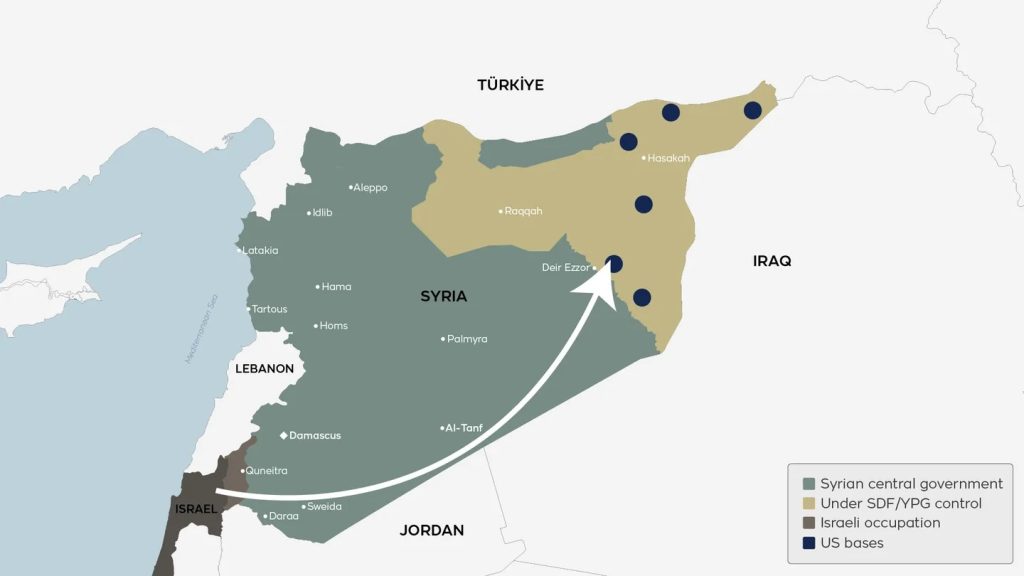
<p>In Syria, the U.S.-Israeli alliance continually seeks to undermine Türkiye's aspirations for stability, striving to maintain an extremist regime linked to Al Qaeda through Syrian President Ahmed al-Sharaa. In April, Azerbaijan mediated efforts to deconflict interests between Israel and Türkiye in Syria, yet whether such agreements can hold remains uncertain. Just weeks ago, <a href="https://www.haaretz.com/israel-news/2025-08-28/ty-article/.premium/syria-says-idf-struck-near-damascus-and-deployed-dozens-of-troops-in-area/00000198-ef0e-d2dc-afde-ef1fced30000" target="_blank" rel="nofollow">Israel destroyed</a> Turkish surveillance equipment in Syria, but this incident did not escalate into all-out conflict, suggesting that perhaps the brokered April mechanism holds merit. Nonetheless, continued friction is likely as Israel and Türkiye hold opposing views on regional objectives, with The Cradle <a href="https://thecradle.co/articles/exclusive-the-us-israeli-plot-to-partition-syrias-west" target="_blank" rel="nofollow">commenting</a>:</p>
<blockquote>
<p>“Israel seeks to exploit Syria’s sectarian and ethnic divisions to utilize minorities as political and military pawns, implementing its plan to partition the country and establish two strategic corridors: one linking Suwayda to Hasakah, and another from Syria’s coast to Afrin, thereby securing multi-front influence and encircling the Turkish axis from within.”<i/></p>
</blockquote>
<p>Israel labels the eastern corridor as “David’s Corridor”: <b/></p>
<div id="attachment_298334" style="width: 610px" class="wp-caption aligncenter">
<img fetchpriority="high" decoding="async" aria-describedby="caption-attachment-298334" class="size-large wp-image-298334" src="https://www.nakedcapitalism.com/wp-content/uploads/2025/09/DavidsCorridor-1024x576.jpeg" alt="" width="600" height="338"/>
<p id="caption-attachment-298334" class="wp-caption-text">Source: TRT World</p>
</div>
<p>In response, Türkiye is arming and training a faction of fighters referred to as takfiris (the Syrian army), while Israel uses this militia and their oppression of minorities as justification for military action and a strategic route to the Kurdish territories in northwestern Syria, which also borders Iran.</p>
<p>Simultaneously, Türkiye’s peace process with the Kurds <a href="https://thecradle.co/articles/the-kurdish-disarmament-that-backfired-on-turkiye" target="_blank" rel="nofollow">appears</a> increasingly ineffective:</p>
<blockquote>
<p>In Syria, where Türkiye contributed to dismantling the state, the U.S.-Israeli axis has restricted Ankara’s capacity to settle the status of the Kurdish-led Syrian Democratic Forces (SDF).</p>
<p>Recent negotiations between the SDF and the transitional government based in Damascus, including a landmark agreement on March 10 <a href="https://www.reuters.com/world/middle-east/syria-reaches-deal-integrate-sdf-within-state-institutions-presidency-says-2025-03-10/?" target="_blank" rel="nofollow">integrating SDF-controlled structures</a> into state institutions, reveal increasing potential for a Kurdish political presence to be formalized in Syria’s new political landscape.</p>
<p>In July, U.S. envoy and Ambassador to Türkiye Tom Barrack underscored that the SDF remains an offshoot of the PKK, <a href="https://www.turkiyetoday.com/region/no-kurdish-state-in-syria-pkk-disarmament-a-major-development-for-turkiye-us-envoy-to-3204160?" target="_blank" rel="nofollow">declaring</a>, “The SDF is YPG. YPG is derived from the PKK. … There’s no indication that a free Kurdistan will materialize, … only Syria will.”</p>
<p>Earlier this year, French President Emmanuel Macron urged the Al-Qaeda-rooted Syrian interim government to “fully integrate” the SDF into Syria’s political transition, <a href="https://apnews.com/article/syria-conference-trump-aid-b0d50283d7ebd28020790d212df2ad44" target="_blank" rel="nofollow">describing</a> them as “precious allies.”</p>
<p>As Kurdish influence ebbs in Anatolia, it burgeons across the Levant, backed by the U.S., Israel, and France. Developments affecting Turkish-Kurdish relations are now largely beyond Türkiye's control.</p>
</blockquote>
<p>To consider various viewpoints, a few observations are notable:</p>
<p>If Erdogan, through his peace efforts with the PKK, secures another term, he might emerge victorious. He has articulated <a href="https://theinsightinternational.com/turkey-must-change-constitution-2025-09-01" target="_blank" rel="nofollow">the necessity</a> for constitutional amendments to enable educational rights and administrative reforms. These changes would also facilitate Erdogan’s eligibility for another term, which likely requires support from a pro-Kurdish party.</p>
<p>If Kurdish influence transitions from Anatolia to the Levant and Iraq, it could also be seen as a triumph for Erdogan. Türkiye might accept an agreement that retains Kurdish-controlled zones within Syria, saving further disputes for a later date.</p>
<p>Moreover, should the U.S. and Israel leverage strengthened Kurdish forces to destabilize Iran—a scenario that think tanks and former officials <a href="https://www.nakedcapitalism.com/2025/06/proxy-fighters-in-the-fog-of-war.html">enthusiastically endorse</a>—it would align with the interests of Ankara, Washington, and Tel Aviv. Türkiye would greatly benefit if Kurds are drawn into conflicts weakening Iran.</p>
<p style="text-align: center;">***</p>
<p>The historical relationship between the West and Türkiye has largely been transactional, with both parties striving to utilize one another against mutual adversaries: Türkiye sought U.S. collaboration against Russia and Iran, while Washington aimed to engage Türkiye to achieve its goals against Moscow and Tehran.</p>
<p>Consequently, the U.S. frequently attempts to maintain pressure on Türkiye in one area while pursuing cooperation in another.</p>
<p>Is the current tension with Israel merely a continuation of this pattern, or does it represent a new development? The answer may hinge on whether one perceives Israel as predominantly a U.S. proxy with Washington orchestrating most of the actions, or as an autonomous force pursuing its own agenda. The lines between these possibilities are increasingly blurred, but it is challenging to comprehend how conflict with Türkiye serves the interests of either the U.S. or Israel.</p>
<p>Forty percent of Israel's oil supply traverses Türkiye, which plays a critical role in U.S. (and Israeli) strategic objectives.</p>
<p>Furthermore, Türkiye is prominently involved in the Trump Route for International Peace and Prosperity (TRIPP), commonly referred to as <a href="https://www.nakedcapitalism.com/2025/08/the-trump-route-in-the-southern-caucasus-setting-events-in-motion.html">Project Iran Encirclement: Caucasus Edition</a>. Washington and Israel aim to redirect a Greater Türkiye vision toward eastern aspirations, where a Pan-Turkic Corridor could function as a NATO alternative stretching into Central Asia. Both TRIPP and the David’s Corridor serve as preliminary steps in the broader agenda toward conflict with Iran:</p>
<blockquote class="twitter-tweet">
<p dir="ltr" lang="en">From the Zangezur to David’s Corridor: The Silent Redrawing of Global Trade and the Road to War with Iran</p>
<p>In the shifting chessboard of global geopolitics, few developments are as consequential and underreported as the emergence of two corridors: the Zangezur Corridor and… <a href="https://t.co/EY8JfSA9f8" target="_blank" rel="nofollow">pic.twitter.com/EY8JfSA9f8</a></p>
<p>— Ibrahim Majed (@ibrahimtmajed) <a href="https://twitter.com/ibrahimtmajed/status/1948675409358303289?ref_src=twsrc%5Etfw" target="_blank" rel="nofollow">July 25, 2025</a></p>
</blockquote>
<p>Simultaneously, Türkiye's defense industry has become increasingly vital as the West strives to meet the demands of multiple conflicts. Here’s a recent <a href="https://www.aa.com.tr/en/europe/explainer-turkiye-s-defense-sector-emerges-as-key-in-europe-s-rearming/3650271" target="_blank" rel="nofollow">report from Türkiye’s Anadolu Agency</a> highlighting this growing relationship:</p>
<blockquote>
<p>The ripple effects of the Ukraine war and shifting transatlantic dynamics have led European nations to reassess their defense postures urgently. As countries scramble to bolster their capabilities and diversify their suppliers, Türkiye has emerged as a key alternative, offering battle-tested systems and reliable deliveries.</p>
<p>In 2023, Türkiye’s defense exports to Europe skyrocketed to $1.2 billion, rising from $369 million in 2020, now constituting 22% of the country’s total defense exports.</p>
<p>The NATO Leaders Summit held in The Hague in late June further fueled this momentum. Spearheaded by U.S. President Donald Trump, allied nations committed to increasing defense spending to 5% of GDP by 2035—more than double prior limits.</p>
<p>“Türkiye has a very large defense industrial base. Sometimes we forget its capabilities. I visited some of their companies—it’s genuinely impressive,” asserted NATO Secretary-General Mark Rutte during the summit.</p>
<p>Additionally, the EU activated its new €150 billion ($171 billion) defense fund—the bloc's first substantial defense investment initiative. EU foreign policy chief Kaja Kallas later stated that, as an EU candidate country, Türkiye could participate in joint projects, emphasizing, “We definitely view Türkiye as a security player.”</p>
</blockquote>
<p>Recognizing its importance, Ankara is <a href="https://archive.is/20250611045756/https://www.al-monitor.com/originals/2025/06/after-3-year-pause-turkey-and-eu-hold-defense-talks-what-know#selection-1349.0-1349.55" target="_blank" rel="nofollow">eager to access</a> the EU’s defense fund. The Turkish defense sector stands to gain significantly if the U.S. lightens restrictions imposed under the Countering America’s Adversaries Through Sanctions Act (CAATSA) in 2017. This sequence of events appears to be more a matter of when rather than if.</p>
<p>In 2020, Washington imposed sanctions on Ankara due to its acquisition of the Russian-made S-400 missile defense system. Erdogan has mentioned that steps toward alleviating the sanctions are underway and that Türkiye <a href="https://www.turkishminute.com/2025/05/17/erdogan-says-easing-of-us-defense-sanctions-under-trump-signals-end-of-caatsa-restrictions/" target="_blank" rel="nofollow">is nearing</a> a resolution regarding these S-400s that have remained boxed since their purchase.</p>
<p>So, what does all this signify? It strongly suggests an increasing overlap in agendas between Ankara and Washington. Israel stands to lose significantly in a direct confrontation with Türkiye, which also holds potential to complicate U.S. strategies, granting Türkiye leverage within the dynamic of regional “Greaters.”</p>
<p>Is this one instance where the U.S. must exert control over Israel's actions—if it's even capable—given Türkiye’s significance in broader U.S. (and Israeli) strategies? As these players are not known for their willingness to abide by agreements, it wouldn't be shocking for one to betray the others abruptly.</p>
<p>Moreover, much of the friction between Israel and Türkiye might be a carefully orchestrated performance, part of the ongoing theatricality in which Israel and the U.S. appear united in their objective to destabilize the Iranian government.</p>
<div class="printfriendly pf-alignleft">
<a href="#" rel="nofollow" onclick="window.print(); return false;" title="Printer Friendly, PDF & Email">
<img decoding="async" style="border:none;-webkit-box-shadow:none; -moz-box-shadow: none; box-shadow:none; padding:0; margin:0" src="https://cdn.printfriendly.com/buttons/print-button-gray.png" alt="Print Friendly, PDF & Email"/>
</a>
</div>