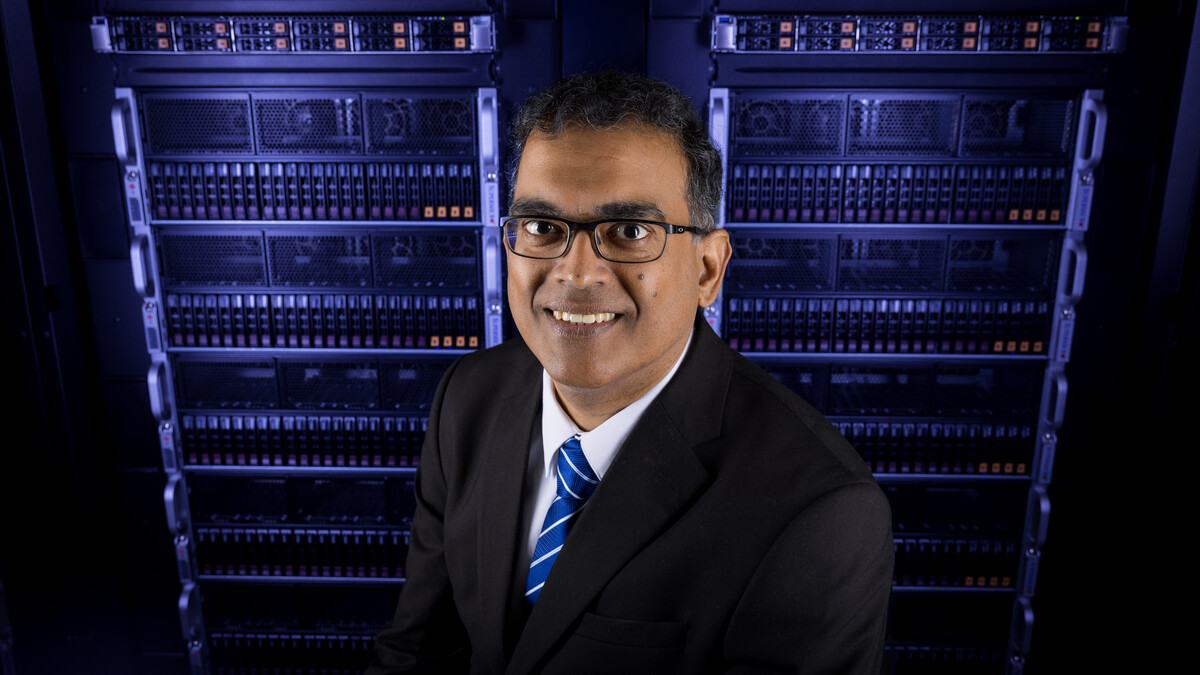
In an era defined by the explosion of data, a Nebraska-based computer scientist is spearheading three innovative projects aimed at enhancing data networks through advanced speed, intelligence, and efficiency. These initiatives lie at the confluence of artificial intelligence and next-generation connectivity, promising significant advancements in how we manage and analyze vast amounts of information.
The projects, which receive funding from prestigious organizations such as the National Science Foundation and the U.S. Department of Energy, tackle a common challenge: effectively managing and dissecting the enormous volumes of data that flow through today’s scientific and digital frameworks.
Byrav Ramamurthy, a professor of computing at the University of Nebraska–Lincoln and principal investigator for these initiatives, highlights that two of the projects utilize AI and machine learning to decode complex, high-volume datasets. One project, funded by the NSF, applies AI tools to analyze routing logs from Internet2 — a national research and education backbone linking universities and laboratories. This project aims to classify traffic, identify anomalies, and gain insights into data movement across extensive networks.
Another project, supported by the DOE, leverages machine learning to scrutinize caching logs from the Open Science Grid, which distributes data from the Large Hadron Collider, the world’s most powerful particle accelerator. This initiative seeks to predict upcoming file requests, enabling the Nebraska team to prefetch and store data more effectively, thereby alleviating bottlenecks in high-energy physics experiments.
The third project concentrates on the future of high-speed optical networks. Also backed by the NSF, this research investigates innovative technologies that could enhance fiber-optic systems, making them faster, more energy-efficient, and more affordable. These improvements are increasingly vital as global data demands continue to escalate.
High-speed networks serve as the backbone for AI development, with distributed applications spanning multiple sites and depending on high-bandwidth connections. Large network infrastructures at universities and research institutions produce tremendous amounts of data, necessitating machine learning-based analyses.
“AI is a powerful tool,” Ramamurthy remarked. “While I understand some concerns surrounding AI, it’s particularly suited for analyzing extensive datasets, where human analysis falls short. It is truly remarkable what AI can achieve with large volumes of data.”
According to Ramamurthy, high-speed networks are essential for facilitating these advancements. As AI models evolve and scientific facilities generate increasingly large datasets, improvements in both wired and wireless communication will be crucial for supporting the next frontier of discovery.
Collaborating with Ramamurthy are his three doctoral students — Sarat Barla, MAU Shariff, and Srikar Chanamolu; researchers from the Indian Institute of Technology Madras for the optical network project; and Derek Weitzel, a research associate professor of computing at Nebraska, who contributes to the Open Science Grid research. The Holland Computing Center is also a key player in this collaborative effort.
In conclusion, the work being carried out by Ramamurthy and his team is not just about enhancing network efficiencies; it is about paving the way for future scientific breakthroughs facilitated by the seamless flow of information. With ongoing developments in high-speed connectivity and AI, the next generation of research is poised for unprecedented achievements.