By Alexandra Jahn, Associate Professor of Atmospheric, Oceanic and Arctic Sciences at the University of Colorado Boulder. Originally published at The Conversation.
Walking onto the frozen Arctic waters near Utqiagvik, Alaska, for the first time, I was captivated by the stunning landscape. The transition from towering piles of blue and white sea-ice rubble to expansive flat areas was striking. Yet the snow covering these ice formations, sometimes several feet thick, concealed hidden gaps, leading to a moment when one of my legs unexpectedly sank into the depths.
As a polar climate scientist with a decade-long focus on Arctic sea ice research, my time spent on the ice alongside those who depend on it offered me a profound, personal perspective.
Local hunters traverse the sea ice on snowmobiles to reach vital resources like whales and seals, essential for their traditional diets. They shared insights on how they determine the safety of the ice and the evolving challenges they face as global temperatures rise. Coastal erosion has been worsening, with protective ice forms disappearing more rapidly, and thawing permafrost is causing roads and buildings to sink beneath unstable ground.

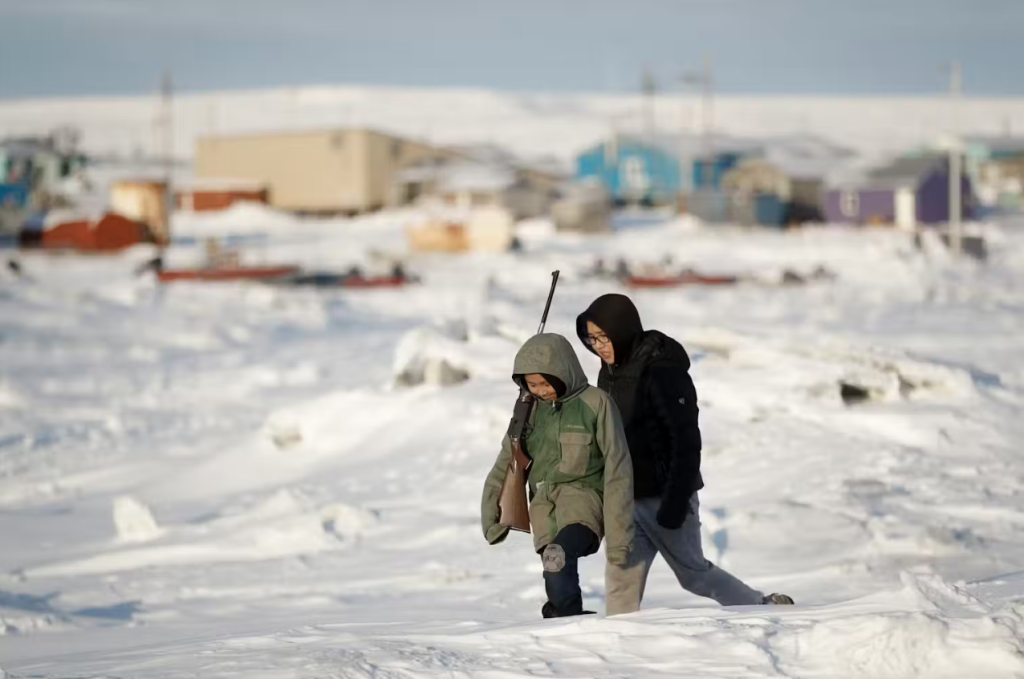
George Chakuchin, left, and Mick Chakuchin walk over the ridges of sea ice that buffer their Bering Sea community of Toksook Bay, Alaska, from winter storms in January 2020. AP Photo/Gregory Bull
Their lived experiences strongly resonate with the satellite data and climate models I have analyzed.
Typically, the entire surface of the Arctic Ocean basin is blanketed by sea ice during winter, extending into the northern North Atlantic and North Pacific. However, the late summer season now sees about 50% less coverage compared to the levels recorded when routine satellite observations began in 1978.

The sea ice concentration at the end of the melt season for 1979, the first September with satellite data, and 2024. The pink line, for comparison, is the 1981-2010 median edge of area with at least 15% ice coverage. Both the ice-covered area and the concentration of sea ice in September have decreased, with ice cover down about 50% from 1979 to 2024. NSIDC
This significant reduction in summer sea ice has far-reaching implications, affecting everything from local ecosystems to the accessibility of shipping routes across the Arctic Ocean. Moreover, it amplifies global warming, as the loss of reflective ice surfaces reveals dark water that absorbs solar radiation, further contributing to heating the atmosphere.
What Coastal Communities Are Losing
Alaskan coastal communities are acutely aware of the changing nature of the Arctic sea ice, particularly the lengthening of the ice-free season. Ice is now forming later in the fall and melting earlier in the spring.
For local residents, this shift translates to shorter periods of safe travel over ice, coupled with reduced ice coverage that protects coastlines from damaging ocean waves.

Traveling by kayak in Camden Bay, on the Beaufort Sea in northern Alaska, on Aug. 1, 1913. Joseph Dixon/U.S. National Park Service
The increased presence of open water raises the threat of coastal erosion, especially when combined with thawing permafrost, intensifying storms, and rising sea levels. All these factors are linked to greenhouse gas emissions, particularly from burning fossil fuels.
In certain areas along the Alaskan coast, erosion endangers infrastructure, homes, and even entire communities. Studies indicate that coastal erosion rates in Alaska have escalated in recent decades.
Additionally, the extended duration of open water impacts wildlife. Polar bears, which spend summer months on land, depend on sea ice to hunt for their primary prey, seals. An absence of sea ice prolongs periods without this crucial food source, threatening the bears’ chances of survival.
The Ice Is Also Thinning and Getting Younger
Satellite observations reveal that Arctic sea ice is becoming both thinner and younger.
In the late 1970s, approximately 60% of Arctic sea ice was at least a year old, typically thicker than its younger counterparts. Currently, this percentage has declined to around 35%.

Age of sea ice percentage within the Arctic Ocean for the week of March 11-18, 1985-2022. NOAA
Local hunters feel this change firsthand, as multiyear sea ice—much less salty than new ice—has become increasingly rare. In the past, they would cut blocks of this older ice for drinking water, but now they often find it challenging to source.
Sea ice forms from ocean water, which inherently contains salt. As it freezes, salt gets trapped between ice crystals, creating salty liquid pockets called brine. This brine drains from the ice over time. Consequently, multiyear sea ice, having survived at least one melt cycle, is less salty than first-year ice.
With the diminishing presence of multiyear sea ice around Utqiagvik, hunters now have to resort to carrying blocks of lake ice or gallon jugs of water when venturing onto the ice for several days.
Why Data Shows a Continuing Decline
Research indicates that as long as greenhouse gas emissions keep rising, Arctic sea ice will generally continue to diminish. One study estimated that the average carbon dioxide emissions by individuals in the U.S. contribute to the loss of summer sea ice equivalent to the size of a large hotel room—approximately 430 to 538 square feet (40 to 50 square meters) annually.
Currently, at its summer minimum, the Arctic sea ice covers roughly half the area it did in 1979. Despite this, there are still around 1.8 million square miles (4.6 million square kilometers) of sea ice remaining at the end of summer—approximately the size of the entire European Union.

Climate models indicate the Arctic could be ice-free at the end of summer within the next few decades, depending on the pace at which we curtail greenhouse gas emissions.
While reduced sea ice may facilitate shipping accessibility across the Arctic waters during summer, research suggests that these significant reductions would trigger profound ecological changes within the Arctic Ocean as increased light and heat penetrate the surface.
Warmer surface temperatures will delay the ocean’s return to freezing by prolonging the ice-free period in fall, further hindering new ice formation.
What Now?
For the next several decades, Arctic sea ice will continue to form during winter, as the absence of sunlight leads to very cold temperatures conducive to ice formation.

Pacific walruses surface through ice off the Alaska coast in 2004. Joel Garlich-Miller, U.S. Fish and Wildlife Service
Experts anticipate that, to prevent winter sea ice from disappearing entirely in the Arctic Ocean, atmospheric carbon dioxide levels would need to reach extremely high concentrations—around 2,000 parts per million, more than four and a half times our current levels.
However, with warming trends, winter sea ice is expected to cover less area. For now, those residing along the Alaskan Arctic coast will experience seasonal returns of winter ice, but if greenhouse gas emissions remain unchecked, models predict that even winter sea ice could vanish by the end of the century.